Search Results

Search results for

0 result(s) found

PRESS RELEASE

UNIQLO logo featured in the Global Photo Exhibition-PEACE FOR ALL campaign.

Exhibition To Launch in New York City and in Over 10 Cities Around the World

New York, NY – October 30, 2024 – Global apparel retailer UNIQLO announces the launch of a major global photography exhibition. Created in close partnership with internationally renowned photographic cooperative Magnum Photos, Global Photo Exhibition-PEACE FOR ALL will be held in over 10 major world cities, hosted in public locations over several weeks, and freely accessible to all. The global initiative was first launched in London in September with other participating cities to follow, including New York City.
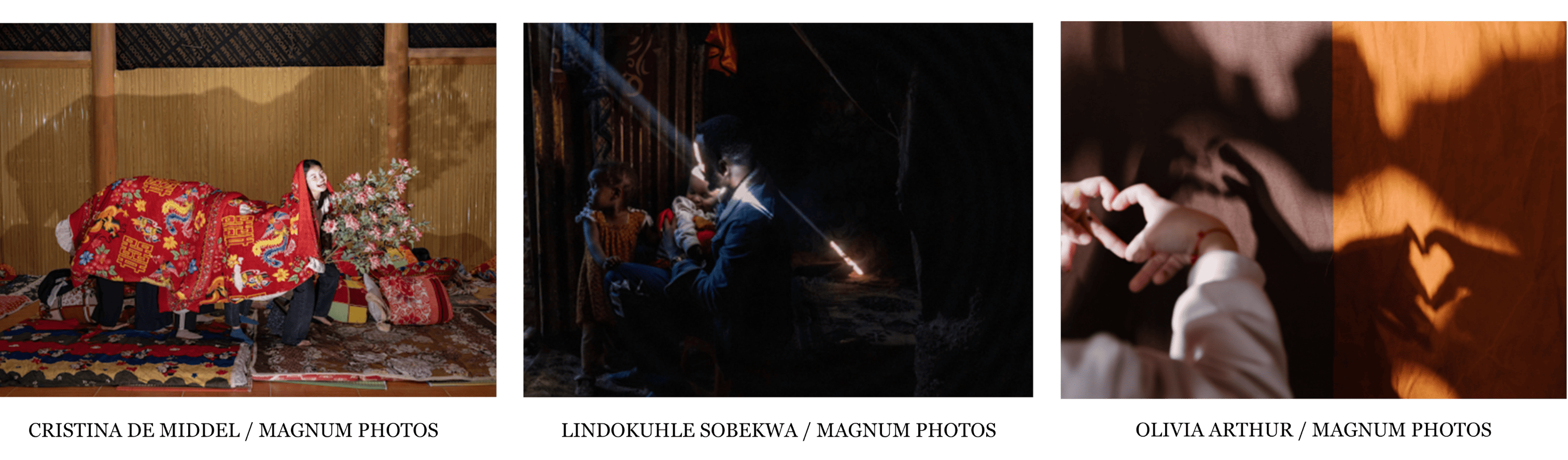
Collage of three photographs from the UNIQLO PEACE FOR ALL project, capturing moments of peace and community in Vietnam, Ethiopia and Romania.

In honor of the stateside unveiling, Global Photo Exhibition-PEACE FOR ALL debuted locally with an in-store installation at UNIQLO’s Fifth Avenue Flagship. In addition, the brand hosted a Magnum Photos-led photography workshop in partnership with the NYC Department of Social Services, with guests like Lindokuhle Sobekwa introducing youth to the art of photography and giving them firsthand practice under expert teachers.
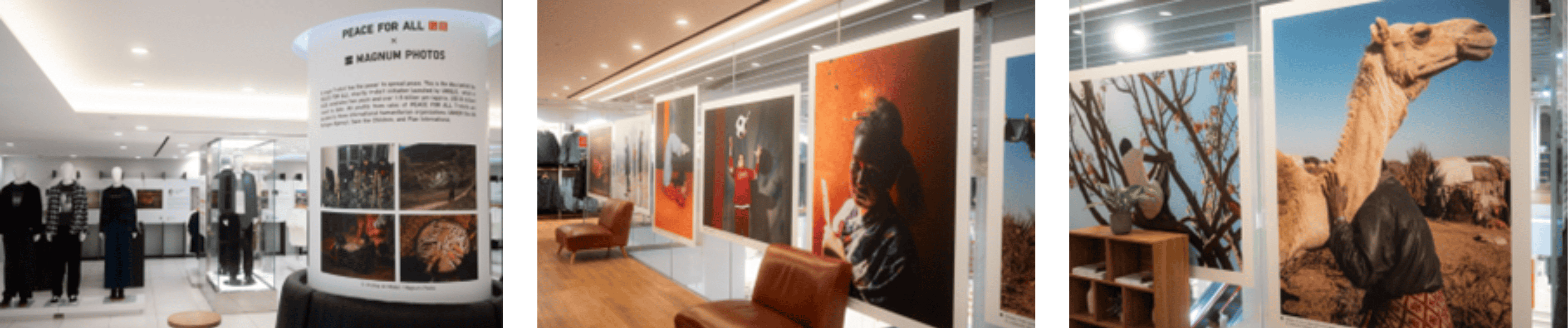
Collage of three photographs from the UNIQLO PEACE FOR ALL project, capturing moments of peace and community in Vietnam, Ethiopia and Romania.

Also in New York, UNIQLO is partnering with NYC Parks for a public exhibition opening on Wednesday, October 30th in several of the city’s most iconic parks. The exhibits on view in NYC parks will offer an opportunity for New Yorkers and visitors to experience the PEACE FOR ALL project through the works of celebrated Magnum Photos photographers, helping to make art accessible to all through a message of peace.


Jean Shein, Global Director of Sustainability at UNIQLO expressed his excitement for the partnership, stating, “Art and sustainability have the power to transform perspectives, and through this exhibition in partnership with NYC Parks, we hope to inspire reflection on peace and the positive impact collective action can have on communities around the world.”


Elizabeth Masella, Senior Public Art Coordinator at NYC Parks added, “We are thrilled to bring this exhibition to New York City’s public spaces. By making these moving images accessible to all, we’re enriching out public greenspaces with high-quality art furthering our mission to create spaces of reflection and beauty amid the bustle of the city.”


Global Photo Exhibition-PEACE FOR ALL is a creative photography exhibition to tell a unique story. The exhibition features a curated collection of striking, joyful, profound photographs from Magnum photographers Cristina de Middel, Lindokuhle Sobekwa, and Olivia Arthur, who travelled to Vietnam, Ethiopia, and Romania to capture moments of PEACE FOR ALL-funded support activities from their own perspectives. The project is intended as a worldwide reflection on the value of peace, to showcase the real-world impact of UNIQLO’s ongoing PEACE FOR ALL project.


The exhibition of 63 works, combining UNIQLO’s ā€˜power of clothing’ with Magnum Photos’ ā€˜power of photography’ ideals, shows the impact of ongoing customer support for UNIQLO’s PEACE FOR ALL charity T-shirt project, which in 2024 celebrates two years and over 1.5 billion yen (approx. US$10 million) raised to date. All profits from sales of PEACE FOR ALL T-shirts are donated to three international humanitarian organizations – UNHCR (the UN Refugee Agency), Save the Children, and Plan International – whose ongoing projects are captured in the exhibition.


The exhibition photographs shine a light on everyday lives of real people in Vietnam, Ethiopia, and Romania who are beneficiaries of funds raised through PEACE FOR ALL, powerfully illustrating how each partner makes good use of funds raised through the initiative. Moreover, Global Photo Exhibition-PEACE FOR ALL presents an important opportunity for UNIQLO customers everywhere to witness the positive impact of their kind participation in PEACE FOR ALL.
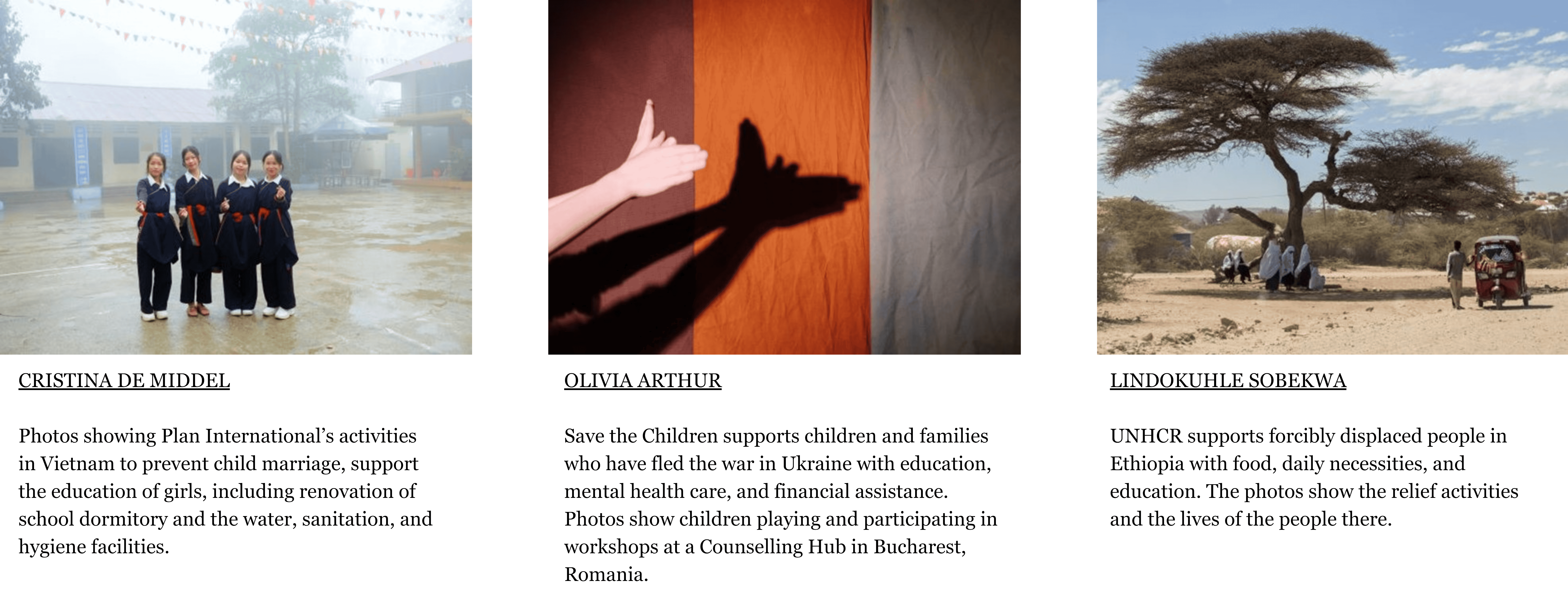
Collage of photographs from the UNIQLO PEACE FOR ALL project in partnership with Plan International and Magnum Photos, highlighting communities in Vietnam, Ethiopia and Somalia.

Global Photo Exhibition-PEACE FOR ALL launched first in London’s King’s Cross at Coal Drops Yard in September. In addition to New York City, similar exhibitions will be on view in other world cities, including Tokyo, Hanoi, Paris, Milan, Shanghai, Singapore, Seoul, Manila, Kuala Lumpur, and Stockholm. More exhibition details will soon be announced locally in each city.


New PEACE FOR ALL T-shirt Designs

To mark the collaboration between UNIQLO and Magnum Photos, three new PEACE FOR ALL designs launched on September 19 at UNIQLO stores and on uniqlo.com, showcasing photos used around the world at Global Photo Exhibition-PEACE FOR ALL. Each design depicts moments of PEACE FOR ALL-supported humanitarian activities in Vietnam, Romania, and Ethiopia, as seen from the perspective of Magnum photographers involved in the exhibition.


All profits from sales of PEACE FOR ALL T-shirts are donated to international humanitarian organizations UNHCR (the UN Refugee Agency), Plan International, and Save the Children.
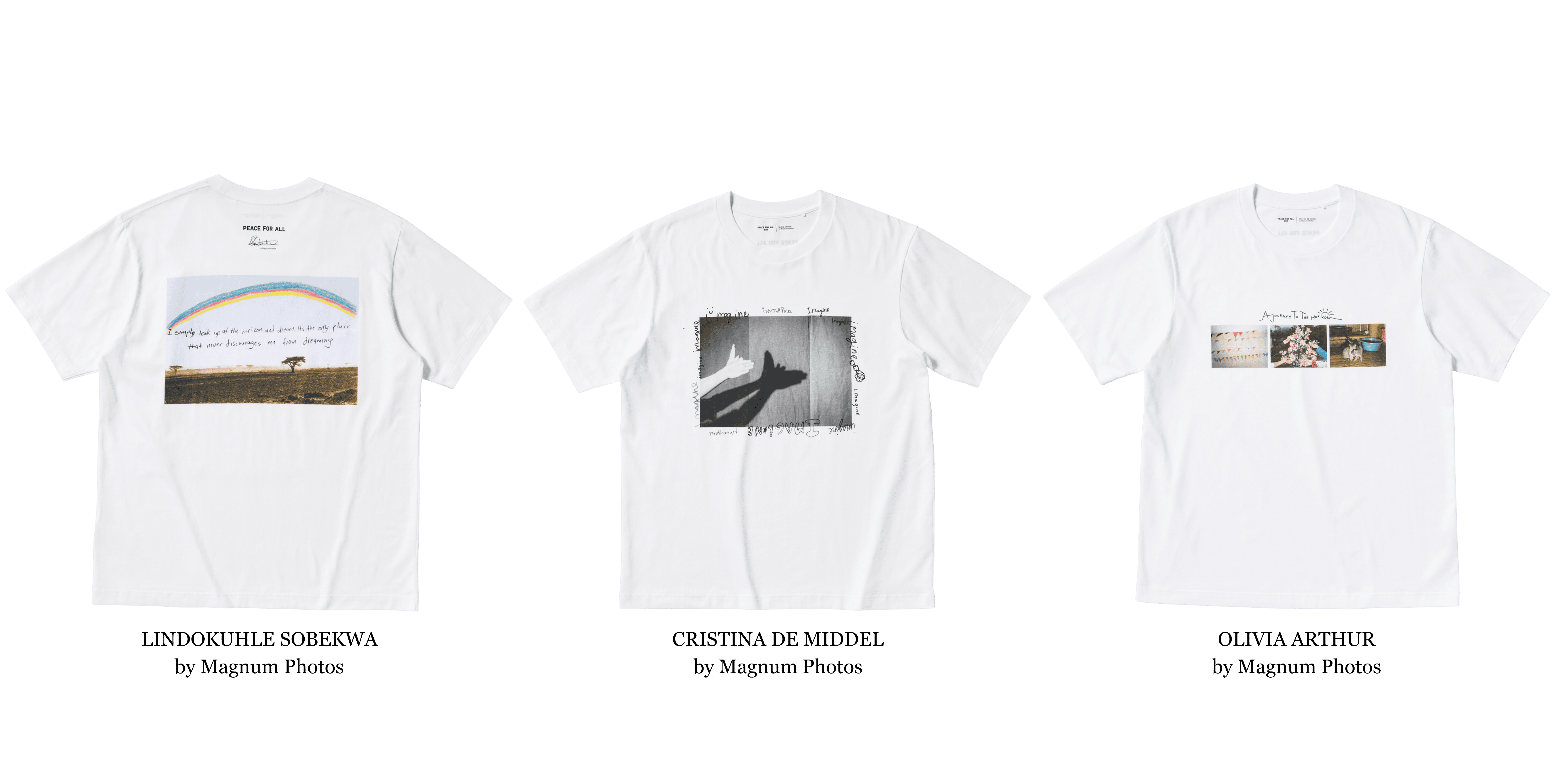
UNIQLO PEACE FOR ALL T-shirt featuring Magnum Photos design promoting global peace. UNIQLO PEACE FOR ALL T-shirt featuring a unique design by Magnum Photos, part of a global initiative with Plan International to promote peace and support humanitarian efforts.

Product nameĀ  Ā  Ā  Ā  Ā  Ā  Ā  Ā  Ā  Ā  Ā  Ā  Ā  Ā  PEACE FOR ALL Charity T-shirt

Launch dateĀ  Ā  Ā  Ā  Ā  Ā  Ā  Ā  Ā  Ā  Ā  Ā  Ā  Ā  Ā  Ā Thursday, September 19, 2024

PriceĀ  Ā  Ā  Ā  Ā  Ā  Ā  Ā  Ā  Ā  Ā  Ā  Ā  Ā  Ā  Ā  Ā  Ā  Ā  Ā  Ā  Ā  Ā  $24.90

SizesĀ  Ā  Ā  Ā  Ā  Ā  Ā  Ā  Ā  Ā  Ā  Ā  Ā  Ā  Ā  Ā  Ā  Ā  Ā  Ā  Ā  Ā  Ā  XXS-3XL (Sizes available in stores are XS-XL)

Product websiteĀ  Ā  Ā  Ā  Ā  Ā  Ā  Ā  Ā  Ā  Ā  Ā  Ā  Ā www.uniqlo.com/peace-for-all/


Comments from photographers

Cristina de Middel

ā€œIt is well known that creativity sits in our capacity to subvert the given order of things and the meanings we learned in our journey to adulthood. In my work, I reconnect to the absolute power that we are born with and use while we are still children. It’s the same power that turns a folded piece of paper into a boat or a pencil into a rocket and I believe that looking at the world as a place you can change and modify is an essential skill to remind the next generation if we want to make a change. Working with these children in Vietnam gave me plenty of hope for what was to come and it was also a lot of fun.ā€


Olivia Arthur

ā€œThe most powerful tool that children have is their imagination. So I wanted to create a space where these children could come and express themselves and play with whatever came into their heads. There was a lot of giggling and some inventive creatures and poses.ā€


Lindokuhle Sobekwa

ā€œI learn so much from the people I photograph. Working with people in Aw-barre Camp, Hope, Dreams, and Resilience became a central conversation I wanted my work to represent. I wanted to play with metaphors of the rainbow that symbolize hope and promise of a better time to come, as well as a powerful quote from one of the people I worked with. The image is set in a landscape on a border that separates the Ethiopian Jijiga from the Somali border, inhabited by Somalian refugees.ā€

Ā 

#####

About Plan International

Plan International is an international development and humanitarian nonprofit that advances children’s rights and equality for girls. Working together with children, young people, supporters and partners, we strive for a just world, tackling the root causes of challenges children face. We are there from birth until adulthood, and we support children to prepare for and respond to crises and adversity, while particularly focusing on the experiences of girls.

With more than 85 years of experience, we work to transform lives in more than 80 countries.

We won’t stop until we are all equal.Ā 


About PEACE FOR ALL

UNIQLO launched the PEACE FOR ALL project on 17 June 2022, and to date has featured designs from 38 collaborators (including this most recent collection). As of July 2024, more than 5 million T-shirts have been sold worldwide, raising more than JPY 1.5 billion (approx. US$10 million). UNIQLO parent company Fast Retailing contributes 100% of profits from the sale of these T shirts (equivalent to 20% of the selling price) to three international aid organizations, UNHCR, Save the Children, and Plan International Inc., which aid people impacted by poverty, discrimination, violence, and conflict.


About UNIQLO LifeWear

Apparel that comes from the Japanese values of simplicity, quality and longevity. Designed to be of the time and for the time, LifeWear is made with such modern elegance that it becomes the building blocks of each individual’s style. A perfect shirt that is always being made more perfect. The simplest design hiding the most thoughtful and modern details. The best in fit and fabric made to be affordable and accessible to all. LifeWear is clothing that is constantly being innovated, bringing more warmth, more lightness, better design, and better comfort to people’s lives.


About UNIQLO and Fast Retailing

UNIQLO is a brand of Fast Retailing Co., Ltd., a leading Japanese retail holding company with global headquarters in Tokyo, Japan. UNIQLO is the largest of eight brands in the Fast Retailing Group, the others being GU, Theory, PLST, Comptoir des Cotonniers, Princesse tam.tam, J Brand and Helmut Lang. With global sales of approximately 3.1 trillion yen for the 2024 fiscal year ending August 31, 2024 (US $21.39 billion, calculated in yen using the end of August 2024 rate of $1 = 144.9 yen), Fast Retailing is one of the world’s largest apparel retail companies, and UNIQLO is Japan’s leading specialty retailer.

UNIQLO continues to open large-scale stores in some of the world’s most important cities and locations, as part of its ongoing efforts to solidify its status as a global brand. Today the company has a total of more than 2,500 UNIQLO stores across the world, including Japan, Asia, Europe and North America. The total number of stores across Fast Retailing’s brands is now close to 3,600.

With a corporate statement committed to changing clothes, changing conventional wisdom and change the world, Fast Retailing is dedicated to creating great clothing with new and unique value to enrich the lives of people everywhere.Ā  For more information about UNIQLO and Fast Retailing, please visit www.uniqlo.com and www.fastretailing.com.


For more information or interviews, please contact:

Vannette Tolbert

Senior Manager, Communications

Email:Ā v[email protected]

Mobile: +1 240.778.9077

A call to action on the Pact for the Future

This article was written by Anya Gass, Policy & Advocacy Lead on Meaningful Youth Engagement at Plan International. For more information on Plan’s work, please reach out toĀ [email protected].

Last month, the world gathered at the UN in New York for the Summit of the Future. This conference was an opportunity to rally the global community in a commitment to accelerate progress toward the Sustainable Development Goals and make sure the international system is fit-for-purpose for the future.

For us at Plan International, this was an important space to raise the profile of girls’ rights and center youth voices. In our work with Member States and other key stakeholders, we aimed to secure recognition of, commitment to and investment in adolescent girls’ rights in the Summit of the Future and its outcome documents (Pact for the Future, Declaration on Future Generations and the Global Digital Compact). Specifically, we advocated to:

Protect against the backsliding of girls’ rights and gender equality: Ā From sexual and reproductive health and rights to girls’ participation in decision-making, hard won gains we have made for girls and young women are being questioned. It is critical that allies of girls’ rights continue to push for those rights to not only be protected but advanced.
Support meaningful youth influencing and engagement: Young people are too often left out of critical decision-making spaces at all levels, and at best, they are involved in a tokenistic manner. Plan International advocates to make sure that they can meaningfully engage and that they are part of policymaking from the beginning.

In support of this second objective, Plan worked with a group of 35 young people from 22 countries in the months leading up to the Summit to advocate jointly to ensure that their priorities were reflected in the Summit. One of the key outputs of the Youth Task Force for the Future was theĀ Girls’ Pact for the Future, a youth-led manifesto outlining adolescent girls’ and young people’s vision for a gender-equal future, and putting forward their recommendations to reach that future.

The Girls’ Pact for the Future led to the identification of theĀ Eight Transformative Actions for Adolescent Girls and Young People, the top actions from the Girls’ Pact for the Future that young people believed would be most impactful in propelling us toward the future they envision.

Given this backdrop of rights under threat, how does the UN’s Pact for the Future measure up? Is this the framework that will deliver the change adolescent girls and young people are calling for?

Image 1
A youth activist amplifies youth voices for gender equality in Vietnam. | Long Vu, Ā© Plan International Vietnam

Here are some of the areas where the Pact for the Future and its two annexes were strong:

— Girls’ rights:Ā Gender equality is at the heart of the Pact of the Future, which highlights the importance of the empowerment of all women and girls for the achievement of sustainable development. Adolescent girls are also explicitly mentioned in the text. In addition, all three texts emphasize the need to address sexual and gender-based violence, a critical barrier for the fulfilment of girls’ rights.

— Youth participation:Ā Youth features prominently in the Pact, the Declaration on Future Generations and the Global Digital Compact. Two of the actions in the Pact are dedicated to the full, meaningful and effective participation of youth in decision-making at both the national and international levels.

— Inclusion and non-discrimination:Ā The Pact recognizes the specific discrimination and vulnerabilities faced by certain groups, including persons with disabilities and those facing racism, xenophobia and other forms of discrimination.

Where does the Pact fall short?

But there were also numerous challenges and areas where the Pact could have been much stronger:

— Education:Ā The Pact falls short of setting out concrete actions to increase global investment in inclusive quality education as the foundation for advancing gender equality and a more sustainable and peaceful future.

— Sexual and reproductive health and rights:Ā We welcome references to the Program of Action of the International Conference of Population and Development and the Beijing Platform for Action, which remain critical frameworks for advancing SRHR and rights for girls. However, we regret that the Declaration on Future Generations missed an opportunity to include an express reference to SRHR.

What comes next is all the more critical: implementation. The UN and its Member States are at no loss for commitments. But what is missing is concrete action, investment and accountability.

We call on governments to work together with adolescent girls and young people to find creative and radical ways of implementing the Pact and particularly the Eight Transformative Actions. We urge all stakeholders to build on these actions in the run-up to COP29, the 30th anniversary of the Beijing Conference and numerous other global policy forums taking place in the next year.

Ā 

For more articles of this nature,Ā sign-up to receive our From Plan to Action, a quarterly newsletter that highlights the technical work of Plan International USA.

Image 1

This article was written by Needa Malik, a Plan USA disaster risk manager. For more information on Plan’s work, please reach out toĀ [email protected].

Localization is now central to every international development and humanitarian organization’s strategy, but its adoption has been slower than expected. This offers an opportunity to realign and ensure we are genuinely shifting power. As we transition to locally led development, how do we ensure that the voices of girls and young people are not diluted, tokenized or ignored? Having just observed International Day of the Girl on Oct. 11, it’s a timely moment to reflect on how centering girls in localization efforts can drive broader, long-lasting change in communities.

Here are three ways we can center girls’ voices in localization efforts — and why doing so benefits entire communities:

1. Support young people — especially girls — by including them in decision-making.

In the recently releasedĀ 2024 State of the World’s Girls report, a survey of nearly 10,000 children and young people across 10 conflict-affected countries revealed that 65% of young people want greater involvement in peace-building efforts, with 39% specifically favoring girls’ and young women’s participation. Including girls in decision-making strengthens their leadership and is crucial for the resilience of entire communities.Ā ResearchĀ shows that women’s participation in peace negotiations significantly increases the durability of peace agreements.

Young people bring unique perspectives on how to rebuild after conflict. Their creativity and adaptability can shape more effective development and humanitarian responses. Identifying and creating meaningful opportunities for girls and youth to participate ensures that localized solutions reflect the diverse needs of the entire community, leading to stronger, more sustainable outcomes.

2. Provide targeted, gender-sensitive humanitarian aid.
Ensuring equal access to basic necessities like food, water and shelter is foundational, but prioritizing services for survivors of violence — especially girls and young women — is essential. In the same survey, 59% of young people reported limited or no access to electricity, and 41% had limited access to water. When local communities design and implement programs, barriers to essential services like healthcare and education are reduced, especially for girls and women.

While localization enables swifter responses to both acute crises and protracted conflicts, it’s vital to recognize and address the differing needs across genders, age groups and identities to ensure effectiveness. Girls face specific challenges in conflict, including an increased risk of sexual violence, childcare responsibilities and higher dropout rates from school. Unsurprisingly, the survey highlights significant emotional distress among conflict-affected youth, with girls reporting more severe impacts than their male counterparts. Many report sleep disruptions, constant worry and limited access to mental health and sexual and reproductive health services. Girls and young women are especially vulnerable, with 38% of young people feeling unsafe and 27% of girls identifying sexual violence as a constant threat.

By providing access to mental health and psychosocial services for girls and young women, we can create a ripple effect that improves well-being across entire communities. When girls are supported, they contribute more effectively to rebuilding efforts — ultimately benefiting everyone.

3. Invest in the well-being and leadership of girls.
Prioritizing girls’ needs leads to better outcomes for entire communities. Programs focused on girls’ mental health, education and protection from violence help them recover and thrive, while simultaneously strengthening community resilience. These initiatives create safe spaces for community healing, fostering sustainable, long-term recovery and community growth.

Mentoring girls and helping to deepen their leadership skills are essential to promoting inclusivity and bridging generational gaps. By investing in girls’ leadership, we support their ability to participate in decision-making and tackle local challenges from a position of strength. This builds a more inclusive, resilient and innovative environment that supports long-term development goals.

When girls are given the tools and opportunity to lead, they contribute to stronger, more equitable communities. Investing in girls not only transforms their lives but strengthens the fabric of society, laying the foundation for sustainable development.

It takes an extra step to include girls’ and young people’s voices in localization efforts, but it is the only way to ensure sustainable, long-lasting transformation. Successful localization requires amplifying the voices of those often overlooked, creating culturally relevant solutions that drive positive change. By centering girls and youth in localization efforts, communities can challenge existing social norms, promote equality and dismantle barriers. When girls and young people are engaged in localization, they are more likely to invest in and advocate for their communities in the long run, ensuring lasting, positive change.

Ā 

For more articles of this nature,Ā sign-up to receive our From Plan to Action, a quarterly newsletter that highlights the technical work of Plan International USA.

PRESS RELEASE

Global campaign launches on International Day of the Girl Child to support girls’ education and gender equality

A young girl in a school uniform stands confidently with her arms crossed, wearing a purple backpack. Beside her are animated characters Dora the Explorer and Boots from Nickelodeon, both smiling and wearing backpacks. The background shows the exterior of a school building. Logos for Plan International and Nickelodeon Our World are prominently displayed on the left side of the image.

Washington, D.C., Oct. 11, 2024 – In celebration of International Day of the Girl Child (Oct. 11), Plan International has announced a partnership with Paramount to launch a new global campaign, featuring Nickelodeon’s iconic Latina heroine Dora, to champion girls’ access to education and gender equality. Kicking off today, the multiplatform initiative includes:

— The establishment of a new Dora Fund: Provides grants for youth-led organizations dedicated to girls’ education.

— Backpacks and supplies: Paramount will provide funding for the distribution of backpacks filled with school supplies. Audiences can choose to contribute to this through Plan’s Gifts of Hope initiative.

— Global PSA: A powerful public service announcement airs across Paramount networks.

— A Plan International resource hub: Offers additional ways for audiences to get involved in the campaign and learn more.

Globally, 224 million children and youth are out of school, with girls facing the greatest barriers to education. To help address this crisis, Plan reached 10.5 million people through inclusive, quality education programs in 2023 alone. Building on this impact, the campaign invites the public to help break down these barriers and ensure all children, especially girls, have the opportunity to learn.

“This partnership showcases the power of education to transform girls’ lives,” said Shanna Marzilli, president and CEO of Plan International USA. “By partnering with Paramount, we are raising awareness about the barriers girls face and providing ways for people to help break them down. Together, we won’t stop until every girl can access the education she deserves.”

Bradley Archer-Haynes, senior vice president, cross company impact at Paramount, said: ā€œWe are so proud to partner with Plan International to encourage discussions about access to education and gender equality for the next generation of female leaders, innovators and groundbreakers around the world. Kids are powerful contributors to societal change, and we hope Dora’s legacy of empowerment, inclusivity and adventure continues to inspire positive transformation through this campaign.ā€

Watch the PSA here.

Campaign details

The campaign kicks off on Oct. 11 with a 60-second PSA airing across Paramount’s networks in more than 160 markets worldwide including Nickelodeon and MTV global feeds, as well as social media, along with a shorter version for broader distribution. The PSA celebrates the limitless potential of every girl, encouraging them to face challenges and pursue their dreams with courage and determination, embodying Dora’s core values of bravery and empowerment.

The campaign also offers an online landing page offering an opportunity for girl- and youth-led organizations to apply for grants to support their work to promote girls’ education, a quiz to test your knowledge of the futures girls want, inspiring stories of changemakers, and other content featuring practical information on how to support girls’ rights.

As part of the campaign, the ā€œDora Fundā€ has been created to provide grants to organizations that support projects aimed at advancing girls’ education in communities around the world. Paramount will also fund the distribution of backpacks filled with school supplies to children in need, and audiences will be able to directly contribute to this effort through Plan’s Gifts of Hope initiative, an affordable way to address global challenges and injustices.

“This campaign opens doors for girls to become leaders, teachers or explorers by providing the resources, support and encouragement they need to pursue their dreams,” Marzilli added. “Through education and community, we can help girls break barriers and create the futures they want.”

Get involved

Be a part of the movement for change. Scan the QR code in the PSA or visit www.planusa.org/dora to join the campaign, apply for grants through the Dora Fund and discover more ways you can champion gender equality today.


##

Ā 

About Plan International

Plan International is an international development and humanitarian nonprofit that advances children’s rights and equality for girls. Working together with children, young people, supporters and partners, we strive for a just world, tackling the root causes of challenges children face. We are there from birth until adulthood, and we support children to prepare for and respond to crises and adversity, while particularly focusing on the experiences of girls. With more than 85 years of experience, we work to transform lives in more than 80 countries. We won’t stop until we are all equal.


About Paramount

Paramount Global (NASDAQ: PARA, PARAA) is a leading global media, streaming and entertainment company that creates premium content and experiences for audiences worldwide. Driven by iconic consumer brands, Paramount’s portfolio includes CBS, Paramount Pictures, Nickelodeon, MTV, Comedy Central, BET, Paramount+ and Pluto TV. Paramount holds one of the industry’s most extensive libraries of TV and film titles. In addition to offering innovative streaming services and digital video products, the company provides powerful capabilities in production, distribution, and advertising solutions.

For more information about Paramount, please visit www.paramount.com and follow @ParamountCo on social platforms.


For more information or interviews, please contact:

Vannette Tolbert

Senior Communications Manager

Email: [email protected]

Mobile: 240.778.9077

www.planusa.org

PRESS RELEASE


ā€œThe Future Girls Wantā€ campaign amplifies girls’ voices to drive gender equality, while 2024 reports reveal the dangers girls face in conflict zones and online spaces

Washington, D.C., Oct. 8, 2024: On International Day of the Girl, Plan International USA launches “The Future Girls Want” campaign to amplify girls’ voices and accelerate progress toward gender equality worldwide. Building on the organization’s ongoing work, the campaign empowers girls to lead the programs that shape their lives and calls on people everywhere to support their rights, safety, education and leadership opportunities.

Take the Future Girls Want Quiz here: https://planusa-quiz.cdn8.app/L1cQFKOf

Plan’s GirlEngage approach empowers girls to drive the changes they need in their lives by leading our programs — from designing projects to measuring success. This unique development model ensures girls have a say in their futures and are central to the decision-making processes that affect them. Ā We asked girls what they want, and they told us: They want to feel safe and to have access to quality healthcare — including mental health support, opportunities for civic participation and leadership, and a good education Yet, it will take 134 years for the world to achieve gender equality — that’s five generations of girls held back from reaching their true potential.

Plan is bringing critical global issues to light with the release of the 2024 State of the World’s Girls Report, ā€œStill We Dream: Girls and Young People Living Through Conflict.ā€ Based on a survey of nearly 10,000 participants from 10 countries, the report reveals that it is not safe to be a girl, particularly in conflict zones.

Key findings from the report include:

— 55% of young people report sleep disturbances, with girls experiencing significantly higher emotional stress than boys.

— 38% feel unsafe or very unsafe, with girls feeling less safe than their male counterparts.

— Over 50% have missed out on education due to conflict, with girls facing distinct risks such as early marriage and sexual violence.

— 63% have seen their livelihoods affected, calling for financial support and opportunities to rebuild their futures.

— Girls are disproportionately subjected to sexual viol ence, including rape, often resulting in unintended pregnancies, while boys are more likely to be recruited into armed forces, facing different but equally severe forms of trauma.

— 65% of young people want peace talks and greater youth involvement, with girls being more in favor of including young people, particularly girls, in peace-building processes.

These findings highlight the urgent need to protect girls’ rights, ensure their safety and support their involvement in decision-making and peace-building efforts in conflict-affected areas.

The campaign also highlights that girls aren’t just unsafe in the real world — but in their online lives too. Findings from the recent CNN As Equals report, conducted in collaboration with Plan International, reveal the pervasive dangers girls face in digital spaces:

— 75% of young women and girls aged 13 to 24 across nine countries have faced harmful content online, with over 10% encountering it daily.

— Nearly 50% reported receiving unwanted sexual images or videos.

— A significant number of participants cited a need for systemic changes, such as stricter enforcement by platforms, stronger legal measures and better education on digital safety.

In 2024, populations in 78 countries will head to the polls in national elections, making this a super election year with far-reaching implications for girls around the world. As political leaders are elected and policies are shaped, it is more important now than ever that girls’ voices are heard, and their rights are prioritized. Plan’s ā€œThe Future Girls Wantā€ campaign urges global action to ensure girls can participate in decision-making and lead the way toward a more equal future.

Globally, 1 in 5 girls are married before they turn 18. It will take 143 years to achieve equal representation in workplace leadership. Seven out of 10 human trafficking victims are women and girls. Six hundred million women and girls live in conflict zones, a 50% increase since 2017. Eighty percent of people displaced by climate change are women and girls, and 500 million women and girls are facing period poverty today.

ā€œPlan remains committed to ensuring that girls can safely participate in decision-making processes and have the opportunity to shape their futures. As we commemorate International Day of the Girl, we ask: What is the future girls want? ā€˜The Future Girls Want’ campaign is an opportunity for everyone to stand with girls, listen to their voices and support their right to a safe and equitable future,” Shanna Marzilli, president and CEO of Plan International USA, said. “Together, we can make meaningful progress toward a world where all girls can thrive.”

Join us on International Day of the Girl by taking the ā€œFuture Girls Wantā€ quiz, exploring our blog series and following along on social media as girls take over leadership roles and voice the future they want. Visit our website to learn more about how you can support girls’ rights and help build a future where every girl has access to safety, education, healthcare and opportunities for leadership and civic participation.

About Plan International

Plan International is an international development and humanitarian nonprofit that advances children’s rights and equality for girls. Working together with children, young people, supporters and partners, we strive for a just world, tackling the root causes of challenges children face. We are there from birth until adulthood, and we support children to prepare for and respond to crises and adversity, while particularly focusing on the experiences of girls. With more than 85 years of experience, we work to transform lives in more than 80 countries. We won’t stop until we are all equal.


For more information or interviews, please contact:

Vannette Tolbert

Senior Communications Manager

Email: [email protected]

Mobile: 240.778.9077

www.planusa.org

Plan International logo


October 4, 2024


This time marks a year since the October 7 attack on Israel and a year of retaliatory military strikes on Gaza and the West Bank. As a humanitarian organization which advocates for children’s rights around the world, we are heartbroken by the horrific violence that has engulfed Gaza, Israel, the West Bank and Lebanon since October 2023. Every day that passes without a permanent ceasefire means more children will be killed. Those who survive are constantly being exposed to highly traumatic events which will leave mental and physical scars for years to come. All children have the right to grow up without fear of violence yet all too often, in conflict and war, children pay the highest price.

For the sake of children everywhere, it is more urgent than ever before that all States with influence over the parties to this conflict take concrete action to ensure an immediate and permanent ceasefire. Together with our peers, we call for the remaining civilian hostages in Gaza, all Palestinian children detained in Israeli prisons and all Palestinians who have been arbitrarily arrested and detained to be released immediately and unconditionally. No child should ever be abducted.

We implore all parties to respect International Humanitarian Law (IHL). States must, in accordance with international law, halt the transfer of weapons, parts and ammunition to parties to the conflict as these are at risk of being used to commit violations of IHL. The unacceptable obstruction of humanitarian access and the targeting of humanitarian aid and workers in Gaza by the Israeli military must end immediately.

As humanitarians, we at Plan International are working to scale up life-saving assistance to children and civilians in the region and to support the work of partners who are also doing so. But the only way to truly start to alleviate the unimaginable suffering children are enduring every day is an immediate ceasefire, now.


About Plan International USA Powered by supporters, Plan International USA partners with girls and their communities around the world to overcome oppression and gender inequality. We provide the support and resources that are unique to their needs and the needs of their communities, ensuring they achieve their full potential with dignity, opportunity and safety. Founded in 1937, Plan is an independent development and humanitarian organization that is active in more than 80 countries. For more information, and to learn about our commitment to safeguarding, please visit www.planusa.org.

Do you know what girls want for their future?

Girls around the world have big goals to achieve and lives to lead, but there are many barriers that stand in their way. Poverty, violence and discrimination are just a few. They key to overcoming them? Education.

Education empowers girls to understand their rights, advocate for their safety and make informed decisions about their health, setting the stage for a future where girls can learn, lead and thrive freely.

Read our blog series for International Day of the Girl to learn how access to education supports (and is supported by):

Girls’ safety and protection, online and offline

Opportunities for girls to lead change in their communities

Girls’ holistic health care


Together, we won’t stop until we are all equal.

This is the future girls want. Are you with them? feature image

The future girls want is one where they can learn,Ā leadĀ and live without limits. But right now, too many obstacles stand in their way. In our ā€œFuture girls wantā€ blog series,Ā we’reĀ shining a light on how education is the key to unlocking the future girls want for themselves, and how itĀ impactsĀ every area of their lives — from health to safety to civic participation.Ā 

Today, we’re talking about how education impacts a girl’s menstrual health — and vice versa.

It’s no secret…

Norma was 9 years old when she got her first period.

When she saw that she was bleeding, she was scared and thought something was wrong.

Like many girls in Guatemala — and around the world — Norma hadn’t learned about her period, so she had no idea what was happening to her.

Menstrual health is an important part of girls’ and women’s overall well-being. But it’s a topic that isn’t talked about enough. In many cultures, menstruation is considered taboo — and girls are paying the price for the silence that surrounds it.

The stigma around menstruation reinforces negative gender stereotypes, keeping girls and women from confidently navigating school and work environments. It allows myths to persist, such as the belief that menstruation makes girls unclean. This can isolate girls, making it difficult for them to feel comfortable during their periods.

The futures girls image
ā€œI was 9 years old when I got my period — I was so surprised,ā€ Norma, 17, shared. She hadn’t learned about menstrual health and didn’t know what was happening to her. | Ā©ļøPlan International Guatemala

Without open conversations, girls may not receive accurate information about their bodies, leading to confusion and fear. This can result in unhealthy practices or misunderstandings about reproductive health.

Studies show period poverty — the lack of access to menstrual products, adequate sanitation and education about menstruation — not only affects girls’ health and well-being but also significantly limits their educational potential.Ā Forced to miss days of school each month, girls fall further and further behind, and in some cases, they drop out altogether.

For those who do attend school, discomfort and embarrassment can prevent them from fully participating. This affects their confidence and ability to concentrate, leading to reduced engagement. When girls fall behind, it affects their career prospects, economic opportunities and personal development. This, in turn, perpetuates cycles of poverty and gender inequality.

For Norma, her struggles with menstrual health didn’t end with her first period.

ā€œOnce, I stained my clothes at school and they teased me,ā€ Norma said. ā€œBoys would start pointing me out. I was afraid to go to school in case I stained myself again. I had a lot of fear and embarrassment, I didn’t want to go to school.ā€

Education is key

So, how do we break the cycle? Well, the first step is to talk about it.

Education is one of the most powerful tools in breaking down the menstrual health barriers that girls face. With accurate information and support, girls can manage their period with dignity and confidence. Without it, the consequences can be dire.

That’s why Plan International embarked on aĀ partnership with Kimberly-Clark, its foundation and the company’s KotexĀ® and Scott brands in 2020, with a goal to shape a future where no girl is held back from reaching her full potential.Ā Together, we have implemented 12 menstrual health and water, sanitation and hygiene projects in 10 countries in South America, Asia and Africa.

We know from experience that the reach and impact of menstrual health programs is significantly increased when there is a strong educational component. So, our projects take a comprehensive approach to menstrual health, meeting girls’ immediate needs for supplies, ensuring they have the knowledge and skills to understand menstruation and creating a supportive environment that is free of period myths and stigmas.

"I learned about what happens in the evolution of our body and the different changes, as well as the freedom and security to express ourselves in public, breaking those taboos that perhaps at some point made us women feel afraid or insecure about issues related to our menstruation.ā€ – Program participant in Colombia

Gender-inclusive menstrual health education fosters empathy, breaks down harmful stereotypes and promotes community-wide support. We engage with entire communities — girls, boys, parents, teachers and leaders —to change harmful beliefs, debunk myths and encourage open discussions, creating platforms of learning with and from youth and families, students and teachers, and children and community leaders alike.

92% of young people surveyed in Colombia now have a moderate understanding of menstrual health, compared to 18% when the project started.

Image 2
Plan Peru celebrated International Menstrual Health Day with an awareness-raising campaign that reached over 200,000 people. As part of the campaign, more than 100,000 menstrual health products and thermal bags for menstrual cramps were delivered to 24 schools, as well as educational materials to debunk menstruation-related myths and notes on talking about menstruation in schools. | Ā©ļøPlan International Peru

Since 2021, 1.5 million people in 10 countries have been reached through awareness-raising campaigns.

We also work with health care providers to make sure their services are adolescent-friendly, so that girls don’t feel ashamed to go to the doctor and talk about their period.

ā€œBefore the project, menstruation was a very secretive and sensitive topic, and no one ever dared to mention or discuss it. We would be very embarrassed if someone found out we’re menstruating.ā€ — Program participant in Vietnam

Young people taking the lead

An essential component of our menstrual health programs is youth leadership. The active involvement of girls in every step of the process ensures that programs align with their needs and priorities, promoting local ownership and sustainability.

Plan, in partnership with Kimberly-Clark, trains young people in menstrual health education to act as advocates and lead trainings with their peers in the community. This peer education model empowers adolescents to be leaders of change, instilling values of confidence and agency, while creating a ripple effect of knowledge dissemination within and across communities.

10,481 young people trained as advocates to lead educational trainings with other youth and community members.

Image 3
Girls participate in a peer educator training session in Vietnam. | Ā©ļøPlan International Vietnam

In Brazil, 475 girls graduated from the Leadership School for Girls course, which required participation in 20 classes on knowing your rights, menstruation, dignity and respect, equality, leadership and empowerment. The girls created a campaign called ā€œMy Cycle, My Rules,ā€ making and distributing bracelets with beads that represented the stages in the menstrual cycle. They reached more than 400,000 people, educating their peers and creating a movement to wear the bracelets as a symbol of breaking the stigma around menstruation.

ā€œThe project awakened my potential in me, you know? The best I can be, because we are often told that we can’t do anything, that our place is only at home, but that’s not it, we can be where we want and we can fight for it.ā€ Maria LuĆ­za, program participant in the Leadership School for Girls course in Brazil. | Ā©ļøPlan International Brazil

"The project has given us the opportunity to feel recognized and that we are heard. It has allowed us to have more confidence that we can talk about menstruation among women, but also with our classmates and with our family." — Alina, a program participant in Peru

Image 5
ā€œI have been empowered by acquiring skills to express myself effectively and communicate in an impactful way,ā€ Luna, a program participant in Colombia shares. ā€œExploring the various communication tools, especially social media, has given me unparalleled creativity and motivates me to continue to raise my voice on behalf of all the girls in my community.ā€ | Ā©ļøPlan International Colombia

79% of program participants surveyed in Peru can identify harmful period myths and stigmas, compared to only 35% when the project started.

Setting girls up for success

Making period products available for free or at low cost in schools, communities and workplaces is essential in the fight against period poverty, and this is a key component of our menstrual health programs.

In partnership with Kimberly-Clark, we’ve distributed 41,972 menstrual health and hygiene kits in 10 countries since 2021.

"Introduction of the pad bank has helped to keep us in school whenever we are menstruating," a program participant named Aisha said. "We are also given uniforms to change into by the school.ā€ | Ā©ļøPlan International Nigeria

But girls need more than pads or tampons to manage their periods — they also need access to clean water and private bathrooms.

Unfortunately, many schools lack adequate girl-friendly bathroom facilities.

15% of adolescent girls surveyed in Nigeria now skip school due to their period, compared to 49% when the project started.

Our menstrual health work involves building bathrooms where students can safely manage their periods while at school. This means creating spaces that have locking doors for privacy, enough space to move around, access to clean running water, enough light to see and a spot to set down their personal items so they’re not on the floor.

Programs that integrate menstrual health with water, sanitation and hygiene initiatives are more effective in holistically responding to the needs of adolescent girls and young women. This multisectoral approach proves to be the most powerful and impactful.

Girls wash their hands in the new bathroom at their school in Brazil. | Ā©ļøPlan International Brazil

"Now going to the bathroom is different, it is clean, well-cared for and everything is working; in addition to that there is security at the doors. Before I didn’t like going to the bathroom because they were useless, and it was unsafe.ā€ — Gladys, program participant in Ecuador

Girls want a future where they have the information, resources and support to manage their period with confidence and dignity, so they can pursue their dreams without interruption. Together, we can break the cycle of inequality, one school day at a time.

The futures girls image