Search Results

Search results for

0 result(s) found
Boston Globe: Boston-based aid organization calls Trump administration shutdown of USAID ā€˜intentionally harmful’

ā€œFor me, peace is a dream — a dream I hope will soon come true,ā€ 18-year-old Valery from Colombia says.


A girl looks out an open window with red curtains. She is framed by a green house and wearing a blue shirt.

Valery hopes her art will inspire younger generations to ā€œlive a peaceful life without fear.ā€ | Nelson Pacheco, Ā©Plan International


Valery, along with many other women and girls living in conflict zones, is seen as a weapon of war — making her particularly vulnerable to gender-based violence and exploitation. This intensifies existing gender inequalities and limits opportunities for education and financial independence.

Violence causes devastating ripple effects in girls’ lives

Instability and uncertainty have a damaging impact on girls’ mental health, creating lasting trauma that affects their overall well-being and development.

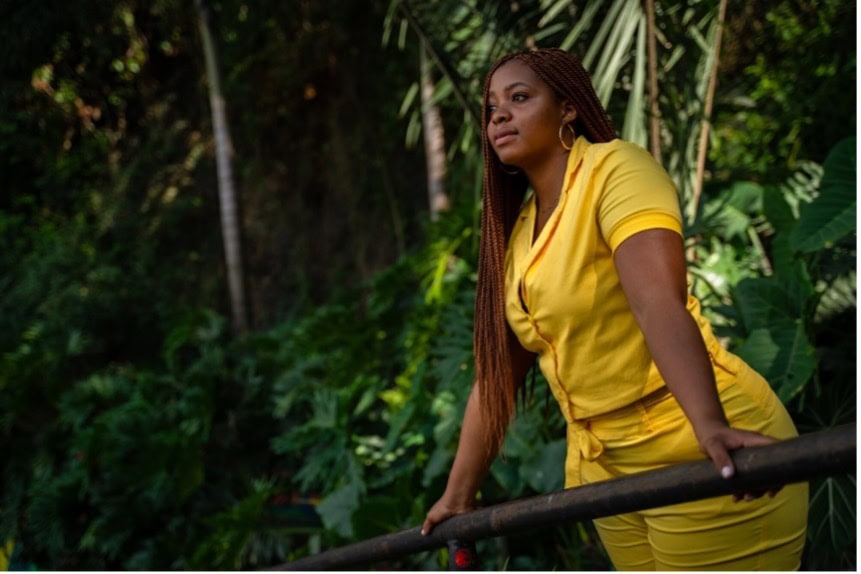
ā€œWhile there are many problems, the one that most affects our lives is violence,ā€ 23-year-old Yadis explains. ā€œIt leads to school dropouts, and girls and women are often seen as objects of war, used for purposes that have nothing to do with us. This violence has also severely impacted our security, limiting our freedom of movement and imposing restrictions on our daily lives.ā€


A woman with long brown hair stands in a yellow dress leaning against a railing. A jungle is behind her.

When you support Plan’s initiatives with a gift, you empower women like Yadis to use their creative talents to find peace within themselves and help others find theirs. | Nelson Pacheco, Ā©Plan International


Finding peace through art and music

Thanks to the generous support of caring people like youĀ , Plan launched the Empower Art for Peace project to help girls like Valery and Yadis.

ā€œWe chose art as a medium because it is a powerful catalyst for emotions, enabling individuals to process negative experiences and transform them into meaningful actions,ā€ Sara Erazo, who manages the project, shares.
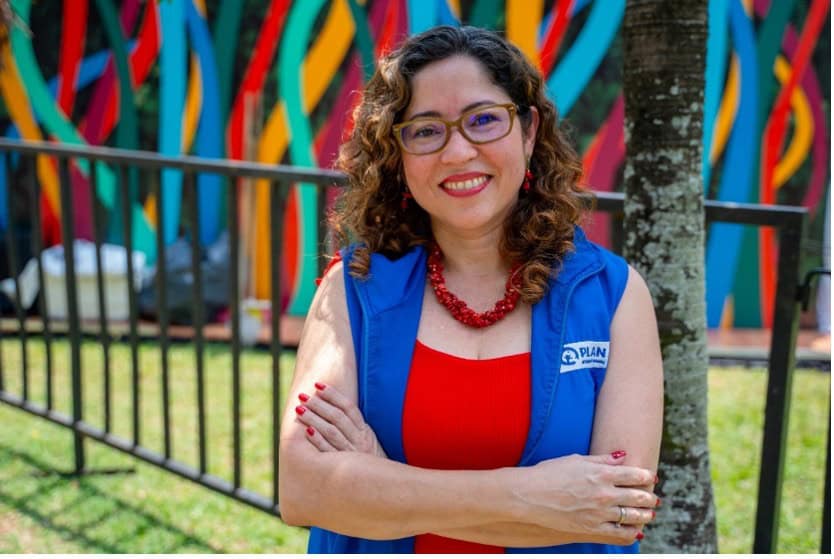
 

A women with curly brown hair stands in front of a fence and a wall mural painted with colorful lines. She is wearing brown glasses, and has a red necklace made of beads and a blue vest with the Plan International logo.

Sara has worked for Plan International for 21 years and believes the connection between art and culture is essential for fostering peaceful resilience. | Nelson Pacheco, ©Plan International


The Empower Art for Peace project promotes reconciliation and peacebuilding in areas heavily riddled with conflict. By fostering students’ creative energy in school through music, art and creative exercises, they can develop leadership skills while expressing themselves artistically.

Through these creative outlets, young people are gradually empowered to recognize and demand their rights as individuals.
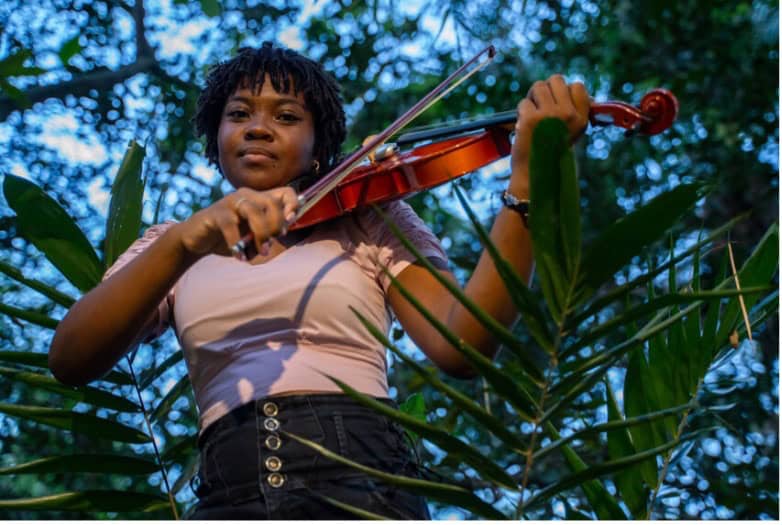
 

A girl in a beige shirt and skirt with buttons with twisted hair plays the violin in a jungle.

Valery has become a talented violinist and drummer, and is often invited to perform at events. | Nelson Pacheco, ©Plan International


Valery has inspired members in her community with her leadership journey through music.

ā€œFor me, music has been the lifeline I need,ā€ Valery says.

A minute of silence

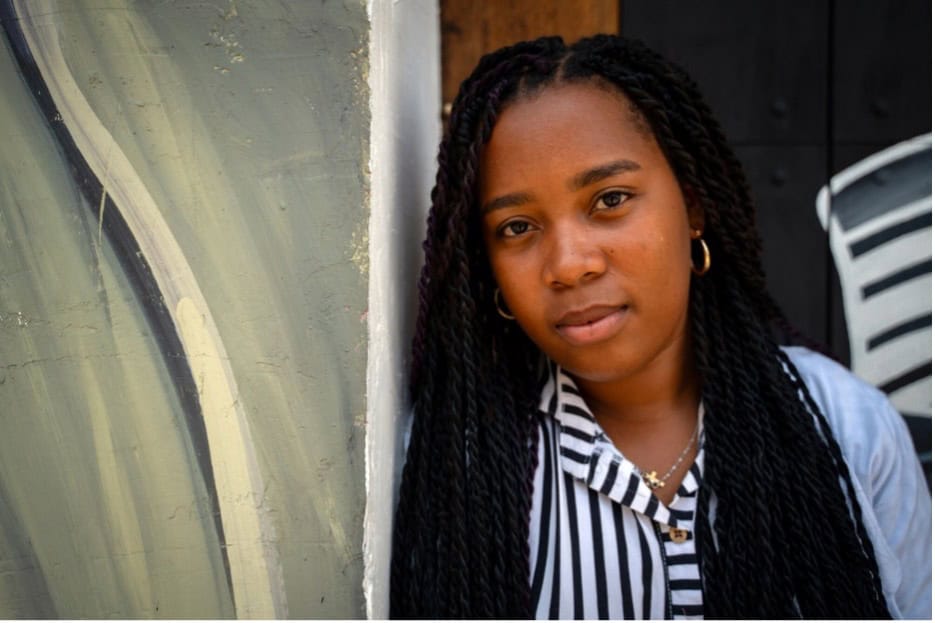
ā€œThe situation that most impacts the lives of adolescent girls and young women in our region is the societal context,ā€ 18-year-old Nicol says. ā€œIt often limits our self-acceptance as girls or women. Sometimes, we wish we had been born as men to avoid the challenges we face, such as sexual harassment, which is a daily occurrence. These issues cause us to feel less confident — sometimes we avoid wearing certain clothes or even going outside to avoid these situations.ā€


A girl with braids stands in front a green painted wall. She is wearing a striped shirt.

Nicol finds peace through the Empower Art for Peace project. | Nelson Pacheco, ©Plan International


ā€œI wrote a song ā€˜Un Minuto de Silencio’ — the song is a minute of silence for the young people who left us, for the government that focuses only on statistics, and for the mothers who cannot stop crying,ā€ Nicol says.

How YOU can help paint a peaceful future

Your generous gifts can inspire other girls, like Nicol, to utilize creative outlets to help them recover from trauma, violence and anxiety. Whether it’s music bringing communities together to sway to the beat or a beautiful painting or poem to inspire conversation, the Empower Art for Peace project provides a safe space for expression, especially in places where verbalizing certain thoughts and opinions might be dangerous.

ā€œInstead of picking up a gun, we can pick up an instrument, a book or start making art or poetry,ā€ Valery says. ā€œWe need to move away from violence and explore possibilities.ā€


Ā 
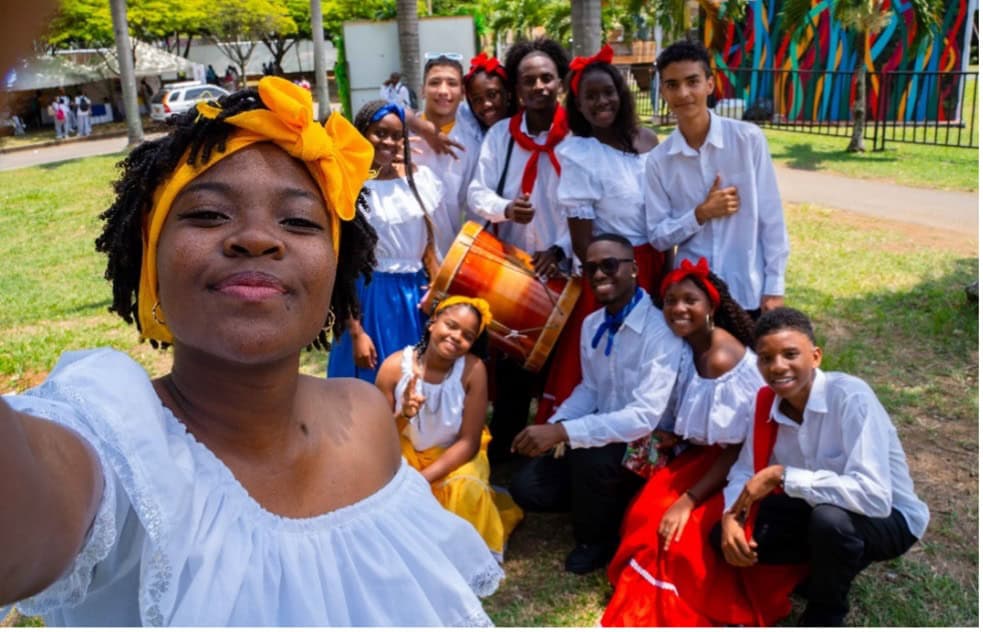
A group of people gather around a drum. They are wearing colorful, traditional Colombian dress and are standing in a park.
Valery motivates others to use music as a creative way to build peace. | Nelson Pacheco, ©Plan International


Thank you for helping to curate a future of peace and possibility for girls and young women in Colombia.

A girl looks out an open window with red curtains. She is framed by a green house and wearing a blue shirt.
The One Club: Plan International and MTV's 8M Infinito Campaign Wins Award at The One Club Miami
Devex: What’s inside USAID’s latest localization report?

Plan International welcomes reports of the ceasefire agreement in Gaza. We urge all parties to commit to taking all necessary measures to ensure that this ceasefire is permanent, sustainable and leads to lasting peace.

While today’s agreement offers a moment of hope for children who have been suffering unimaginable loss for over 15 months, we must remember that the situation for children in Gaza remains bleak. At least 17,580 children and 12,050 women have been killed1 in just 15 months in Gaza and over 21,000 children in Gaza have sustained conflict-related injuries – with 5,230 children (25%) requiring significant rehabilitation with a high likelihood of disability.

Over 46,707 people have been killed in Gaza since October 7 2023 with the actual number of deaths believed to be much higher, as thousands of people remain buried in the rubble of decimated homes, hospitals, and schools. Food, water, safe shelter, healthcare and other essentials are in desperately short supply after the targeting of civilian infrastructure. Action must go beyond the immediate end of violence. Immediate and unhindered humanitarian access to all areas of Gaza is critical to address these vital needs.

Children face devastating challenges

The scale of the crisis in Gaza has left children and their families facing devastating challenges. The destruction of homes, infrastructure, hospitals, schools, and essential services by the Israeli military has left Gaza in an unlivable condition. The few remaining hospitals are only partially operational, significantly understaffed, overwhelmed with critical patients, and medical supplies are dangerously low, putting children at risk of untreated injuries, preventable diseases, long-term mental health and psychosocial impacts and disability.

The international community must prioritise the immediate humanitarian needs of Palestinian children and their families.

In addition to the medical crisis, the destruction of schools and the displacement of civilians means that countless children are separated from their families, caregivers and friends and are left without access to education or safe spaces to play, heal and learn. Rebuilding educational infrastructure must be a key focus, as it provides not just learning, but a pathway to cope and heal during this traumatic time.

The complete destruction of civilian infrastructure in Gaza has a catastrophic impact on Palestinians, in particular the destruction of water and sanitation systems has left children exceptionally vulnerable to life threatening waterborne diseases, such as diarrhoea and cholera. Restoring clean water access and sanitation must be a top priority to avoid further health emergencies and preventable deaths of thousands of children.

Urgent mental health support

Equally important is the need for immediate and wide-scale mental health support. Many children in Gaza, including thousands of orphaned or separated children, have experienced or witnessed extreme violence for over 15 months. Psychosocial services must be expanded immediately to help children begin to recover from the psychological scars of horrendous hostilities. Children who have sustained blast injuries and disabilities arising from shrapnel, burns and fallen buildings with no surviving family members require special attention.

The international community must ensure that children’s rights to health, education, and safety are prioritised. These efforts must be part of a broader commitment to peace, justice, and lasting stability.

The international community must prioritise the immediate humanitarian needs of Palestinian children and their families. Although the ceasefire is a crucial first step, the needs of Gaza’s children will not disappear once the hostilities stop. The international community must come together to support Gaza, ensuring that children’s rights to health, education, and safety are prioritised. These efforts must be part of a broader commitment to peace, justice, and lasting stability.

Prioritise the needs of Gaza’s children

All civilian hostages in Gaza must be released immediately. We also renew our call for the immediate release of all children who have been abducted or detained by Israeli forces, and for a full and impartial investigation into the conditions they have faced in detention camps.

Plan International urges all governments, international organisations, and humanitarian agencies to prioritise the needs of Gaza’s children. We continue to call for all governments to cease the transfer of weapons, parts and ammunition while there is a risk they will be used to violate international humanitarian or human rights law.

The survival and future of Palestinian children in Gaza depends on our prompt collective action and meeting their humanitarian needs and is an essential step towards building a lasting and just peace in the region.

About Plan International

Plan International is an international development and humanitarian nonprofit that advances children’s rights and equality for girls. Working together with children, young people, supporters and partners, we strive for a just world, tackling the root causes of challenges children face. We are there from birth until adulthood, and we support children to prepare for and respond to crises and adversity, while particularly focusing on the experiences of girls. With more than 85 years of experience, we work to transform lives in more than 80 countries. We won’t stop until we are all equal.

For more information, please visit www.PlanUSA.org.

Ā 

PRESS RELEASE

Plan International is delighted to announce UN’s Reena Ghelani as its new Chief Executive Officer following a global search.

Portrait of Reena Ghelani, newly appointed Chief Executive Officer of Plan International, smiling confidently. Reena Ghelani will begin her role as Plan International’s Chief Executive Officer in April 2025.

Reena Ghelani, Plan International’s newly appointed Chief Executive Officer, set to begin her role in April 2025.

Ghelani has extensive international executive leadership experience in the humanitarian and development sector. She joins Plan International from her current role as UN Assistant Secretary General – Climate Crisis Coordinator for the El NiƱo / La NiƱa Response, having previously served at senior levels in the United Nations Office for the Coordination of Humanitarian Affairs (UN-OCHA) and roles in the United Nations High Commissioner for Refugees (UNHCR).

“I am deeply inspired by the organisation’s girl-focused strategy and youth-centred approach to its development and humanitarian work.”

Reena Ghelani

Ghelani said: ā€œI am excited and honoured to be joining Plan International as CEO. I am deeply inspired by the organisation’s girl-focused strategy and youth-centred approach to its development and humanitarian work. I have been impressed with Plan from afar, now I get the chance to help a skilled team across the globe have even more impact for girls and all children in a world that seems to need us more than ever.ā€

Gunvor Kronman, Chair of the Members’ Assembly and International Board of Plan International said: ā€œWe are delighted to have such a talented and well-regarded sector professional join our organisation. Reena can drive us as we realise our ambition to scale-up our humanitarian work, deepening our gender transformative and girl-focused responses in crises settings, alongside our existing development work which has localisation at its heart. Together these areas ensure we are an INGO that is fit for the future.ā€

Debbie Simpson will continue to serve as Plan International’s Interim Chief Executive until Ghelani joins in April 2025.

With 10,000 staff worldwide, Plan International is an independent development and humanitarian organisation that advances children’s rights and equality for girls. It is active in more than 80 countries and promotes the rights of the world’s most vulnerable children, especially girls. In the fiscal year 2024, Plan International raised €1.04 billion and supported 43 million children worldwide, including 23.3 million girls.


Learn about Plan’s impact in our annual review.

##


For more information or interviews, please contact:

Vannette Tolbert

Senior Communications Manager

Email: [email protected]

Mobile: 240.778.9077

www.planusa.org

January 11 is National Human Trafficking Awareness Day — a time to shine a light on the pervasive issue of human trafficking and share information on how to recognize and prevent it. Social media has completely changed how we connect, share and learn — but it’s not all good news. For traffickers, these platforms provide countless opportunities to exploit vulnerable individuals.

Plan and CNN’s As Equals teamed up to create an interactive report surveying more than 600 girls and young women across nine countries. The results were chilling. The report revealed that 58% of respondents have experienced online abuse — with many highlighting social media platforms as the primary spaces where harm occurs.

Read the full interactive story here.

How to report a suspicious profile

If you encounter a suspicious profile or receive unsolicited messages, take these steps:

—  Ā  Use the platform’s “report” feature to flag inappropriate behavior.

—    Block the account to stop further contact.

—    Share your concerns with someone you trust.


Multiple people using smartphones with comment bubbles, likes, and message icons floating above, representing social media interactions.


Red flags to watch for

Traffickers often search for posts or profiles where people share their struggles. For example, they might respond to a teen posting about feeling alone or misunderstood with comments like, “I know how you feel,” or “You deserve better than this.”

Traffickers use empathy as a weapon — they gain trust and create dependency. Once trust is established, they may escalate the grooming process by offering gifts, promising opportunities or isolating their target from friends and family.

Be cautious about engaging with strangers online. Trust your instincts and talk to someone you trust if something feels off.


Is this a fake profile?

Fake accounts are a common tactic traffickers use to lure potential victims. Here’s how to recognize them:

—      Limited or generic personal information in their bio.

—      Profile pictures that look overly polished or appear to be stock images.

—      Messages that are overly friendly or offer quick opportunities, like ā€œGet rich fast!ā€ or ā€œWork with us.ā€

If it sounds too good to be true, it probably is.

Awareness of these red flags is a strong tool to protect yourself from online predators.


A hand scrolling through a social media profile on a smartphone screen, highlighting online activity and digital engagement.


Strengthen your digital resilience

Digital resilience helps you recognize and navigate online risks. You can protect yourself by taking these practical steps:

—      Limit personal information: Avoid sharing sensitive details like your location, school or daily routines online.

—      Strengthen privacy settings: Regularly update privacy settings on social media to control who can see your posts and contact you.

—      Trust your instincts: If something feels off about an interaction or a profile, it probably is — trust your gut.

—      Know where to get help: Familiarize yourself with each platform’s reporting features and resources like the National Human Trafficking Hotline for support.

Learn more in Plan’s Building Digital ResilienceĀ  report.

How traffickers stay in control

Traffickers don’t stop at initial contact. They often use social media to monitor and isolate their victims — restricting access to friends and family or impersonating them to spread misinformation.

If someone you know suddenly pulls back from online interactions or seems distant, it could be a sign they’re being manipulated. Reaching out to show support can make a difference.


Plan’s fight against online trafficking

Plan is at the forefront of creating safer digital spaces. Through advocacy, education and resources, we work to equip girls and young women with the tools they need to thrive in the online world. Plan’s Building Digital Resilience report and CNN’s As Equals interactive report identify risks and provide strategies to navigate and mitigate these dangers.

Our advocacy extends to supporting legislative efforts like the Kids Online Safety Act — aimed at holding platforms accountable and fostering safer online environments. Together, these initiatives create a foundation for long-term safety and resilience in digital spaces, ensuring girls and young women can confidently navigate the online world.

A young woman live-streaming on her phone with social media engagement icons, like hearts and thumbs-up, surrounding her.

The internet should empower — not endanger. Staying informed, vigilant and connected ensures everyone — especially girls — can learn, lead and thrive safely both online and offline.

To learn more about staying safe online and avoiding trafficking risks, visit the National Human Trafficking Hotline website.


Together, we won’t stop until we are all equal.

A hand scrolling through a social media profile on a smartphone screen, highlighting online activity and digital engagement.

This article was written by Aisha Bukar Usman, Access to Education Lead for Plan International Nigeria.

With approximately 20 million children out of school, Nigeria is grappling with a significant educational crisis, fueled by poverty, insurgency and displacement. In response to this alarming situation, the Opportunities to Learn activity was launched in 2021, funded by United States Agency for International Development with the International Rescue Committee as the lead organization, working with partners — Plan International, Inclusive Development Partners, Restoration of Hope Initiative and American University of Nigeria.

The activity’s mission is to provide quality, safe basic education to out-of-school children and youth aged 10 to 15, using Nigeria’s Accelerated Basic Education Program curriculum. This curriculum was designed to provide foundational skills in literacy and numeracy to enable these children to transition to higher education levels or enter the workforce.

The impact of the OTL activity has been profound. By July 2024, 5,075 OTL activity learners across Borno and Yobe states took the Basic Education Certificate Examination, a significant achievement considering the educational challenges in these locations.

The Basic Education Certificate Examination is a pivotal milestone in a student’s educational journey in Nigeria. Success in the BECE is a prerequisite for transitioning from junior secondary school to senior secondary school. For girls in particular, succeeding in the BECE can have a profound impact on their future prospects, enabling them to pursue their academic and career goals. This, in turn, can lead to improved economic prospects, enhanced life skills and confidence, and a break from the cycles of poverty.

In Yobe state, 641 learners (430 girls and 211 boys) participated in the examination. The Ministry of Education in Yobe state waived the examination fees and allowed learners to write the examinations without the usually compulsory requirement of wearing school uniforms. This is the first time in Nigeria that learners from an accelerated non-formal education pathway wrote the BECE — and the results were inspiring.

All program participants passed the BECE, and the Yobe State Government has offered them entry admissions into government senior secondary schools. This is a testament to the resilience of communities and the importance of targeted educational interventions in crisis-affected regions. Education is undeniably a catalyst for change, especially in regions facing significant socio-economic challenges. The collaborative efforts of the OTL activity’s consortium, government stakeholders and community members have made a significant difference in the lives of thousands of children.

Among the many success stories emerging from this education initiative, Fatima’s story stands out. Before enrolling in this program, Fatima’s life was marked by hardship. She spent her days begging in the streets, a daily routine that left her physically and emotionally exhausted.

Fatima-and-mother image
Fatima (right) with her mother, who never had the opportunity to go to school. ©International Rescue Committee

At the inception of the OTL activity, Fatima was provided with crutches to aid her mobility, as she had previously relied on a locally made stick to support her mobility to school. This support not only improved her physical mobility but also changed her social interactions.

ā€œMy classmates used to mock me, knowing me as the girl who begged on the street, but my teachers helped change their attitude,ā€ Fatima shares. ā€œNow, with my new crutches, I arrive on time, and my classmates respect me for my uniqueness.ā€

Fatima-at-school image
Fatima attends classes through the Opportunities to Learn initiative. | ©International Rescue Committee

Fatima’s journey is a powerful reminder of how inclusive education can change lives. The OTL activity not only provided her with the tools to succeed academically, but also fostered a supportive learning environment that allowed her to thrive.

ā€œShe comes back home excited, singing songs I do not even know the meaning of,ā€ Fatima’s mother says. ā€œI have never gone to school, but I am glad Fatima has the opportunity I didn’t get as a child through OTL.ā€

Fatima’s story is not just about overcoming personal challenges — it is a testament to the broader impact of educational initiatives. When girls like Fatima have access to quality education, they are able to unlock their full potential and become change-makers in their communities.

ā€œI want to continue with my studies to become a doctor,ā€ Fatima says. ā€œI understand what it means to be in special need and would love to be able to support more people like me in the future.ā€

Insights-logos-update
Fatima-at-school image