Search Results

Search results for

0 result(s) found
A CDC report recently found that 57% of teenage girls in the U.S. reported feeling persistently sad or hopeless in 2021 — double the rate of boys, and the highest level reported over the past decade. Nearly 25% of girls reported making a suicide plan. Officials noted that no one factor caused the increase; instead, they suggest that the pandemic, social media, stressors at school, online misinformation and societal conflict can all contribute. And, the report found that nearly 70% of the LGBTQIA+ people surveyed experienced persistent feelings of sadness or hopelessness during the past year, and more than 50% had poor mental health during the last 30 days. This mental health crisis has unique effects for girls, but we also know it goes beyond gender identity. Everyone is affected by mental health, and everyone can be an ally for someone in need. So, we asked two young people who are part of Plan International USA’s leadership network to tell us how they see the mental health crisis in their own lives. Here’s what they had to say.  

What does mental health mean to you?

Riya, 15: To me, mental health means keeping my mind healthy, free of stress and being emotionally stable to take on the challenges of life. Garrett, 20: As a gay male growing up in the deep south, I frequently feel very isolated. My mental health journey has been very lonely, and this did not change until going to college. This makes sense, sociologically, as stigma plays a major role in identity, especially at young ages. But I am a White male who is able to “pass” (portray oneself as a member of a social group other than the one they belong to) as straight. I was also able to afford mental health treatment and I had a great support system. So, for all intents and purposes, I was guaranteed to be okay in the end. My identity fits (almost) perfectly with those who maintain power. But most members of marginalized communities do not have this experience. Black people, women, and especially Black women, cannot typically mask their skin color or gender, which carry so much stigma. This makes them vulnerable to both systemic and societal racism and misogyny, worsening their mental health and stripping them of equal opportunity. Mental health has a lot to do with eliminating these stigmas and fighting for social justice and equality in society. An individual’s mental health has a lot to do with their place in society and the identities and roles that society places on them.

We are thought by many, especially older generations, as being "dramatic" or "weak." In reality, we face unique challenges that older generations did not face. — Garrett, 20

Do you think mental health is a problem at your school? Why/why not?

Riya: Mental health is an issue at every school. Everyone that isn’t or hasn’t experienced the current generation of high school does not understand the extensive social, academic and familial pressures that are placed upon us and that we place upon ourselves. Most high schoolers are working hard 24/7 trying to achieve their dreams of getting into their perfect college (because that’s all anything seems to be about these days) while balancing a respectable social life. Lots of people say ā€œOh you’re young, just enjoy yourself,ā€ not realizing that it’s because we’re stuck in that older-but-still-youngish phase of life that we’re not able to enjoy ourselves, thus leading to mental health problems and even depression. Garrett: Mental health is a problem at my school because it is a problem everywhere. In fact, many youth that suffer with mental health are neglected, and others are abused or bullied because of their struggles. In addition to physical markers like skin color or gender, stigma is also attached to mental health, and youth are especially vulnerable here. We are thought by many, especially older generations, as being ā€œdramaticā€ or ā€œweak.ā€ In reality, we face unique challenges that older generations did not face. These challenges are concurrent with issues of environmental justice, growing up in an inflated economy dominated by the 1% and the politicization of identity (gender and sex, sexual orientation, socioeconomic status, skin color and more). A sense of anomie, a disconnect from society, from being unable to achieve institutionalized goals, is rampant among marginalized communities. This leads to a myriad of mental health issues, especially suicide.

What I’ve noticed is that people will ask girls if they’re okay and once they get that standard response of "I’m fine," they’ll stop trying. Don’t stop trying. — Riya, 15
Do you think that girls experience unique mental health challenges? Why/why not?

Riya: Yes, I do think that girls experience unique mental health challenges because I feel like there’s more expectation for girls to look or act or do things a certain way, whether it’s the way they act, dress, etc. A guy could show up to school in sweats and a hoodie and it would be considered ā€œcool,ā€ but a girl could do the same thing and it would seem like she isn’t trying hard enough. Girls also tend to put more pressure (i.e., academically) on themselves because of those expectations (this I know from firsthand experience). These seem like totally minor things, but they do have a significant amount of influence on the way that we see ourselves and the people we interact with. Girls also have an extra physical and mental obstacle to overcome: their menstrual cycle. It’s been scientifically proven that girls and boys have differences in hormone fluctuations and brain chemistry which could also affect their levels of anxiety. I don’t think that it’s strictly physical or psychological differences that affect girls’ mental health challenges, but I do think that a combination of both results in more mental deterrents for girls over boys. Garrett: Girls absolutely experience unique mental health challenges. From oversexualization to being legal property of their husbands, women have been historically oppressed (and still are). There are many long-term effects of this oppression. Even in clinical trials, girls have historically been excluded from participation. This means that a majority of modern medicine has been tested primarily on men and does not take into account the biological differences between men and women, such as metabolism. Because of this, women are 50-75% more likely to experience adverse drug reactions, putting them at greater risk when taking medication for mental health treatment.  

What do you wish more people knew about the state of girls’ mental health in the U.S.?

Riya: I wish that more people knew that when girls say they’re fine, we’re almost never fine. If you can sense something off about a girl you know, your instincts are probably right. This does not mean pressuring her until she talks (that could simply lead to further mental retraction), it simply means that you need to be aware that she is not okay at that moment and be prepared if she decides to talk about it. Until then, treat her kindly. What I’ve noticed is that people will ask girls if they’re okay and once they get that standard response of ā€œI’m fine,ā€ they’ll stop trying. Don’t stop trying. We may not express it very well, and we may come across as moody, but giving up on us will only heighten the mental issues we’re facing. Garrett: The current state of girls’ mental health is a result of historic oppression. People (especially White men) see women and girls in the workforce or at the polls and seem to forget how they got here. Women’s place in society today was fought for, and women are still fighting. Progress has been made, but the fight for gender equality is not over. I wish that more people understood that. It is infuriating that we have the social science proving the inequalities between men and women, yet local and world leaders refuse to acknowledge it. As a White man myself, I have an incalculable amount of privilege and I can see the inequalities between myself and my female colleagues every day. We must continue elevating girls and women to an equal place in society so that girls can make these policies and advancements for gender equality themselves. As long as governments and bureaucracies are dominated by White men who simply do not care about equality for women, nothing will change. We have to elect more women into office and leadership positions, and we have to educate and empower girls across the world to do this. And – I cannot stress this enough – we have to ensure intersectional feminism in our practices to empower Black women and girls, who face even more unique challenges than their White female colleagues and classmates.   If you or someone you know is experiencing mental health-related distress, help is available. The National Alliance on Mental Illness runs a hotline you can text at 62640 or call at 800.950.6264. You can also call or text the National Suicide and Crisis Lifeline at 988.

Education is free in Ecuador.

But access to a quality education — or any education at all — is far from equal.

In rural areas, educational opportunities are extremely limited. It’s not unusual for children to walk miles each way to school, traveling down mountains and over rough terrain. Chronic challenges like poverty force young people to drop out of school and find work in order to help support their families. And girls face unique barriers. They are more likely to drop out due to marriage, pregnancy or gendered social norms, which prioritize boys’ education.

A third of girls in Ecuador don’t even start high school, let alone graduate. And girls in remote Indigenous communities, where traditional gender roles are often enforced, are even less likely to continue with their education.

A girl may have to drop out because of the distance, or because the journey to school isn’t safe. Her family may not be able to afford the additional expenses, like uniforms or school supplies. She may be driven away by abuse and discrimination from teachers or peers. Or she may be forced to abandon her education simply because she is a girl.

Today, you’ll meet three Indigenous young women in Ecuador who faced these exact challenges and found the courage to defy the status quo, with support from strong women in their lives, encouragement from child sponsorship and unwavering confidence in their own potential. Ā 

Ā 

Estefania, 26

Estefania doesn’t take her education for granted, because it was almost taken from her — not once, but twice.

The first time was when she was 12 and had just finished primary school. Her father decided there was no need for his daughter to go on to high school. Why? Because she was a girl, and her place was at home.

For many girls, that would have been the end of the story. They would have no choice but to obey their father’s orders. But, fortunately, Estefania had a strong mother who recognized the value of her daughter’s education. She stood up to her husband and insisted that Estefania stay in school.

With her mother’s support, Estefania graduated from high school. She was proud to reach this milestone, but thought that was the end of the road for her.

“I didn’t see the possibility of studying at university because I needed to dedicate myself to working in order to provide for my family,ā€ Estefania explains.

Then, one day, Estefania was talking to a Plan community volunteer. A sponsored child for many years, Estefania was very familiar with Plan’s work. Even as an adult, she can still recall the happiness she felt every time she received a letter or a gift from her sponsor. So, when the volunteer told her about a university scholarship project run by Plan, Estefania jumped at the chance. She applied and was one of 35 young people to be awarded a scholarship.


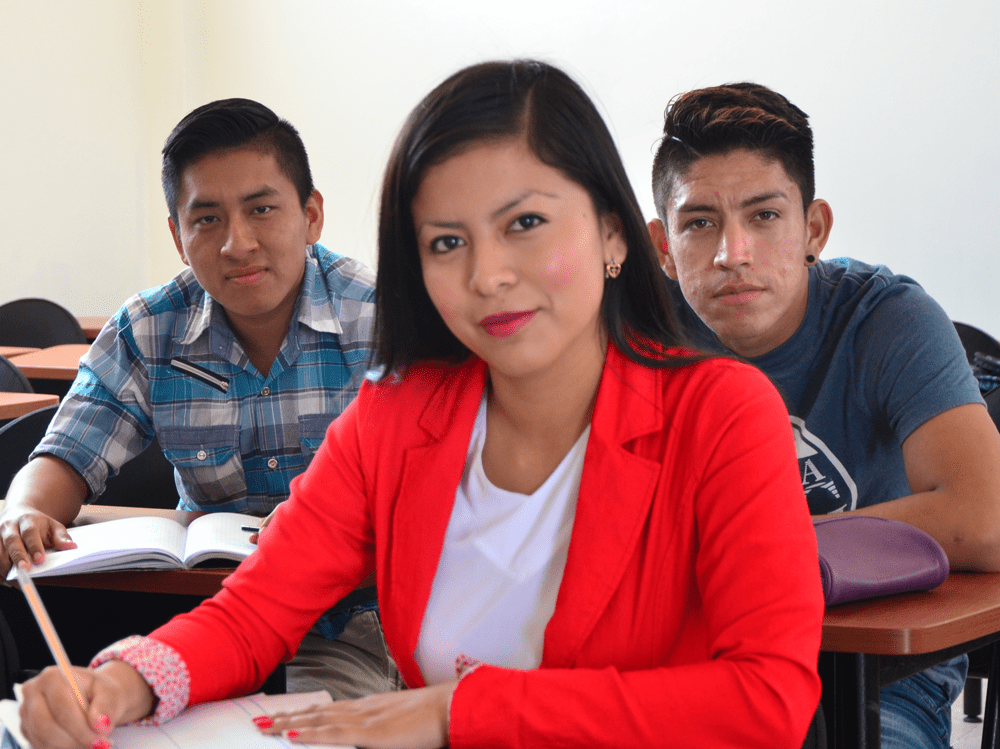
A young woman in Ecuador sits at a desk in a classroom holding a pen in her right hand and writing on a piece of paper; she looks at the camera along with two classmates seated behind her.

ā€œOne of the biggest expenses I was able to pay for with my scholarship money was the transport fares to travel from my community to the city where the university was located,ā€ Estefania says. ā€œDistance is one of the barriers that prevent many people from studying.ā€


In addition to monthly financial support for five years, Estefania also received technical support and participated in training sessions to develop life skills in leadership, communication, self-esteem and resilience.

ā€œI always had the support of the Plan International project team, which was so valuable to me,ā€ Estefania says.

In 2020, at the age of 24, Estefania graduated with a degree in accounting and auditing. She now works as an administrative manager for a well-known laboratory camera company.

ā€œI feel very proud to be able to prove to myself, my family and community that as a woman from a rural community, I was able to achieve one of my biggest dreams. I now contribute financially to my family, which means my younger siblings can also stay in school. My next goal is to study for a master’s degree in human resources.ā€

Ā 

Evelyn, 19

Evelyn grew up in a traditional Quechua community, where she lived with her parents and four younger brothers.

Believed to be the largest Indigenous group in the world, the estimated Quechua population in South America is over 10 million, but the actual number may be much higher. Although they are considered part of the same large group, there are at least 15 Quechua sub-groups in Ecuador. The Quechua have a unique tradition of making textiles and handicrafts, and most rely on agriculture for their livelihood. In the Ecuadorian highlands, traditional clothing such as ponchos, shawls, woven belts, bowler hats and pleated skirts are still worn on a daily basis.

Both Spanish and Quechua are spoken in most Ecuadorian primary schools where there is a large Indigenous population. However, in high school, the majority of lessons are taught in Spanish. This can make it hard for Indigenous students to keep up with their classmates, and some may drop out of school as they start falling behind. The language barrier can also make them feel isolated and even ostracized by their peers.


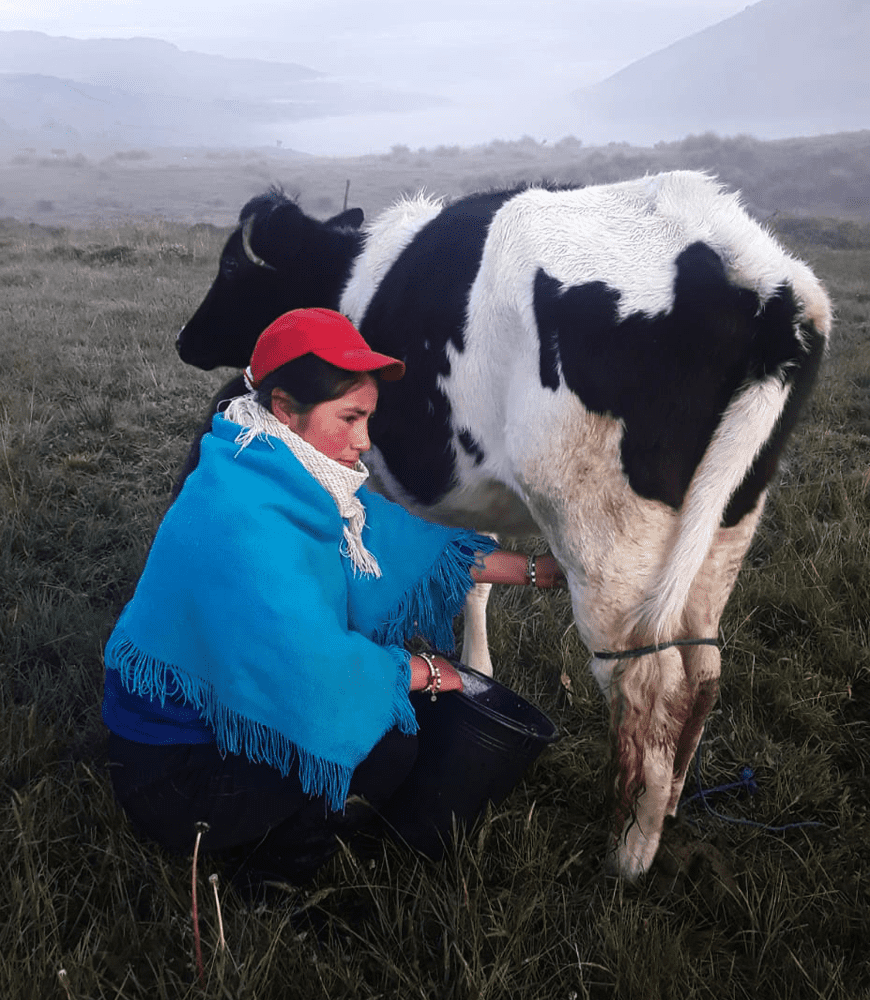
Evelyn, a 19-year-old Indigenous young woman in Ecuador, milks a cow outside, wearing a red hat and a blue shawl.

ā€œI come from a humble family, full of affection and love, courage and a lot of respect,ā€ Evelyn says.


Evelyn had a happy childhood, and she was proud of the traditional clothing, language and customs that shaped her into the young woman she is today. It wasn’t until high school that she and her brothers first experienced discrimination based on their ethnicity. The bullying didn’t come from their peers, but rather from a new teacher at their school.

ā€œA teacher started teaching at my school,ā€ Evelyn recalls. ā€œWe received mistreatment, discrimination, bullying insults … I suffered a lot.ā€

Even though she came from a loving home, Evelyn was afraid to tell her mother what was happening at school. But, eventually, the teacher’s abuse was too much to endure and she had to say something. Fortunately, when Evelyn’s mother found out how her children had been mistreated, she didn’t hesitate to come to their defense. She made sure the situation with the teacher was handled immediately, and that her children didn’t have to sacrifice their education to escape the abuse.

As a sponsored child, Evelyn participated in Plan workshops in her community that helped to improve her self-esteem and reinforced the value of education. She understood that education was the key to unlocking the future she deserved, and with her mother’s support, she refused to let this bullying stand in her way.

ā€œI am aware that to achieve my dreams, I have to prepare, work hard and study,ā€ Evelyn says.

Evelyn’s involvement with Plan didn’t end when she graduated from our sponsorship program — she now works with us as a community volunteer.

ā€œPlan International helped me to become an agent of change and I now help other children and young people to value their identity,ā€ Evelyn says. ā€œI want to continue influencing and promoting a change in people’s attitudes towards gender equality.ā€

Ā 

Mirella, 16

Mirella lives in a remote village in the Andes with her mother and sisters. Her father left when the girls were young, and her mother raised her three daughters on her own.

Each morning, Mirella and her mom get up at 4 a.m. to feed their animals. They make traditional handicrafts to sell as an additional source of income.

Life in the highlands is beautiful, but isolated, making it difficult to get to school. Still, Mirella’s mother is supportive of her education, and a scholarship from Plan has helped them to buy school supplies, uniforms and shoes.

[Read more: Photo story: Portraits from the Andes]

ā€œIt was very motivating for me to receive this kind of assistance because I am aware that education is very important for my life and future,ā€ Mirella says.


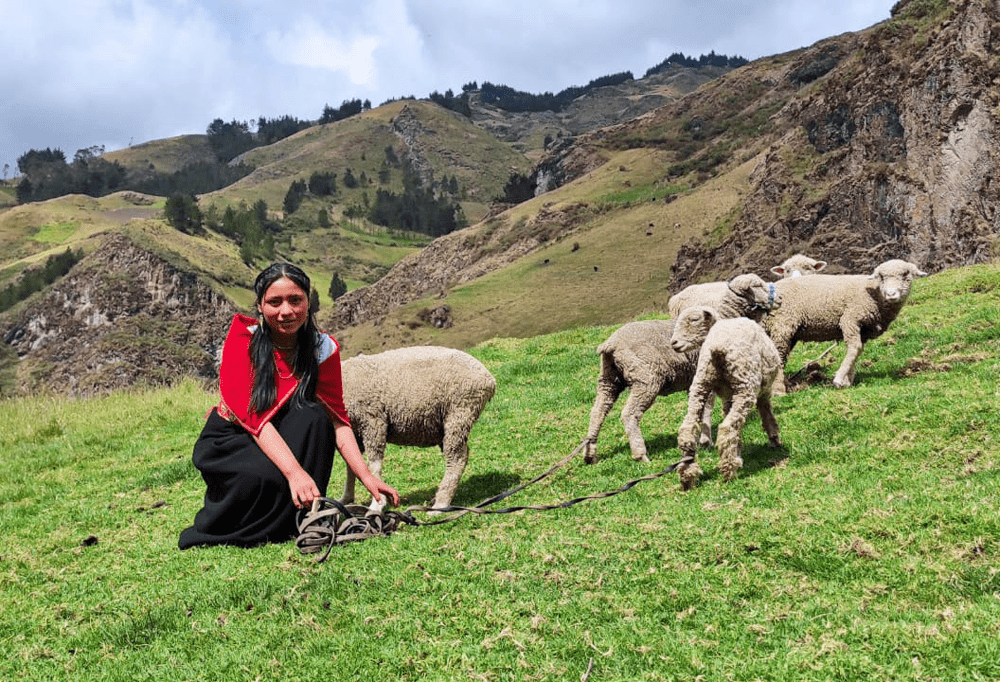
Mirella, a 16-year-old girl with her long black hair in two ponytails, tends to her family’s sheep in the mountains of Ecuador, wearing a red shawl and a long black dress.

ā€œEvery day we get up at four o’clock in the morning to start making crafts and feed our animals,ā€ Mirella says. ā€œThat way, things are ready by half past six, which is usually the time we go to school.ā€


As a sponsored child, Mirella also participates in Plan workshops in her community, where she has learned about her rights and developed leadership skills.

ā€œThis space has given me the tools to express myself without fear, to give my opinions and have them considered,ā€ she says.

It’s also given her the confidence to dream big. ā€œI am sure that I will finish high school, and my dream is to go on to study at university, to become a doctor and save other people’s lives,ā€ Mirella says.

Every day, young women like Estefania, Evelyn and Mirella are beating the odds and fighting for the futures they deserve. Their perseverance in the face of overwhelming adversity is inspiring, and you can help them reach their goals. When you sponsor a girl, you can encourage her to unlock her full potential, and help communities recognize the value of education for all children.


Devex: Opinion: A how-to guide for meaningful youth engagement

From the United Nations to the White House, 2023 was an incredible year for youth engagement at Plan International USA! In this report, we highlight just some of our amazing young people and their experiences in partnership with Plan USA. You’ll read about Plan’s Youth Leadership Academy, our Youth Advisory Board, Girl Takeovers and more.

Cover for Domestic Youth Engagement Report 2023 Wrapped
Sustainable Brands: 3 Ways to Tailor Your Programs to Invest in Girls

PRESS RELEASE


WASHINGTON, D.C. March 5, 2024 — Plan International USA is investing in the women of tomorrow by supporting the girls of today on International Women’s Day. To celebrate the UN’s International Women’s Day theme of #InvestinWomen, Plan is equipping girls with the skills they need through partnering, funding and elevating their voices.

Adolescence is a critical time of opportunity for girls, often shaping the adults they will later become. A study by Plan and the Citi Foundation found that achieving 100% upper secondary school graduation rates, known as high school in the U.S., for girls could lift national GDPs an average of 10% in many countries. However, our experience also tells us that education by itself isn’t enough. Gender stereotypes and lack of job training limit what girls think they can be and thus their economic potential. By providing girls with the skills they need to successfully enter the workforce, they become agents of change toward securing more prosperous and just economies.

ā€œGender inequality and stereotypes tell girls that certain industries are off limits,ā€ Laura Willis, sr. director of corporate and foundation partnership, said. ā€œAnd that limits her potential. We are celebrating investing in girls today because we know they hold the power for economic growth for themselves, their families and their communities.ā€

Year-round, Plan’s skill and work programs equip girls for the careers they choose rather than the life path that society dictates, striving for a world where every girl’s potential is realized. In 2022, Plan improved skills and work opportunities for more than 1,200,000 girls and young women globally. A key way we achieve this is through partnerships that support economic justice and rights for young people, such as our partnerships with Google.org, J.P Morgan, The Children’s Place the and the Western Union Foundation.

Other ways we are celebrating International Women’s Day are with brands Marikmekko and UNIQLO. Marikmekko, a design house focused on fashion and home collections, is donating 20% off purchases sitewide and in its Marimekko NY store on March 8. These funds will be used to support Plan’s work with girls and young women around the world.

In partnership with UNIQLO, young people had the opportunity to share about the world they want to live in and are having their voices elevated. This took place through a multi-generational roundtable between members of Plan’s Youth Advisory Board and executives at UNIQLO. The conversation explored the question ā€œwhat is the future working world we want for girls and young women?ā€ and discussed how investing in girls today can help achieve this future.

ā€œYoung people have hopes and dreams and see the world in a different way,ā€ Lily, a youth advisory board member, said. ā€œI am excited to use my voice on behalf of all girls and women, so we have a world with better representation, a world with people succeeding and supporting each other.ā€

This International Women’s Day, Plan is celebrating actions that encourage the girl leaders of today and their dreams for tomorrow so they can challenge traditional barriers and think big about their futures. Join us in investing in the girls of today through donating to Plan and learning more about our skills and work programming.


For more information or interviews, please contact:

Maria Holsopple

Director, Communications & Creative Services

Email: [email protected]

Mobile: 540.383.3628

Ā 

About Plan International USA

Powered by supporters, Plan International USA partners with adolescent girls, young women and children around the world to overcome oppression and gender inequality. We provide the support and resources that are unique to their needs and the needs of their communities, ensuring they achieve their full potential with dignity, opportunity and safety. Founded in 1937, Plan is an independent development and humanitarian organization that is active in more than 80 countries.

For more information, and to learn about our commitment to safeguarding, please visit www.PlanUSA.org.

Plan International logo
World Economic Forum: How countries can save millions by prioritizing young people’s sexual and reproductive health

This story was originally posted on the Department of Labor’s website.


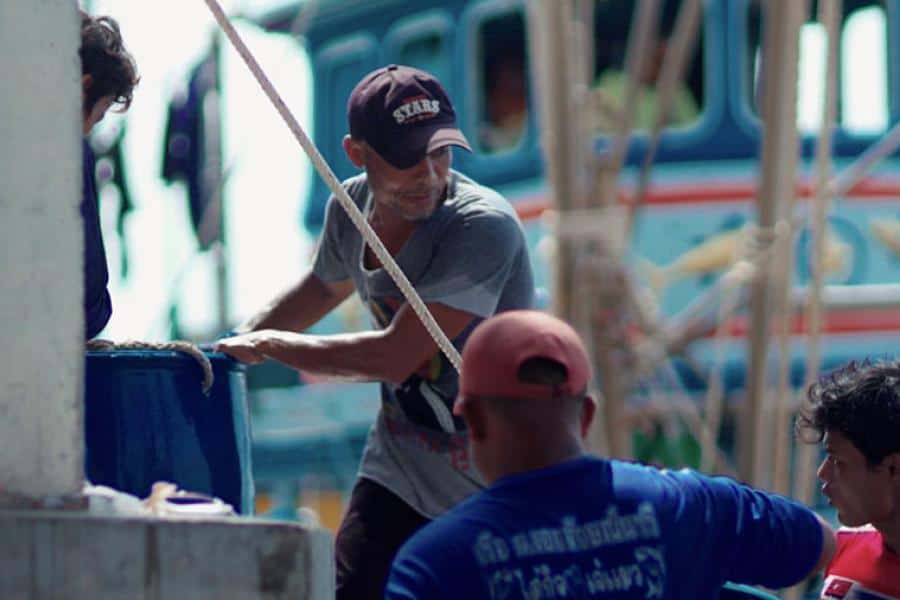
A man in a gray t-shirt pulls on a blue plastic tub. In the background is a blue and red boat.

Workers unloading catch at Mahachai pier in Samut Sakhon, Thailand.


“The good part is that it helps us adjust our thinking about how to work.”

An innovative project is creating a culture of responsible recruitment in the Thai seafood sector and empowering migrant laborers with access to critical information about their rights.

It was around midday when the two large trawlers docked at Mahachai pier in Samut Sakhon, Thailand. The din of the fishermen could be heard from a distance. Vibrations at the dock were an eclectic mix: Burmese and Thai voices shouting instructions, the clanking of large baskets of freshly caught fish tossed across wet makeshift conveyor belts. Baskets were rushed from the vessels down towards a group of migrant laborers waiting to separate the various fish into piles.

“We have to make sure we organize the fish properly,” said Thaet Thaet, a Burmese migrant worker who had been hired that day to offload the boats. “The fish are sorted by species and size, some to be sold at markets, others to go to factories,” he said.

“The job can be tedious, but at least it’s not dangerous,” Thaet said. About 16 years ago, he was a fisherman aboard a trawler. While onboard, Ā he was forced to work brutally long shifts for low pay. His employer verbally and physically threatened the laborers – Ā one time, he recalls, with a handgun.

“We would work for 24 hours a day, and the work was very hard,” notes Thaet. “I was unlucky and got a bad employer. The captain would always berate me every day.”

Thaet Thaet’s experience is far from an isolated case. Migrant workers like him have long faced a range of risks in the fishing trade, including human trafficking, forced labor, and other forms of exploitation.

Research from the International Labor Organization shows that forced labor and human trafficking in the fisheries sector remain a severe global problem. The U.S. Department of Labor and numerous human rights groups haveĀ documented forced labor and widespread abuse in the Thai fishing industry. While significant challenges remain, local labor and anti-trafficking organizations say that reforms, research, and enforcement are helping to alleviate the longstanding crisis.

The FAIR Fish: Fostering Accountability in Recruitment for Fishery WorkersĀ project, funded by The U.S. Department of Labor’s Bureau of International Labor Affairs and implemented by Plan International, is engaging those historically at the root of the trafficking problem.

The project is educating employers, recruiters, and workers about responsible employment and human rights through advocacy, training programs, and a mobile application on workers’ rights. The goal is to create a culture of responsible recruitment in the seafood sector and empower migrant laborers with access to critical information about their rights.

“Workers in the seafood processing industry are migrant workers from neighboring countries, mostly Myanmar and Cambodia, and… [that] makes them more vulnerable to exploitation,” said Sujintana Hemtasilpa, the project director for FAIR Fish. “So, we are helping employers and recruiters… Ā to protect them from forced labor and human trafficking.”


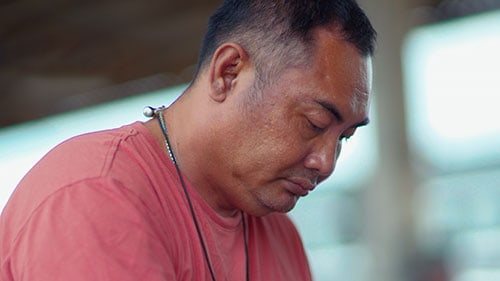
A man wearing a red shirt leans forward while looking down.

Thaet Thaet at work in Mahachai, Thailand.


Sujintana added that because most migrant workers are not well informed about Thai labor laws and regulations, they are more vulnerable to exploitative work than Thai workers. As many migrant workers don’t read or speak Thai, accessing crucial information about their rights can compound this problem.

“Through our community outreach, we hope that this engagement process and our efforts to change the behaviors of stakeholders, particularly among employers … will create a more sustainable impact,” said Sujintana. And their efforts to clean up the recruitment process are making a difference.

FAIR Fish found that the companies and recruitment agencies working with the project had developed a deeper understanding of responsible recruitment after completing the coaching sessions over two years.

“The good part is that it helps us adjust our thinking about how to work,” said Sirikorn Worrapanya, the director of the Central Unity Group Service, one of Thailand’s leading foreign worker employment agencies. “It’s not just about business and profits alone anymore.

” Major seafood industry companies said in five separate interviews that they are taking steps to protect the migrant workers they hire.

“Trainings like this remind you that in order to work together, you must be mindful of human rights, and you must respect the law,” said Thida Songnangrong, a human resource officer at Southeast Asian Packaging and Canning.

Back in Mahachai, Thaet Thaet begins another day at work. He recently started volunteering part-time as an interpreter for the local group, Proud Association, an organization that works closely with FAIR Fish to educate fishers about their rights. Today, his mind is free from the once-constant stress of working in exploitative conditions.

“The more training we have, I feel these problems have decreased,” Thaet Thaet said. “Employers and employees understand each other better now.”

It will still take time and further collaboration to ensure migrant laborers are fully protected, but the FAIR Fish program has helped the industry take essential steps forward so that fishers like Thaet Thaet can thrive.

FAIR Fish feature image