Search Results

Search results for

0 result(s) found
The New Humanitarian: Sudan’s collapse is a test for the international community. We are failing it.

STATEMENT: Conflict-induced hunger in Gaza

Feb. 15, 2024

We, the signatories of this statement, call for an immediate and permanent ceasefire and a massive increase in humanitarian assistance to avoid famine in Gaza, and as the only way to comply with the United Nations Security Council Resolution 2417. Allowing access for humanitarian aid to reach the civilian population is an obligation under International Humanitarian Law and immediate measures need to be taken to effectively address and comply with the demands of the United Nations Security Council Resolution 2417 which condemns the use of starvation of civilians as a method of warfare.

The riskĀ of famine is increasing each day in Gaza due to the continuation of hostilities, and the continued blockade of the Strip. The Integrated Food Security and Nutrition Phase Classification (IPC) analysisĀ results from the end of 2023 found the entire population are living with crisis-level hunger, andĀ one in four households — more than half a million people — face catastrophic conditions. This is the highest proportion of any population in food security crisis and above on the IPC’s global records. Virtually all households are skipping meals each day. Some families go days and nights without eating. Before October 7th, acute malnutrition in Gaza was almost non-existent. However, the UN predicts that child wasting is likely to increase byĀ 27% in Gaza in the coming months.

The UN,Ā Human Rights WatchĀ andĀ humanitarian organizations have warned that starvation of civilians as a method of warfare is being used in Gaza. Starvation of the civilian population is illegal under International Humanitarian Law, and in direct breach of UNSC Resolution 2417.

Before the current conflict, humanitarian food assistance was supporting over two-thirds of the population. Now, needs have largely increased and worsened and humanitarian assistance has reduced due to violence, insecurity and access barriers. The siege tactics imposed by Israel on Gaza are one of the key factors impeding the delivery of aid. Under International Humanitarian Law, parties to the conflict are obliged to facilitate rapid unfettered access to aid.Ā Additional factors include the ongoing bombardments of densely populated areas,Ā including distribution sites, and Israel’s denial of humanitarian aid missions to theĀ North and other areas of Gaza.

Infants, young children, and pregnant and lactating women are currently more vulnerable than before the conflict escalation. The wholly insufficient access to food, water and essential lifesaving services exposes these groups to greater chances of suffering from malnutrition and disease, heightening the risk of mortality and morbidity.

Lack of adequate water and sanitation is leading to widespread diarrhea and disease, one of the direct causes of malnutrition, along with dietary intake.Ā Only one out of the three water pipelines coming from Israel is operational, and there is no access to clean water in the northern governorates. At leastĀ twentyĀ water facilities, including reservoirs, have been damaged or destroyed. Fuel shortages are also severely impacting water infrastructure. Accumulation of solid waste in streets – approximately 50,000 tones – is a priority health concern.

The destruction of food production and distribution infrastructure and the restriction of commercial imports have reduced access to food.Ā OCHAĀ reportsĀ that only 15 of the 97 bakeries operating in Gaza before October 7 are still operational. Satellite imagery shows the destruction of many fishing ports, markets, greenhouses and agricultural land.

The prevention of sufficient food aid from reaching the population and targeting food production and distribution infrastructure, including farms, water systems, mills, food processing and storing sites, hubs, and means for food transportation are aĀ direct violation ofĀ United Nations Security Council Resolution 2417.Ā This resolution was unanimously approved in 2018 to condemn the use of hunger and starvation as a weapon of war.

Recent provisional measures delivered by the International Court of Justice demand that Israel must take immediate and effective measures to enable the provision of urgently needed basic services and humanitarian assistance in Gaza, such as food assistance and safe drinking water. Third States have the legal obligation to ensure that all parties are allowing for sufficient aid to enter Gaza, and removing any barriers to timely and unimpeded access.

The only way to avoid the risk of famine is to immediatelyĀ stop the deteriorationĀ of health, nutrition and food security, and increasing morbidity,Ā through the restorationĀ of health services, water and sanitation services, fisheries and agricultural lands, and markets. Avoiding famine cannot be done with ongoing hostilities.Ā An immediate and permanent ceasefire and the scale-up of access to aid across the Gaza Strip are essential.

Ā 

Action Against Hunger

ActionAid
Danish Refugee Council
Humanity and Inclusion / Handicap International (HI)
Insecurity Insight
INTERSOS
Islamic Relief USA
Mercy Corps
Norwegian Refugee Council
Plan International
Project Hope
Save the Children
SolidaritƩs International
Tarjimly
War Child Alliance

* Plan International is not responsible for the content of other sites.

ENDS

About Plan International USA

Powered by supporters, Plan International USA partners with girls and their communities around the world to overcome oppression and gender inequality. We provide the support and resources that are unique to their needs and the needs of their communities, ensuring they achieve their full potential with dignity, opportunity and safety. Founded in 1937, Plan is an independent development and humanitarian organization that is active in more than 80 countries.

For more information, and to learn about our commitment to safeguarding, please visitĀ www.planusa.org.

PRESS RELEASE


WASHINGTON, D.C. Feb. 6, 2024 — Plan International USA has hired Katherine Williford as chief development officer. In this role, Williford will oversee all private giving, as well as brand and communications.

Williford is a seasoned executive with experience in scaling nonprofit organizations for transformational impact. She joins Plan following five years at Water For People, where she served most recently as Chief Growth Officer. While at Water for People, Williford grew giving by more than 100% over three years. Throughout her career, she has worked for organizations and campaigns focused on food access; literacy and education; and water and sanitation.

ā€œI’ve seen firsthand how women and girls are disproportionately impacted by poverty, the global water crisis, climate change and lack of access to health care,ā€ Williford said. ā€œAnd I also know that girls have a unique ability to build solutions that create a better world for themselves and for all of us. I’m inspired by the way Plan puts girls in the driver’s seat to achieve this change, and for the opportunity to support millions of girls in doing just that.ā€

As the chief development officer, Williford will oversee individual giving teams that manage one-time gifts, emergency response, child sponsorship, major donors, planned giving and other forms of reoccurring giving. She will support the development of relationships with corporate and foundation partners through grants, staff giving and audience engagement, as well as Plan’s signature Takeover experiences, in which young people step into the role of an executive for a day. In addition, Williford will be responsible for setting strategic direction for brand and communications.

ā€œI am thrilled to welcome Katherine to Plan and expand Plan’s expertise in private giving and fundraising,ā€ Plan International USA’s CEO and President Shanna Marzilli said. ā€œHer experience working with donors to support girls’ access to clean water and other essential rights will broaden our base of supporters for girls’ equity. This will allow even more girls to be safe, educated and economically successful.ā€

Williford will officially join Plan on Feb. 26.


For more information or interviews, please contact:

Maria Holsopple

Director, Communications & Creative Services

Email: [email protected]

Mobile: 540.383.3628

Ā 

About Plan International USA

Powered by supporters, Plan International USA partners with adolescent girls, young women and children around the world to overcome oppression and gender inequality. We provide the support and resources that are unique to their needs and the needs of their communities, ensuring they achieve their full potential with dignity, opportunity and safety. Founded in 1937, Plan is an independent development and humanitarian organization that is active in more than 80 countries.

For more information, and to learn about our commitment to safeguarding, please visit www.PlanUSA.org.

Plan International logo

Click here to read “A Growing Number of Women Activists Confront Technology and Gender-Based Violence” in Tech Policy.


Tech Policy: A Growing Number of Women Activists Confront Technology and Gender-Based Violence

This article, written by Plan International USA Head of Policy Justin Fugle, was originally posted as a commentary piece on the Brookings Institution’s website.

More than a decade ago, the efforts of the Centers for Disease Control to directly fund its local implementers accelerated substantially, showing that localization could be successfully implemented within the rules and constraints of the U.S. government. Ā At the same time, the U.S. Agency for International Development’s localization initiative failed to move the needle, with direct funding to local entities at 4.2% in 2012 and merely 4.4% in 2018. USAID’s troubles with localization were so systemic at the time that,Ā according to an article earlier this year by former senior U.S. officials, the Agency ā€œdeclined to adoptā€ an approach shifting its resources to local organizations, ā€œdespite agreeing to the policy by signing the agreementā€ with the State Department’s Office of the Global AIDS Coordinator, better known as PEPFAR.

US implementers transferred leadership to local orgs in just four years

By contrast, the CDC followed its PEPFAR agreement to advance localization, transforming grants with U.S. implementers into ā€œterminal transition awards,ā€ mandating that the American organizations would have just four years to transfer full responsibility for all activities to local entities ā€œwithout any drop off in the quality or coverage of servicesā€ to the population. As a result, PEPFAR’s budget flowing directly through the CDC to local organizations and governments reached fully 67% by 2012! This was a result ofĀ CDC transitioningĀ its antiretroviral therapy programs in 13 countries from U.S.-based organizations and grantees to ministries of health and Indigenous organizations. Critically,Ā studiesĀ found that program service delivery by those local entities was comparable to that of itsĀ U.S. partners, demonstrating 11 years ago that localization could be achieved while delivering results and safeguarding taxpayer dollars. Based on this success, PEPFAR went on to set and largely achieve a goal that a whopping 70% of its funding would be awarded directly to local organizations and governments.

PEPFAR’s budget flowing directly through the CDC to local organizations and governments reached fully 67% by 2012.

With this in mind, it must be satisfying for USAID staff to see their own in-house localization model finally emerging with direct local funding increasing to more than 10% in FY22. Of course, this shift would need to accelerate considerably to meet or even get close to Administrator Samantha Power’s goal of 25% local funding by 2025; however, there now seems to be a path that bureaus and missions across USAID could follow to fulfill that commitment. It builds on the PEPFAR-CDC model and USAID’s ongoing procurement and staffing reforms.

USAID’s direct local funding for HIV/AIDS programs jumped 81% in just four years

Two recentĀ peer-reviewedĀ journal articles byĀ USAIDĀ document that between FY18 and FY22, USAID’s PEPFAR-funded HIV/AIDS programs expanded annual direct funding ā€œto local partners by $345 million, or an 81% increase.ā€ The data shows that this major expansion was accomplished incrementally across the missions. For example, local direct funding rose from $452 million in FY18 to $600 million in FY20 to $797 million in FY22. Thus, the 81% increase was accomplished through steady, widespread, and manageable progress. It should be noted here thatĀ third-party assessments of USAID localization data have raised doubts, both in terms of methodology and the inclusion of some international organizations. Still, it seems clear that the increases were rapid and significant. This sharp jump also gains credibility from the fact that it replicated the increases achieved by the CDC in the 2010s.

The USAID authors stressed that to qualify as local, partners had to be ā€œlocally incorporated, registered, and have a majority of local staff, including at senior levels,ā€ so their local partners would all qualify as local entities under USAID’s current definition. They added that based on the available program assessments, local partners again ā€œdisplayed quality of service comparable to international partners.ā€ So, after struggling for years to move the needle at all, how was USAID’s HIV/AIDS team able to achieve an 81% jump in just four years? The authors cite six aspects of USAID’s emerging localization model. None of these seem to be exclusive to HIV programming, suggesting they could be widely adopted across the Global Health Bureau and the Agency.

Local direct funding rose from $452 million in FY18 to $600 million in FY20 to $797 million in FY22. Thus, the 81% increase was accomplished through steady, widespread, and manageable progress.

Six key factors made it possible

  1. An ambitious goal (PEPFAR’s 70% local funding commitment) resulting inĀ country-specific strategies that include local funding targetsĀ based on the Missions’ specific context and procurement plans.
  2. Strong data systemsĀ to monitor progress toward both the direct local funding target and the program performance of the local partners.
  3. Strengthening local partner organizational and financial capacity. Critically, theĀ capacity-strengthening efforts have short timelinesĀ and focus on preparing the local partners to become prime awardees, as in terminal transition awards. This may not completely align with USAID’s new local capacity-strengthening approach.
  4. Bolstering USAID’s capacity to manage local awards. As noted in aĀ blogĀ last year, this point recognizes that USAID sometimes lacks the capacity in its operating systems and organizational culture to work with local organizations, and must accept responsibility for improving. In the case of USAID’s HIV programs, 98 new positions (funded by PEPFAR) were approved across 16 missions. These included new staff in Global Health as well as Acquisition and Assistance and Financial Management. Some missions also hired a local transition or local capacity adviser. Therefore, current requests by missions and Bureaus for similar positions should be prioritized.
  5. Changing the way USAID does business, includingĀ expedited procurementĀ approaches and building a wider network of local partners through personal and online outreach and by conveningĀ local partner conferences.
  6. USAIDĀ leadershipĀ at headquarters and within country teams made transitioning to local partners a top priority.

Model is transferable to other bureausĀ 

As to whether these results were replicable beyond HIV programs, then-Acting Administrator for Global Health Jennifer Adams wrote that USAID HIV had developed theĀ ā€œlargest local partner funding footprintā€Ā across any Agency program with ā€œsignificant experience and lessons learnedā€ to share with their colleagues within the Global Health Bureau and through the Agency about successful direct partnerships with local organizations. Reflecting on the same results, USAID’s former chief of staffĀ testified before CongressĀ this year that the experience was widely applicable, asserting that ā€œevery largeā€ cooperative agreement and contract should include ā€œmandatory Transition Awards to local organizations/local entities for the vast majority of the substantive work by the end of the period of performance.ā€ Ā 

Key reforms in A&A staffing and partnering

The second set of breakthroughs at the heart of USAID’s emerging localization model have been reform to its acquisition and assistance practices and staffing. This builds from recognition in Congress and the front office that USAID’s business practices are perhaps the single largest barrier to advancing locally led development. To address these issues and improve aid effectiveness,Ā USAID’s new acquisition and assistance strategy was launched six months ago. It sets out a path to achieve the 25% local funding goal, expand and equip the A&A workforce, and acquire a more diverse set of partners for locally-led development solutions.

One key personnel innovation was to recognize USAID’s local staff as an overlooked resource. The new A&A strategy explicitly recognizes that the local contracting officer corps is underutilized, with just 10% having warrants to obligate and manage funds on behalf of the U.S. government. After years of ā€œslow walkingā€ the idea, USAID has again made rapid progress, moving from 19 local staff with these administrative warrants in FY22 to 40 now, exceeding its ambitious target of doubling the number in just one year. This shows that there are many well-qualified local staff as well as pent-up demand, so hopefully, USAID will continue to expand their ranks in FY24.

A key effort to expand USAID’s local partner base is a new public-facing A&A website.Ā WorkWithUSAID.org helps introduce USAID to prospective partners in civil society and has seen a good amount of traffic and engagement with more than 5,000 organizations registered, over 60% of which are considered local entities.

Another important shift in the A&A strategy is the effort to improve local partners’ ability to recover their costs of winning and implementing awards. The current ā€œde minimusā€ overhead recovery rate of just 10% underfunds the core and proposal-writing expenses of local entities. When compared to the 20-40% overhead rates received by USAID’s traditional implementers through NICRA, the current 10% rate emerges as a glaring disadvantage and disincentive for local partners to accept the risk of working with USAID. Thankfully, new draft guidance from OMB has opened the door to raising the ā€œde minimusā€ overhead rate to 15%. Finalization of this rule would allow USAID to more fairly compensate its local partners and break what has been called the ā€œstarvation cycleā€Ā of unrecovered overhead costs by local entities. Ā 

Successful localization at CDC and USAID HIV have blazed a trail

The rapid growth of direct funding to local entities by the CDC’s PEPFAR-funded programs a decade ago and by USAID’s PEPFAR-funded HIV programs more recently demonstrate that USAID can still reach or get close to the 25% direct local funding target by FY25. One key aspect would be the adoption of this internal USAID model by other technical sectors. That would be aided by the innovations of the A&A strategy, facilitating changes to USAID’s business practices while also reducing the costs for local entities to become its partners. It’s now fair to say that the localization trail has been blazed with PEPFAR, CDC and USAID HIV as its pioneers. It’s reasonable for localization’s bipartisan supporters in Congress to expect other parts of USAID to adopt similar approaches.

Last year, we presented some of our most dedicated supporters with a special challenge — and an opportunity to multiply the impact of your legacy. We asked you to notify us by Dec. 31 if you had named Plan International USA in your will or made another deferred giving arrangement. And we shared some exciting news: For every planned gift notification we received, an anonymous donor would give $1,000 to Plan USA’s We Are the Girls campaign! Well, you accepted our challenge, and the results were inspiring. We couldn’t wait to share them with you, and to celebrate your tremendous impact — for girls today, and generations to come. Because of you, we not only met but exceeded our challenge goal!

You notified us of a total of 32 legacy gifts — that’s 32 investments in the futures of girls around the world. And, those 32 planned gifts resulted in an incredible $32,000 donation to Plan USA’s We Are the Girls campaign.

Your generosity truly made a significant impact, amplifying the positive change that we’re achieving together, and helping the campaign to finish strong!

A powerful ripple effect

When we launched our We Are the Girls campaign five years ago, we asked a simple question: What if girls led the way? That question led us to create a new way of doing things, called GirlEngage, where girls become the drivers of the change they need in their lives. Persistency, a participant of The Graduation Project in Zimbabwe, said it best: ā€œThe project is for us, by us.ā€ The We Are the Girls campaign transformed the way we work, triggering chain reactions across Plan’s projects. Girls are now realizing their power and using their voices to create the world they want to live in. Here are just some of the achievements made possible with the support of people like you:
  • 15.5 million people impacted.
  • $205 million raised in support of girl-led programming in 80+ countries.
  • 568 young entrepreneurs in Guatemala received seed funding to start their own businesses through Plan’s Connection to Success program.
  • 15,735 individuals in India and Nepal received information on trafficking risks and available support programs through information centers established by the PROTECT project.
  • 160 girls in Zimbabwe are living safely in two dormitories they helped to design through The Graduation Project.
  • 26,886 hygiene, dignity, food and other types of kits were distributed to girls and families in Mexico, Guatemala, Honduras and El Salvador through Protected Passage.
  • 1,098 girls and young women from the U.S. shared their opinions on and experiences with political participation in 2022, as part of a global Plan survey.

Beyond the numbers: Hear from the girls that are changing the world

ā€œThe project has changed my life. Knowing about issues of gender, violence and others have made me see the world differently, and having participated in other spaces helped me feel more secure in my abilities and skills. I have developed my inner power and it has allowed me to be a leader in my community to empower more girls.ā€ — Dayana, Champions of Change participant, El Salvador

ā€œI believe that we have been trusted with the work we continue to do in our community. I now realize that all the dots are connected to form one line.ā€ — Roshani, PROTECT project participant, Nepal

ā€œMy mom says she sees changes in my life. I tell her what I learned in the employment sessions. She tells me not to stop, to put everything into practice, and to keep growing.ā€ — Eliza, Connection to Success participant, Guatemala

ā€œI enjoy comfortable nights now, as it is my first time ever to leave the mat and sleep in a bed.ā€ — Nokuthula, The Graduation Project participant, Zimbabwe

The Legacy Match Challenge and We Are the Girls campaign have both come to an end, but Plan’s work with and for girls through GirlEngage is just getting started. We’re so glad you’re on this journey with us, because none of this would be possible without you.

Questions?

Making a planned gift is a personal decision, and I am always happy to answer any questions you may have about the process. Please don’t hesitate to call me at 401.562.8525 or email me at [email protected] to discuss your gift. Thank you for making a difference for girls and their families today, and for investing in a more equal future for us all!
Angelica Scanu Associate Director, Planned Giving

By: Coco, Youth Leadership Academy participant Coco, 17, is a participant in Plan International USA’s Youth Leadership Academy and the founder of The Shield Initiative. With Plan’s support, she’s raising awareness of young people’s mental health through art. Here, Coco shares how her activism is fostering a more equitable mental health experience for young people, in her own words. My journey of advocacy started in a data analysis project. I was asked to analyze a national dataset and bumped into the U.S. Household Pulse Survey while researching online. After a quick t-test on the difference between males’ and females’ anxiety and depression score over the past three years (2020 to 2023), I surprisingly found out that females have a much higher mental distress score in both measurements in comparison with males. The female population experienced about a 20% increase in their depression score than the male population, and the statistics are similar for anxiety. But why? What causes the gender disparity in mental illness? I ended up researching online to find out the related factors.
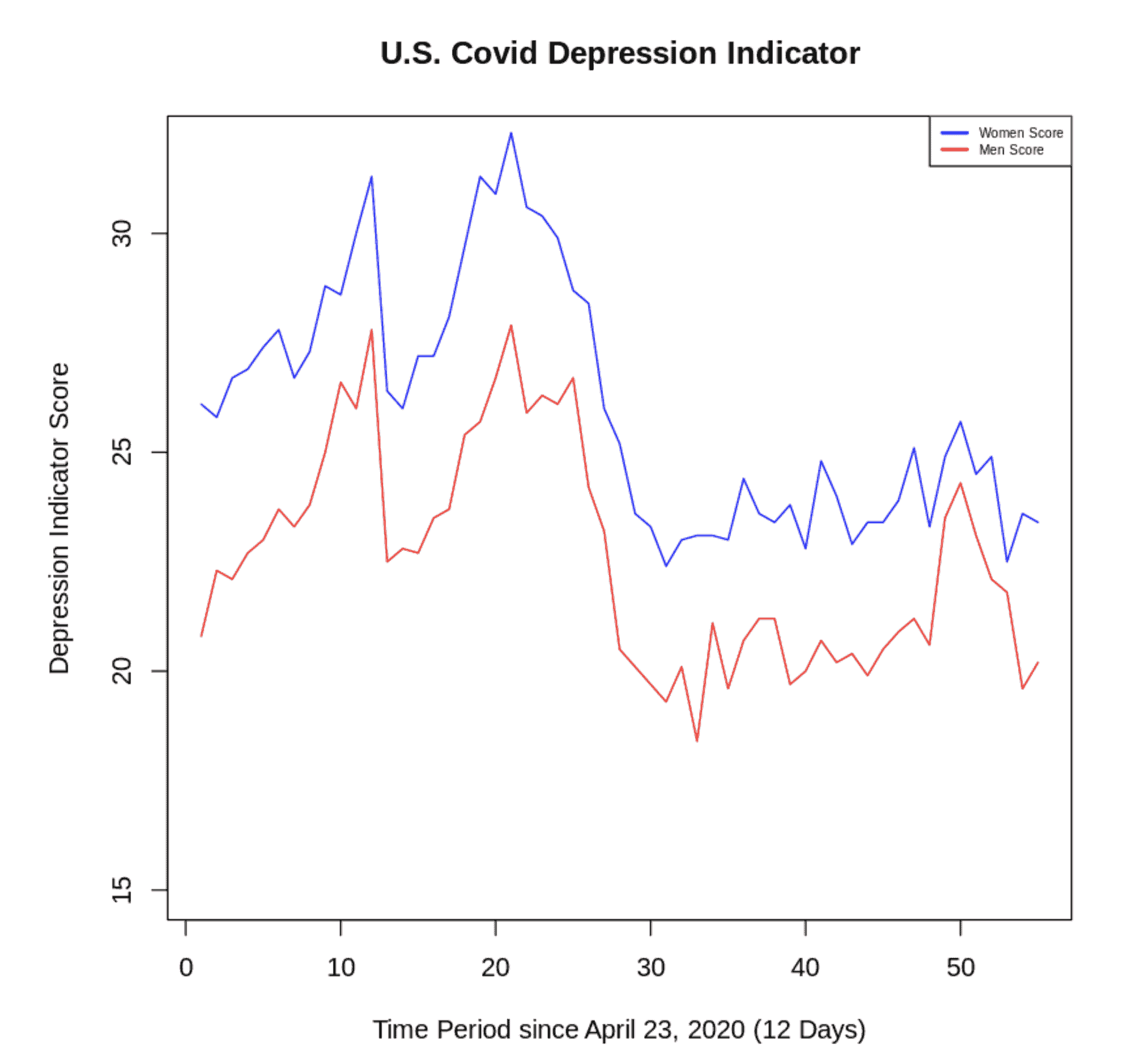
Line graph showcasing gender disparity in U.S. depression score from Coco’s research.

Line graph showcasing gender disparity in U.S. depression score from Coco’s research.


It turns out mental health disparity is not at all uncommon to women and girls all over the world. Research has shown that compared to men, women are three times more likely to encounter mental health issues, and this statistic has been growing. A study done across 73 countries discovered that this disparity is more pronounced among adolescents. Poor understanding of gender during the adolescent age of rapid physical changes causes girls to doubt their overall identity, leading to more serious mental distress. [Read more: ā€œWe’re almost never fineā€: Young people on girls’ mental healthā€]

From understanding to change-making

I was shocked by these statistics, and how many people don’t know the mental health challenges that girls are going through. As these numbers remain in academic journals, I want to bring awareness on gender disparity by delivering the statistics to the public. In order to investigate firsthand what causes this mental health disparity, I completed my own research on gender disparity in mental health during COVID-19. I analyzed the U.S. Household Pulse Survey data I found and built data models to study its correlation with COVID-19. Through the research, I found out that females are generally more impacted by the pandemic than males due to factors such as lack of decision-making power inside the household and lack of access to health care ā€œservices.ā€ This researchĀ inspired me to take actions to democratize knowledge on mental health inequity. With support and funding from Plan USA’s Youth Leadership Academy, I founded The Shield Initiative to combat mental health issues among youth with the medium of art therapy.

Why art therapy?

Art therapy emerged in the 1940s, gaining wider recognition by the 1970s. It’s a mental health profession aiding individuals to improve various aspects of their lives, using art to express emotions and address issues under professional guidance, facilitating understanding and discussion for effective problem-solving. I experienced my own journey with stress a few years ago, and came to realize that peers around me are often stuck in a mindset that stigmatizes rest-taking. Specifically, we don’t invest enough time for self-care, and, as a result, we build a work-life schedule that is prone to stress–related issues. Practicing art since kindergarten and experiencing the power of creativity made me realize that what we need is simply a lifestyle that invests time and value in healthy resting. We need to educate young people on the importance and necessity of incorporating this type of practice into our schedule. What better way to do that than bringing art into our journey with mental health?

What we’ve done with Shield

The two important missions we’ve been trying to achieve with Shield are: 1) to create awareness of the gender disparity in mental health data; and 2) to lead art therapy workshops with youth globally to alleviate mental health crises. During the summer of 2023, in my hometown, Shanghai, I curated an exhibition to highlight the mental health impact of COVID-19 through data visualization. The exhibition was called ā€œA Weaving Mess,ā€ to capture the complexity of emotions and the fact that even negative emotions cannot be neglected by our society. The exhibition has seven installation pieces consisting of data visualizations made by yarn.

 

Coco poses for pictures with a group of people at the opening ceremony for her curated exhibition, ā€œA Weaving Mess,ā€ in Shanghai.

Line graph showcasing gender disparity in U.S. depression score from Coco’s research.


I exhibited the gender inequity dataset I found during my independent research to call attention to mental health disparity. Along with the major dataset, we included more detailed statistics on gender inequality to explain this phenomenon, such as the hours of household chores females had to complete compared to males during quarantine, or the number of girls that dropped out of school due to the pandemic. The first step of change-making is to shed light on the existing inequity. Through the exhibition, we wanted to tell a story through numbers. In addition, we collected mental health data from the Shanghai population to highlight these mental health statistics.
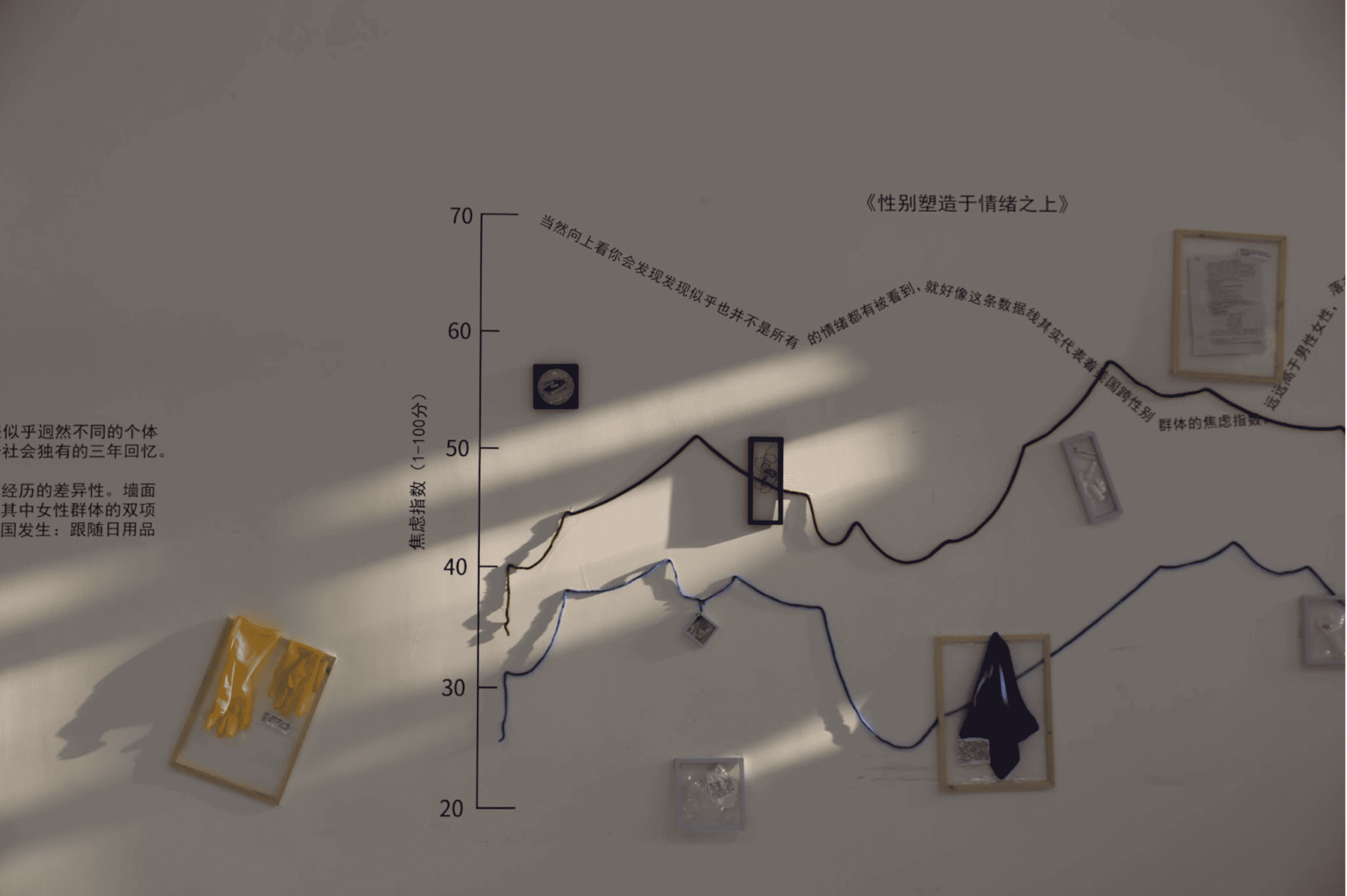
 

Coco’s curated exhibition featured an installation named ā€œGender over Emotions.ā€Coco’s curated exhibition featured an installation named ā€œGender over Emotions.ā€


“The first step of change-making is to shed light on the existing inequity.”

The Shield Initiative also advances progress toward a more equitable mental health experience by leading art therapy workshops. With a special focus on addressing gender disparity, I decided to take Shield’s first step in my current high school — an all-girl school. On Valentine’s Day, we organized a self-appreciation flower-folding workshop, where participants first filled in an appreciation worksheet to help them think about things they love about their body, spirit and energy. Then, we worked on flower–folding, and put each thing we love about ourselves on a petal of the paper flower. We voluntarily started to fold appreciation flowers for each other, and eventually gathered a pile of paper flowers by the end of the workshop. Inspired by the positive changes this workshop produced on my local campus, we decided to expand Shield’s reach to more campuses, youth communities and countries. Now, Shield works in 15 schools and organizations in seven countries. The types of workshops Shield has led include:

  • A ring-making workshop on female empowerment in Shanghai.
  • A playback theater workshop on visualizing participants’ emotions.
  • A flower-making session on self-appreciation.
  • A rock-painting workshop.
  • An outdoor painting and meditation workshop.
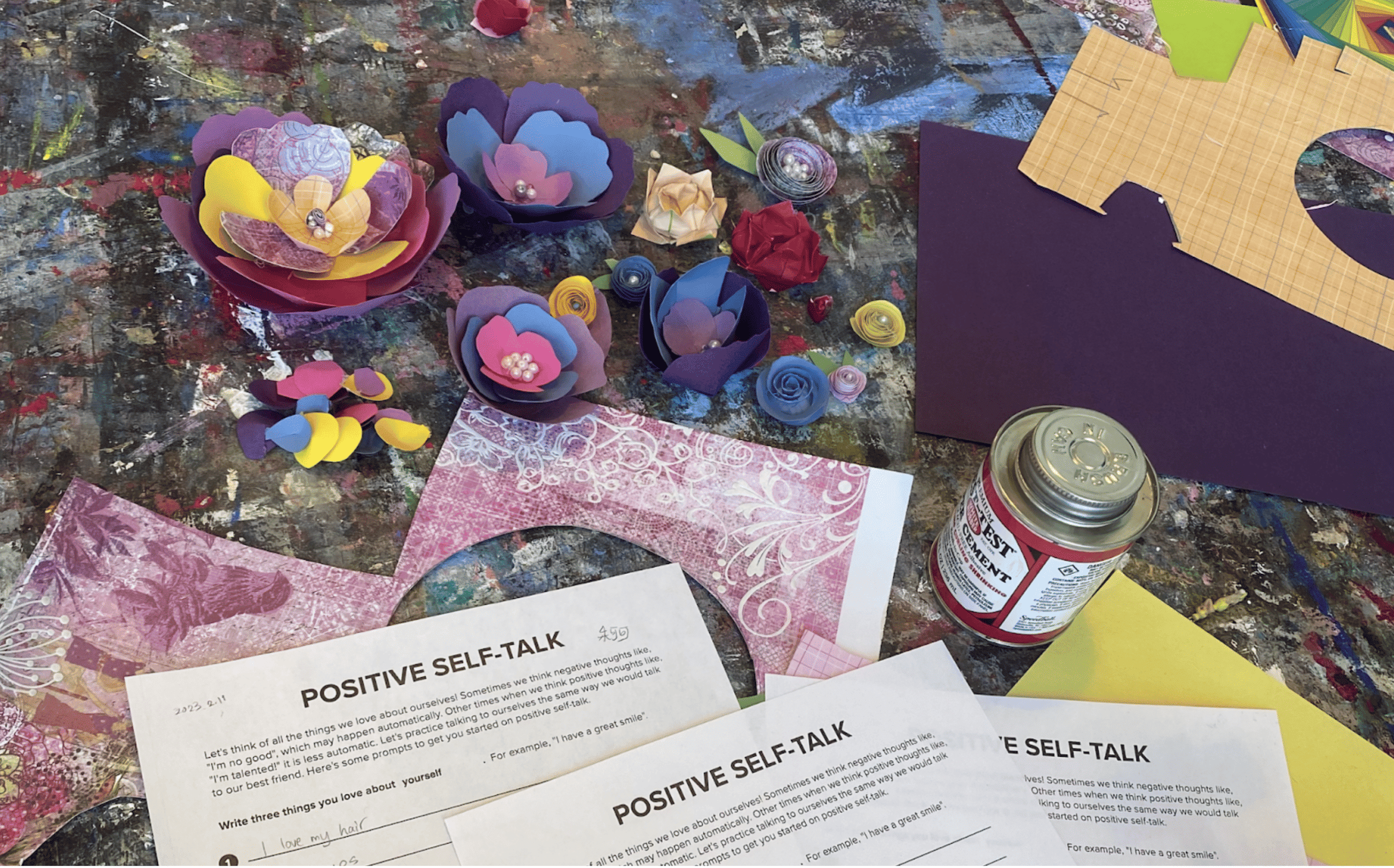
 

The Shield Initiative holds a flower-making self-appreciation workshop.The Shield Initiative holds a flower-making self-appreciation workshop.


From healing, moving forward Leading various workshops made me realize the power of seeing and being seen in the process of healing emotions, as well as the importance of having a connective community that supports one’s mental wellness. Moving forward, I encourage everyone to make art when you are struggling mentally. Here are some small art projects that can be easily done at home:

  1. Mandala drawing: Create a mandala, a circular geometric design, using paper and colored pencils, markers or paint. Start from the center and work outward, allowing the design to evolve spontaneously. Mandala-drawing promotes relaxation, mindfulness and self-expression.
  2. Painting emotions: Use colors to paint how you’re feeling. Choose colors that resonate with your emotions at the moment and let them guide the strokes and shapes on your canvas or paper.
  3. Music painting: Play a meditating soundtrack and draw how you feel during the song on a piece of paper. This is a great way to visualize emotions and to practice being conscious of your own feelings.

Try these techniques out! You can send a picture of your creation to our Instagram account to be posted on Shield. Painting not only helps us to heal and express our emotions — we can also paint for activism, so that girls’ emotions are seen through the art we make. I will continue the journey of advocating for mental health equity. With a paintbrush in hand, I am no longer afraid to make my voice heard.


Inside this issue, you’ll see how your support made a difference in 2023, and read about some of the incredible accomplishments made possible through Plan USA’s We Are the Girls campaign over the past five years. You’ll discover why we’ve joined forces with Paramount to launch 8M Infinito, a campaign that seeks to promote gender equality and make women’s and girls’ rights visible throughout the year. And you’ll hear from four young women fighting to ensure all girls are free to reach their full potential.

Cover of the report Your Impact: Winter | Spring 2024