Search Results

Search results for

0 result(s) found

Why education in emergencies matters

When conflict breaks out, when hunger spreads, when disasters strike, one of the first things children lose is school. Yet education is more than a classroom. It is protection, stability and the foundation for recovery, especially during conflict and crisis. And when we talk about protecting schools, we are really talking about keeping education going, even in the toughest places.

Globally, 224 million school-age children living in crisis-affected countries need education support. Of these, 72 million are completely out of school, while another 127 million are in classrooms but not learning at even the most basic levels. Still, children and families show extraordinary determination to hold on to learning. Because every child deserves the chance to build a better future — no matter the crisis.

That’s why the United Nations established Sept. 9 as the International Day to Protect Education from Attack. Schools should be safe havens, not targets. And education must never be used as a weapon or sidelined in emergencies.

At Plan International, we work with children, families and communities to make sure learning continues — from temporary classrooms to school kits to long-term research on girls’ lives.

Here are five examples of how conflict and crisis are disrupting learning and what we’re doing to fight back.

1. Gaza: Education interrupted by airstrikes

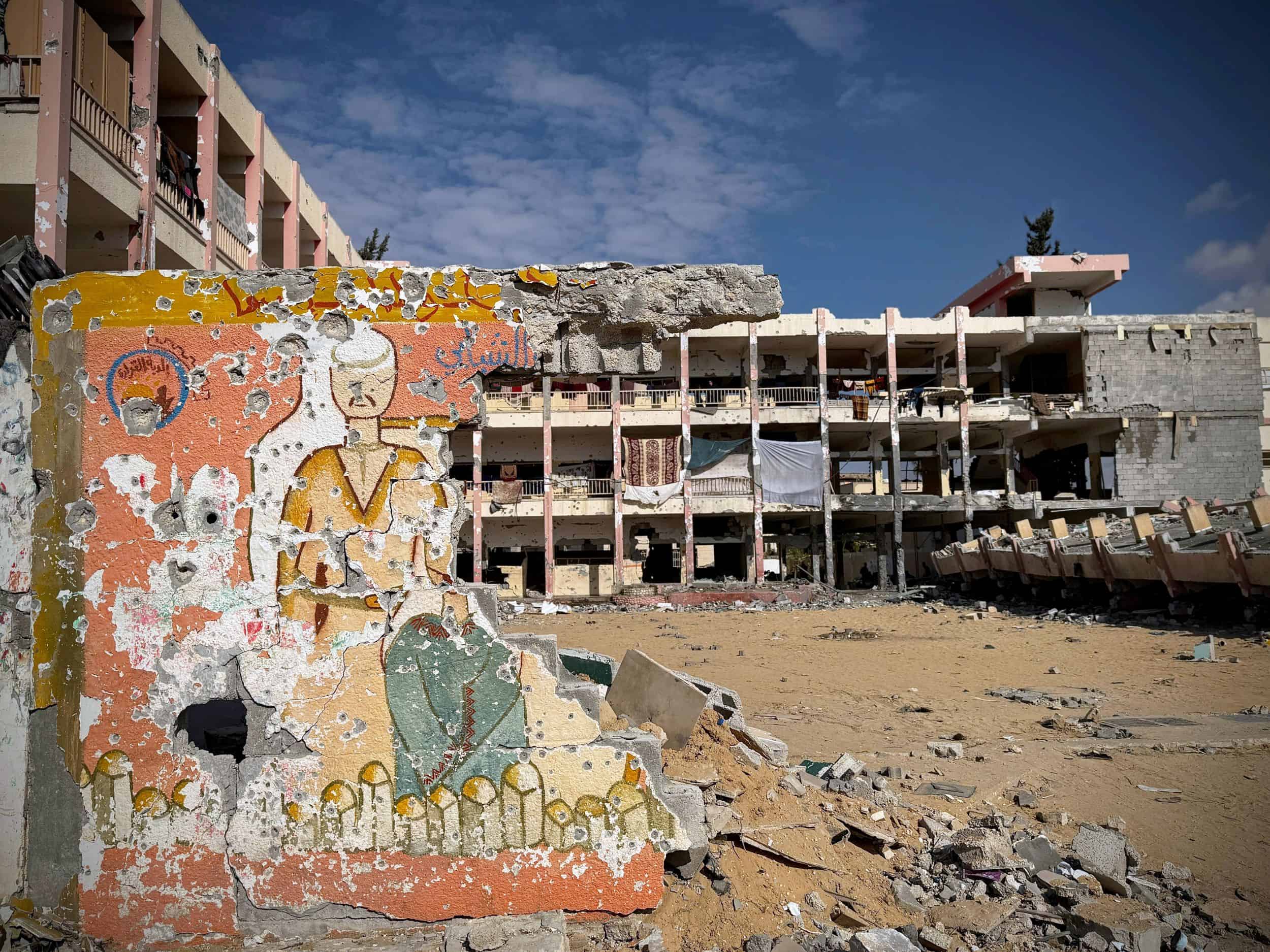
In Gaza, schools lie in ruins after months of airstrikes. Families say their children are desperate to return to learning — not just to keep up with lessons but to reclaim a sense of normal life.
A bomb-damaged school in Gaza
Education should never be a casualty of war. In Gaza, nine out of 10 schools have been damaged or destroyed, with many turned into shelters for displaced families. | Ā© Plan International, Ahmed Salama

Plan and partners have set up temporary learning spaces so 500 children can continue their education, play and begin to heal. In the weeks leading up to this, we also reached nearly 100,000 people with hot meals, dignity kits and clean water — urgent support that helped families survive long enough to think about schooling again.

2. Sudan: Displacement can’t stop learning

Sudan is now the world’s largest displacement crisis. In Gedaref state, more than 1 million displaced people have arrived, overwhelming already stretched schools. Families who lost everything in the conflict want only one thing for their children: to keep learning.

To help, 1,000 displaced children recently received school kits — each containing a bag, pens, pencils, notebooks and basic supplies.
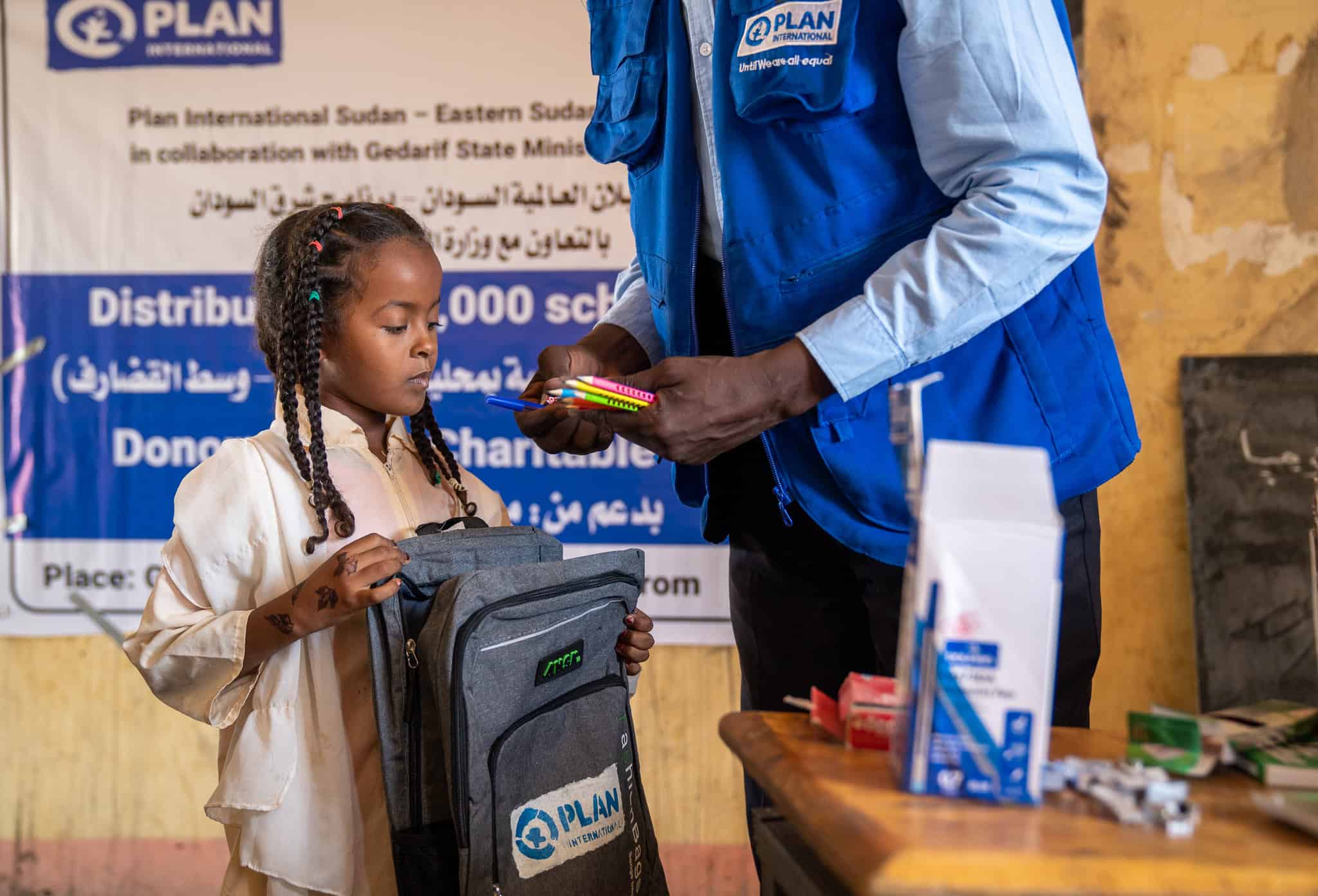
A girl in Sudan receiving school supplies
A girl in Gedaref, Sudan receives a school kit from Plan International, helping children continue learning despite conflict and displacement. | Ā© Plan International, Abdelrahman Justen

ā€œDespite not having pens, paper and textbooks, we have seen determined teachers volunteer in their communities to ensure that children can keep learning, even through this brutal conflict.ā€

— Mohamed Kamal, Sudan country director, Plan International

In crises like Sudan’s, girls often face the steepest barriers — including caregiving burdens and early marriage — that keep them out of school.

3. Myanmar: Earthquake recovery through learning

On Mar. 28, 2025, a massive earthquake struck central Myanmar, destroying nearly 4,000 schools and displacing more than 200,000 people. Children were left in shelters and open spaces, afraid and cut off from routine.

Nan, 23, remembers what it felt like. ā€œI was quite scared when it happened. I had never experienced anything like it before. I didn’t expect an earthquake like that.ā€

Instead of dwelling on fear, Nan chose action. ā€œRather than dwelling on this, I should overcome it and focus on the things I can do for my future.ā€ Today, she volunteers at a child-friendly space in Mandalay, helping children recover through play and learning.
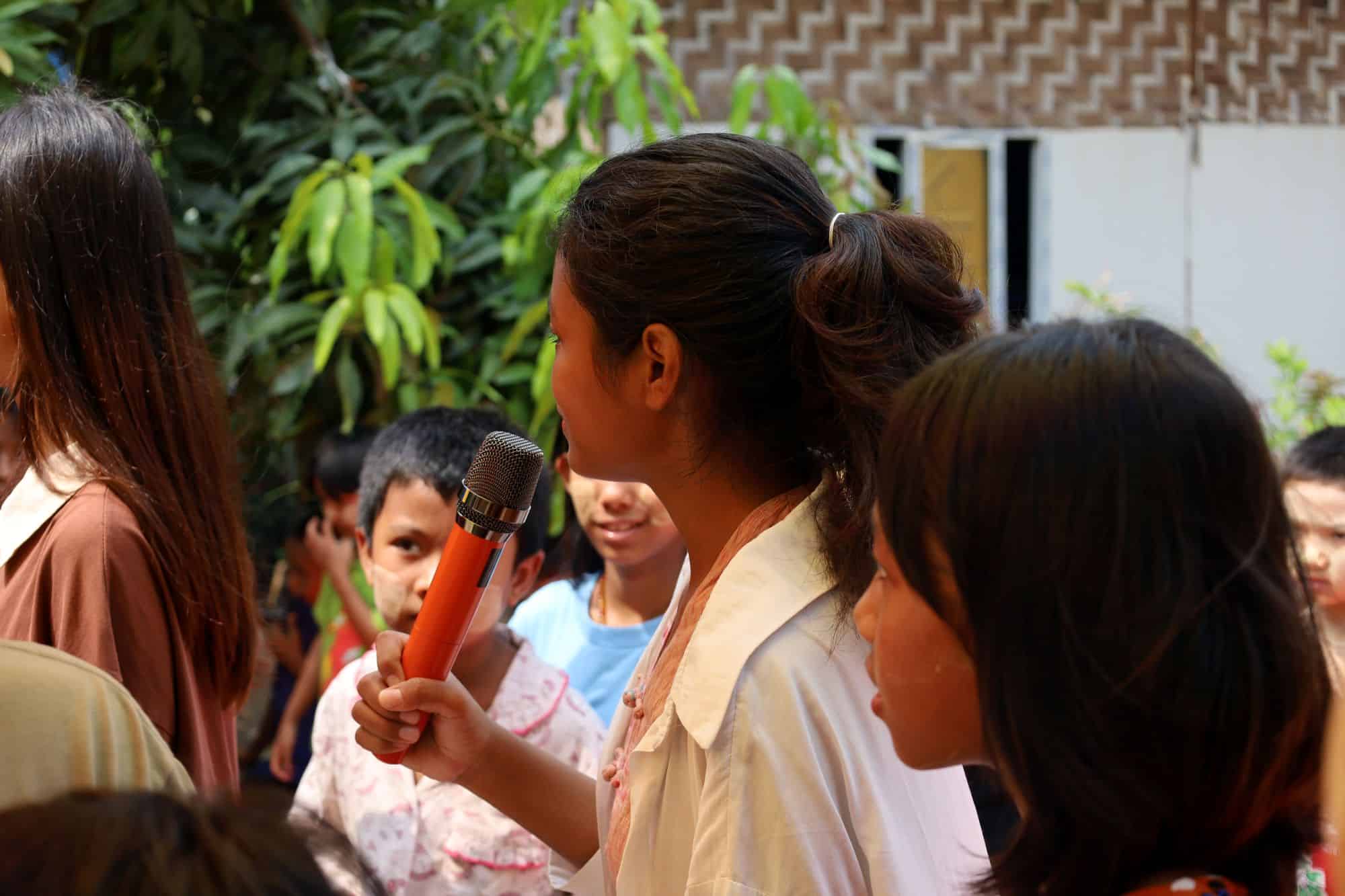
Nan, Myanmar volunteer with children
Nan*, 23, volunteers at a child-friendly space in Mandalay, Myanmar, supporting children after the earthquake. | Ā© Plan International, Plan staff

ā€œAt the child-friendly space, I registered the children and their parents. We read poems to them. We played games with them.ā€

4. Ethiopia: Hunger’s hidden toll on education

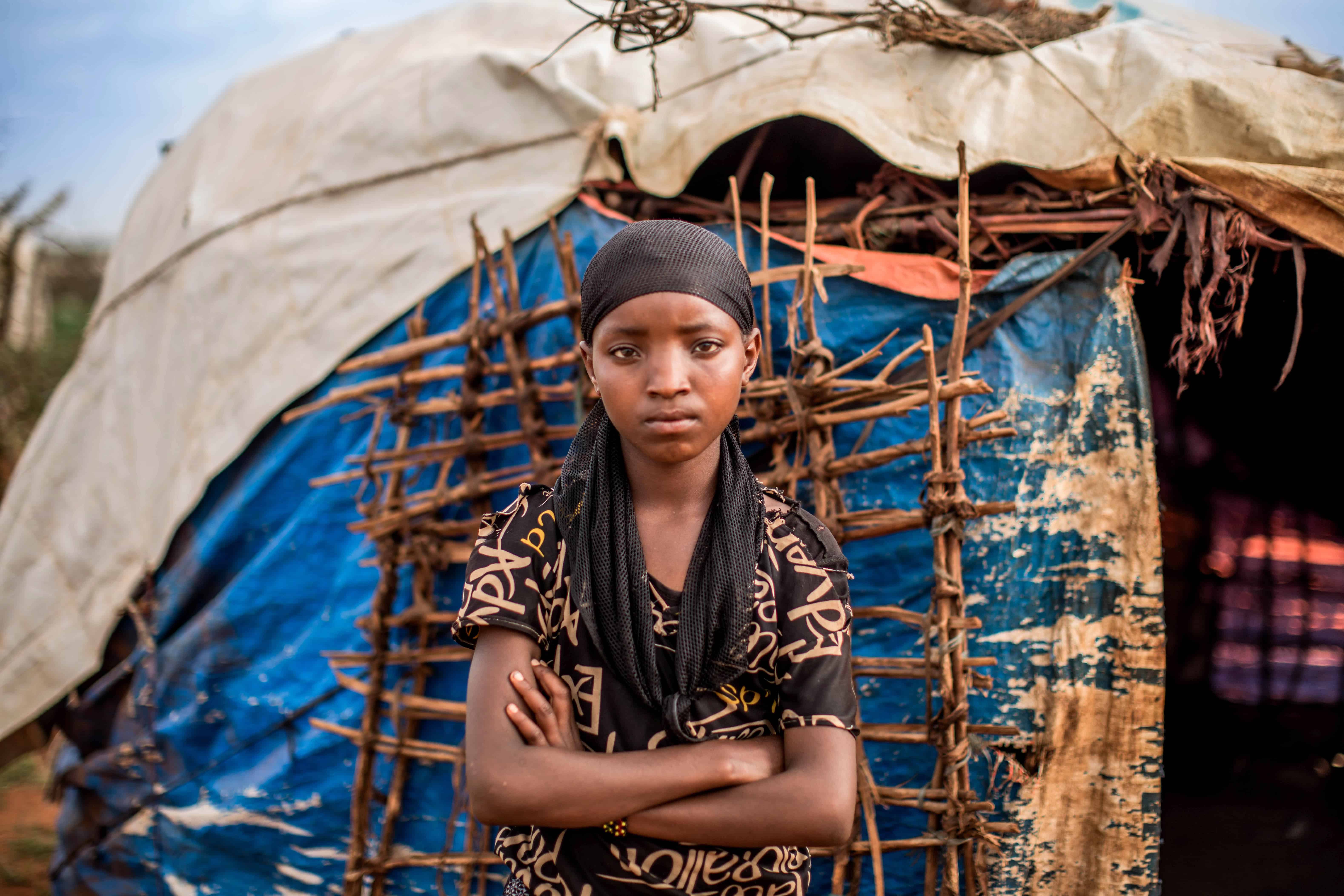
In Ethiopia’s Borena Zone, drought killed crops and cattle, leaving families without food. For 11-year-old Dabo, it also meant leaving school.

ā€œI feel hungry and sad when there is no food at home. We don’t have food, so we are hungry every day. When there is no food, I feel faint and very tired. Hunger changes people’s lives and doesn’t make anyone happy.ā€ — Dabo, 11-year-old girl, Ethiopia

Dabo, Ethiopia
Dabo, 11, left school three years ago when her family could no longer afford supplies and food. She dreams of returning to class in Borena Zone, Ethiopia. | Ā© Plan International, Izla Bethdavid

Her neighbor Liban, a mother of six, knows the same struggle.

ā€œMy daughter, who is deaf, is supported by Plan to go to school. She received a school bag, pens and books, and a torch so she can study. If it wasn’t for Plan, she wouldn’t be able to go to school.ā€ — Liban, 37-year-old mother, Ethiopia

Liban's daughter in Ethiopia
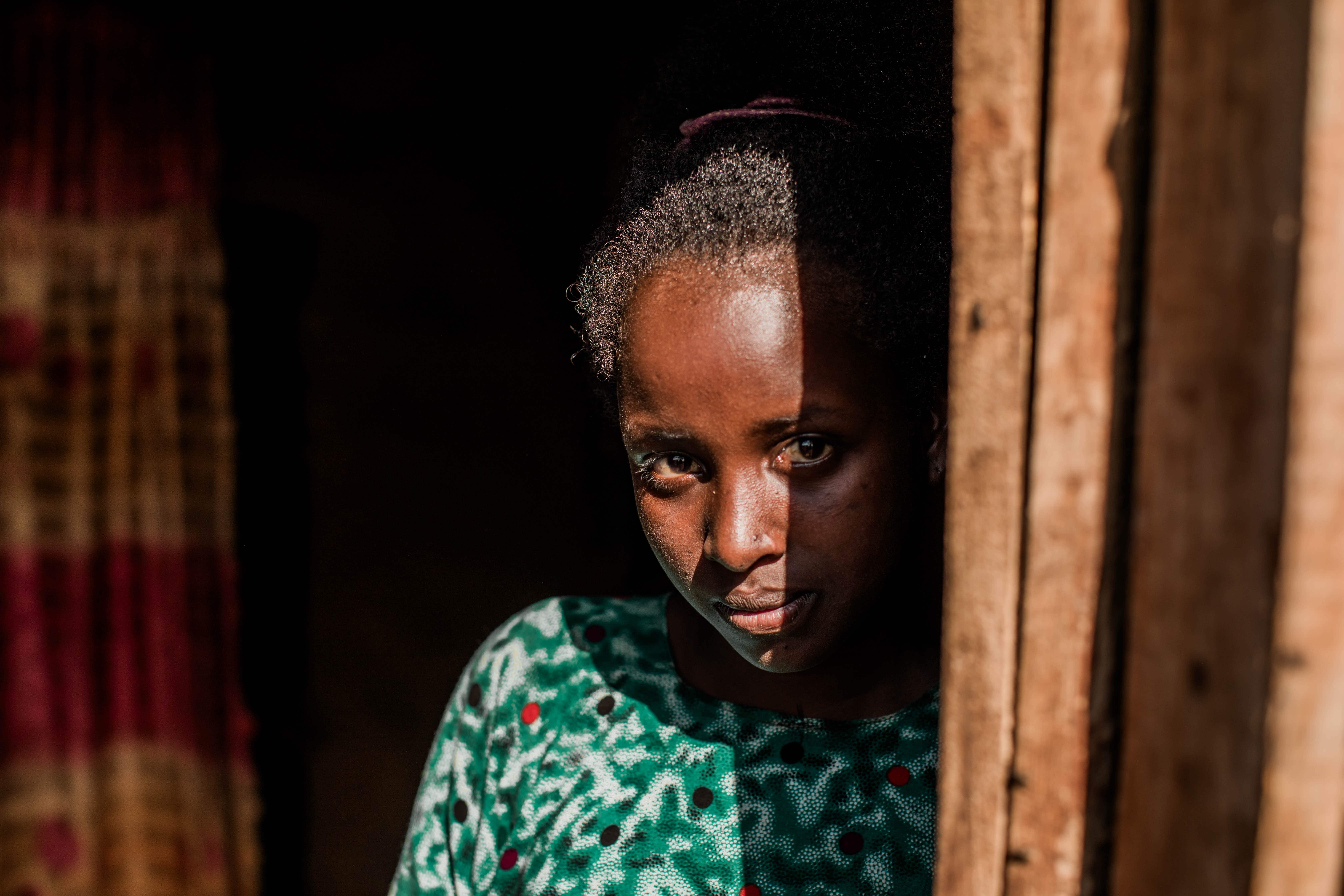
Liban’s daughter, Dabo, 14, who is deaf, is supported by Plan International with school materials so she can continue her education in Borena Zone, Ethiopia. | Ā© Plan International, Izla Bethdavid

5. Global trends: Girls at highest risk of school dropout

When education is disrupted — whether by conflict, poverty or disaster — girls are often the first to lose their chance to learn:

  • Out-of-school risk: Girls in crisis-affected areas are nearly 2.5x more likely to be out of school.
  • Violence link: In Plan’s Real Choices, Real Lives study, 91% of girls reported experiencing violence, often in or near school.
  • Child marriage: According to Plan’s State of the World’s Girls 2024 report, over half of surveyed girls had missed school due to conflict, with many forced into marriage.

Why we must protect schools as safe havens

From the rubble of Gaza to the displacement camps of Sudan, from Myanmar’s earthquake recovery to Ethiopia’s hunger crisis, one truth is clear: children refuse to give up on learning.

And the threat isn’t limited to conflict zones. Around the world, even in wealthier countries, education is under pressure. Abrupt foreign aid cuts and shrinking domestic budgets put children’s futures at risk.

Children and their families are fighting to hold on to learning. Our responsibility is to stand with them — and to protect education from attack, neglect and disruption.

We’re calling on you to take action, because every child deserves the chance to learn, lead, decide and thrive.


Help protect a child’s education


FAQs: Protecting education from attack

Q: What does it mean to protect education from attack?

A: It means ensuring schools remain safe spaces during conflict or disaster, free from military use or violence.

Q: Why are girls more affected in education emergencies?

A: Girls face higher risks of child marriage, early pregnancy, and violence when schools close, making them 2.5 times more likely to drop out than boys.

Q: How does hunger impact learning?

A: Hunger forces children to leave school and prevents them from concentrating. Families often must prioritize survival over education.

Q: Why is uninterrupted learning so important?

A: It provides safety, routine, and hope. Education is as vital in emergencies as food, water, or shelter.

Q: What can I do to help protect schools in crisis zones?

A: You can advocate, share their stories, and donate to Plan’s education in emergencies programs that help children continue learning.
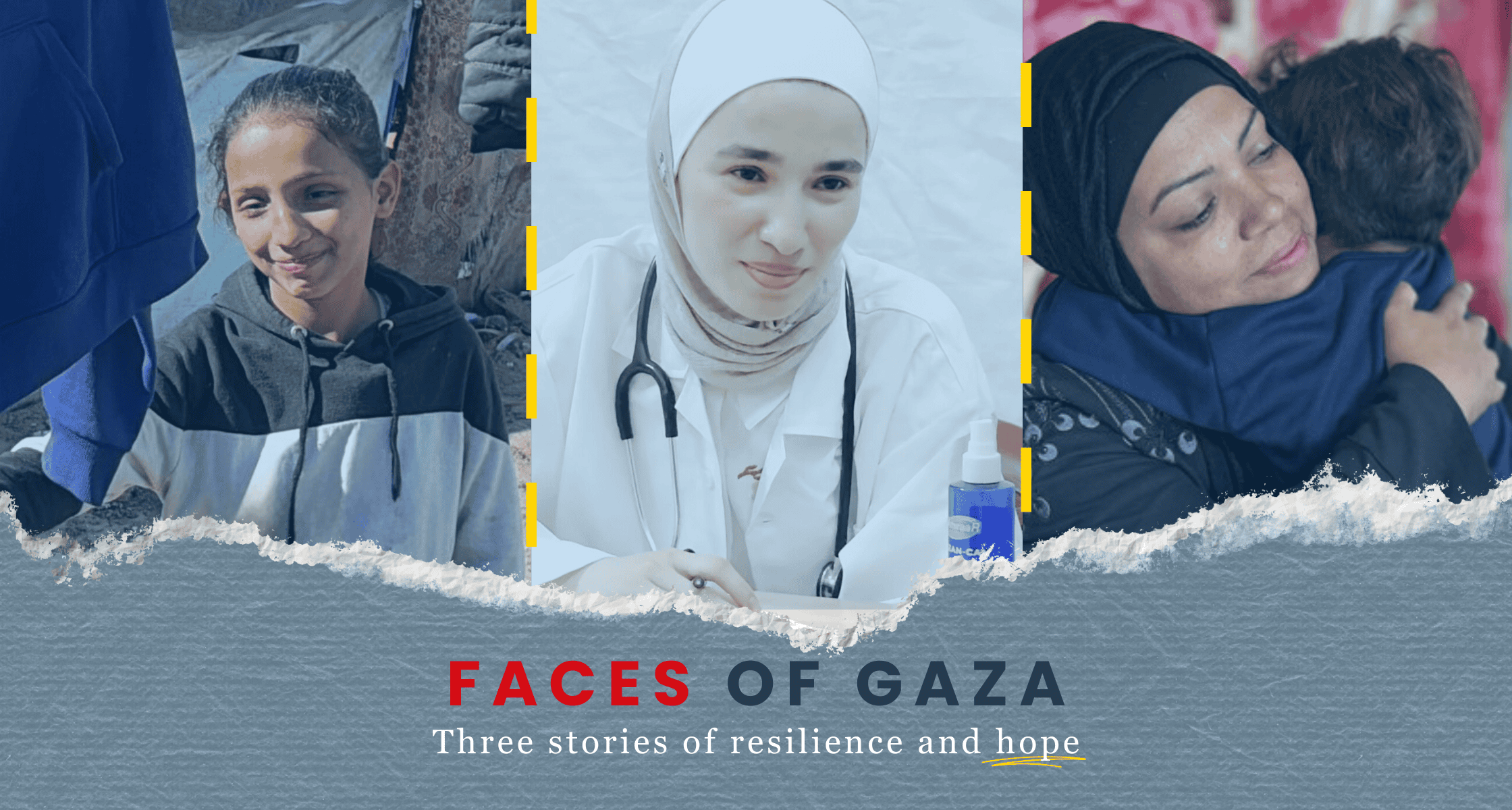
A composite image showing three people in Gaza: a young girl smiling in a hoodie, a woman doctor in a white coat with a stethoscope, and a mother hugging her child. The text overlay reads: ā€œFaces of Gaza — Three stories of resilience and hope.ā€

In Gaza, daily survival has become a race no one should ever have to run. Families cling together as bombs reduce schools and neighborhoods to rubble. Parents risk their lives just to stand in line for bread. Crowds push and scramble in desperation to reach humanitarian aid, knowing they could be shot on the way. For Gaza’s children, this daily race for survival means lost childhoods, lost classroom education, and lost futures.

It’s been likened to a scene from The Hunger Games, except this isn’t fiction. This is real life for millions of children and families in Gaza.

Faces of Gaza

Behind every headline are children still dreaming of classrooms, mothers determined to keep their families safe and doctors who refuse to stop fighting for life.

Hope in Gaza has many faces: Asmaa, who writes poems by candlelight; Dr. Walaa, who heals children in collapsing hospitals; and Latifah, who carries her family forward after unimaginable loss.

Asmaa’s dream: A girl’s fight for education in Gaza

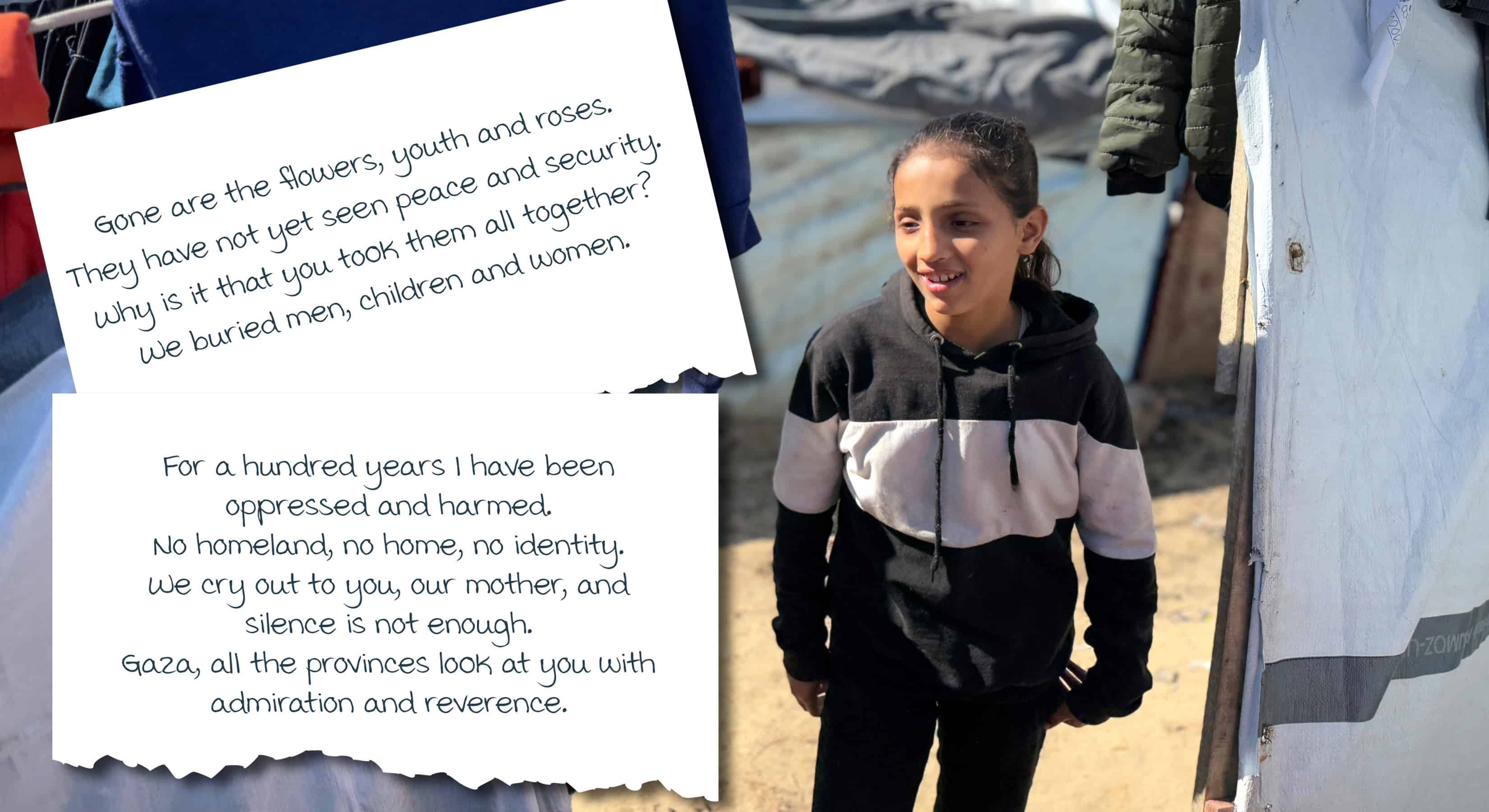
For 12-year-old Asmaa, dreams come alive in poetry. She writes about the sky, her future and the hope she refuses to let go of.

Before the war, school was her favorite place. She loved her Arabic lessons, playing with friends during recess and helping her younger siblings with homework. She dreamed of becoming a writer — maybe even a poet whose words would travel the world.

Asmaa, 12, lives in a displacement camp in Gaza. She dreams of returning to school and one day becoming a poet. | Ā© Plan International / Ahmed Salama

Now, her classroom is gone. Her family lives in a crowded displacement camp, where electricity has been cut for months. She studies by candlelight, her schoolbooks worn thin from the dust and damp. Outside, the sound of shelling rattles her window. Inside, she keeps scribbling verses on scraps of paper, determined to hold on to her education.

ā€œEducation is the only thing that no one can take away from me.ā€

— Asmaa, 12, Gaza

She still dreams of returning to school one day: of graduating, publishing her poems and telling her story to the world. Even in the middle of destruction, Asmaa finds words of hope.

Dr. Walaa’s mission: Healing children in Gaza’s collapsing hospitals

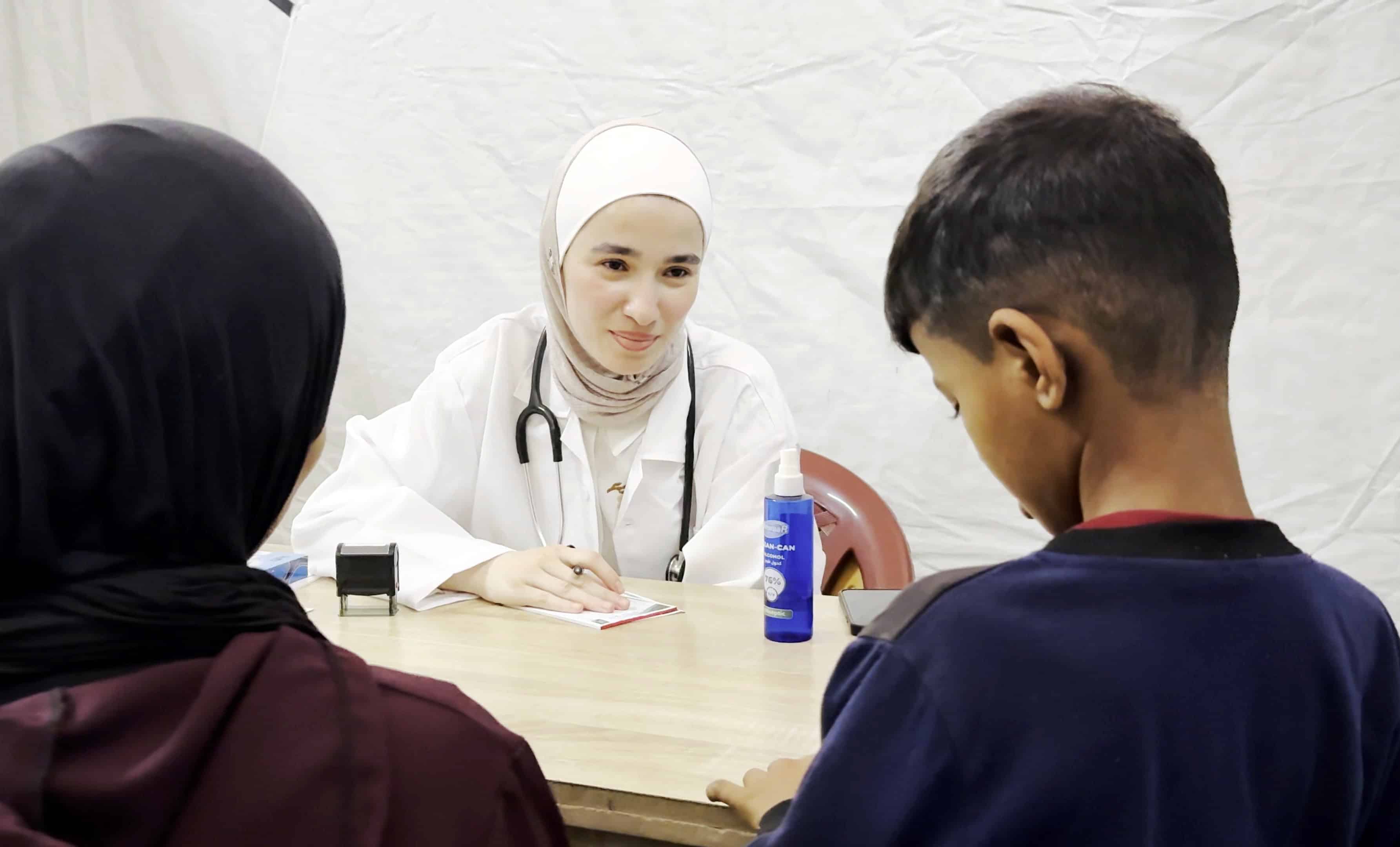
Dr. Walaa Wissam Abu Samra has spent her life working to protect children’s health in Gaza. Before the war, she was a pediatrician who dreamed of opening her own practice — a safe place where parents could bring their children for care.

Now, that dream feels impossibly far away. Every day she walks into overcrowded hospital corridors lined with children lying on the floor because there are no more beds. Supplies are nearly gone, and even the simplest medicines are out of reach. Still, she refuses to leave.

ā€œI have treated children with burns, shrapnel wounds and starvation,ā€ she says. ā€œOne father held my hands and cried because I couldn’t save his son. I will never forget his face.ā€

Dr. Walaa Wissam Abu Samra tends to children in Gaza’s overcrowded hospitals despite extreme shortages.

Dr. Walaa Wissam Abu Samra continues treating patients in Gaza despite extreme shortages of doctors, medicine and safe facilities. | Ā© Plan International

ā€œWe need the world to stand with us. Gaza’s children cannot survive this alone.ā€

— Dr. Walaa, Gaza

For Dr. Walaa, the future is uncertain. But as long as there are children who need her, she will continue to fight to keep them alive — one patient and one family at a time.

Latifah’s strength: A mother’s fight to protect her family in Gaza

Before the war, Latifah’s days were filled with simple joys like cooking meals for her husband and five children, watching them play and planning for their future together.

That life suddenly ended when an airstrike killed her husband and two of her sons. ā€œMy husband and two of my sons were killed in an instant. My world collapsed that day,ā€ she recalls.

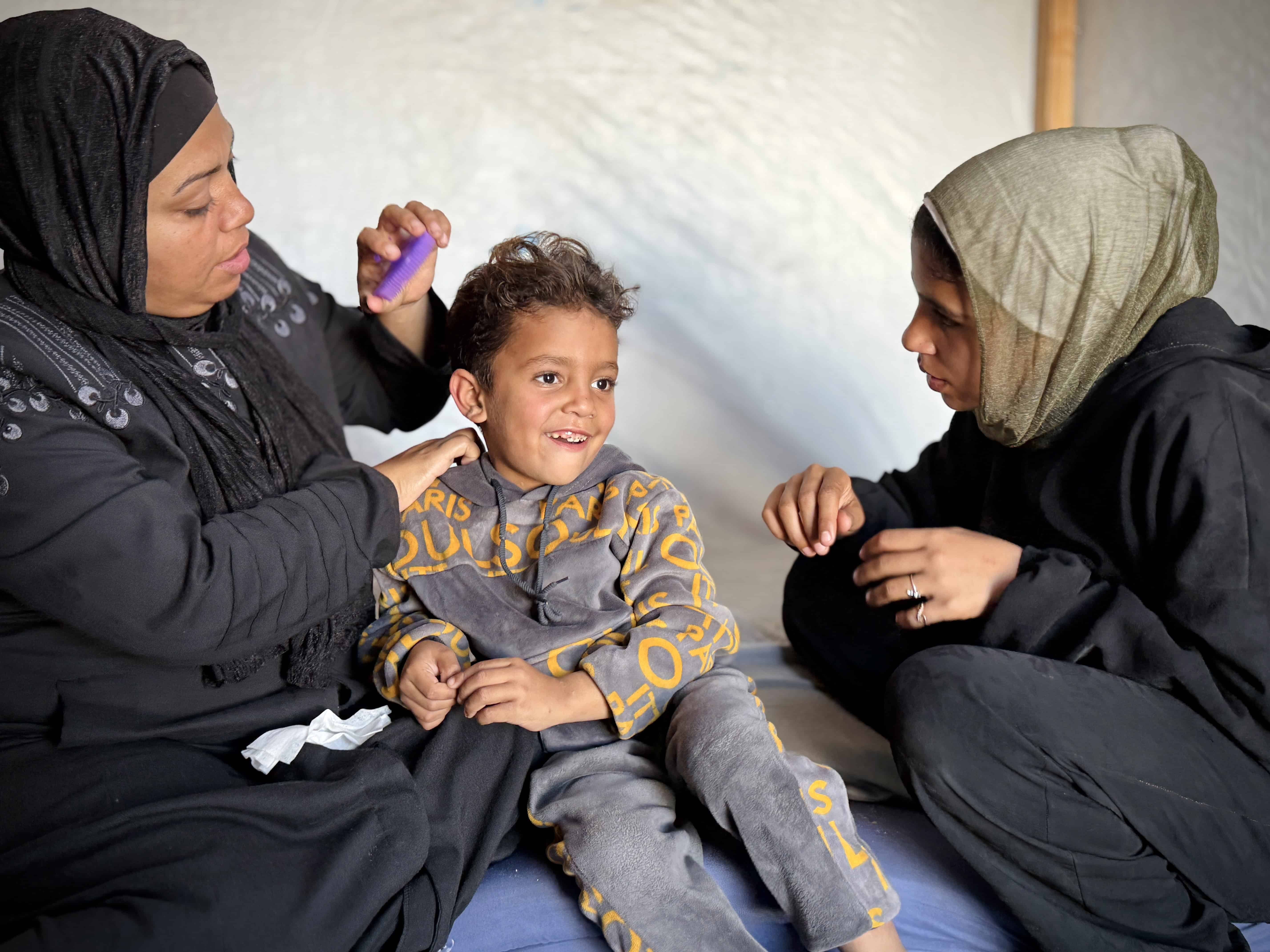
Latifah, a widowed mother of three, sits with her children in a crowded displacement shelter in Gaza.

In Rafah, Latifah, a widowed mother of three, faces unimaginable loss while fighting to protect and provide for her children amid Gaza’s ongoing crisis. | Ā© Plan International / Ahmed Salama

Now, in a crowded displacement shelter in southern Gaza, she struggles to care for her three surviving children. Every day is a test of strength. They share cramped rooms with other families, stretching the little food they receive as she shields her children from the chaos outside.

ā€œI have to stay strong for them. But I feel empty inside.ā€

— Latifah, Gaza

More than statistics

These are not just numbers on a page. They are children still determined to learn, doctors pushing past exhaustion to save lives with what little they have and parents fiercely fighting to protect their families. Each one carries dreams, hopes and goals — just like any of us.

Yet what they long for most is the simple safety of a home. And every day, their lives hang in the balance.

How you can help families in Gaza

Every child matters. Every truck matters. Every hour matters.

Your gift today will give children food when they’re hungry, medicine when they’re sick and clean water when they’re thirsty. It will provide dignity kits that restore safety and comfort, and help keep children in school so they can hold on to routine, community and hope.

Donate now to support children in Gaza


A crisis children can’t escape

For nearly two years, Gaza’s children have been living through the unthinkable. They have endured bombings, rapid displacements and the constant fear of losing everything. Homes and schools lie in rubble and entire neighborhoods have been erased. Families are starving. Hospitals are overwhelmed. Parents tell us their children go to bed hungry, and some whisper that they would rather die than endure another day without food.

More than half of Gaza’s population is under 18. Children make up a heartbreaking share of the casualties, and those who survive face hunger, trauma and disease every single day.

Earlier this month, the Integrated Food Security Phase Classification, the global authority on hunger crises, officially declared that famine is now gripping Gaza City, affecting more than half a million people, with numbers expected to rise to over 640,000 by the end of September. It is a catastrophic, man-made crisis.

Why getting aid to children in Gaza is so difficult

The world has sent trucks filled with food, medicine and clean water, but many are stopped at the border or delayed for days. Restrictions, destroyed roads and ongoing airstrikes make it nearly impossible to get aid to families when they need it most. Parents tell us they risk their lives just to collect bread, as even aid distribution points have been struck, leaving people injured or killed. Even humanitarian offices have been bombed and aid workers themselves are among the casualties.

And yet, despite the danger and delays, Plan and our partners have managed to get life-saving supplies into Gaza, proving it can be done. With more resources, we could deliver much more, much faster.

A bomb-damaged school in Gaza with a bullet-riddled mural of children in the foreground and a partially destroyed building in the background.

Education should never be a casualty of war. In Gaza, nine out of 10 schools have been damaged or destroyed, with many turned into shelters for displaced families. | Ā© Plan International / Ahmed Salama

How Plan is responding to the humanitarian crisis in Gaza

Plan International is on the ground, working with trusted local partners. Despite the obstacles, we have reached nearly 98,000 people with food, water, medicine and psychosocial support in just three weeks. Working closely with our partners in Egypt and Jordan, we have been able to get trucks into Gaza and critically needed aid into the hands of children and families.

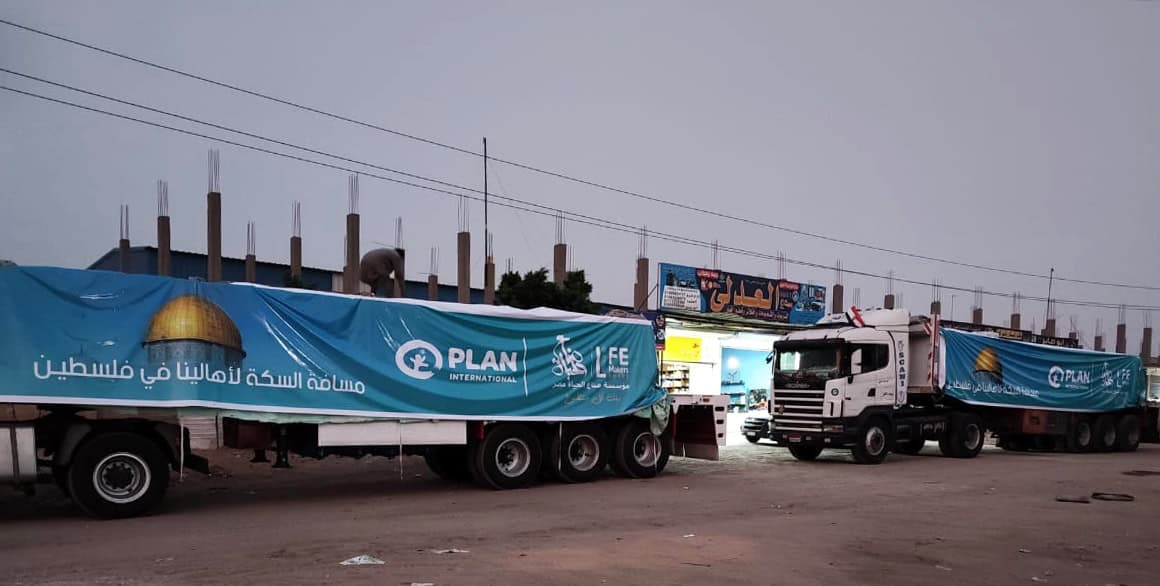
Two large trucks in Gaza covered with Plan International banners deliver food baskets to families as part of emergency humanitarian aid.

Ten trucks carrying 11,250 food baskets have crossed into Gaza, reaching 45,000 people with three days of rations. Another 14 trucks with thousands more baskets are prepared and awaiting entry. | Ā© Plan International

We are also setting up temporary learning spaces so children can continue their education, even in tents. Education in emergencies is more than lessons, it is lifesaving. It provides children with safety, routine and hope in the middle of chaos. For girls especially, staying in school reduces the risk of early marriage, exploitation and gender-based violence. For every child, it builds resilience and protects their future.

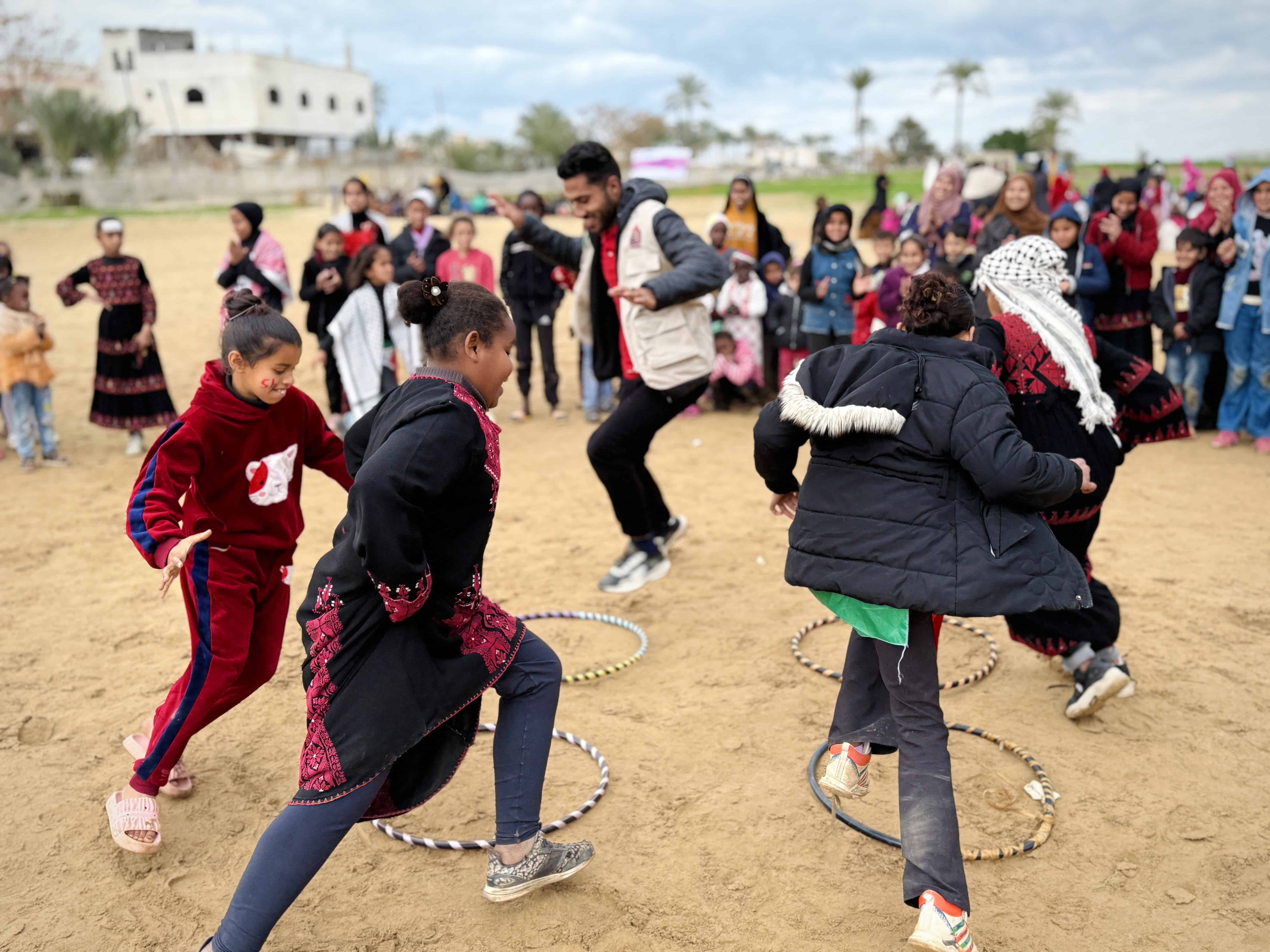
Children in Gaza play an outdoor game with hula hoops in a group activity, supported by Plan International safe spaces for displaced families.

Children in Deir al-Balah, Gaza, take part in play-based activities in safe spaces created to help them cope with trauma and rebuild a sense of childhood. | Ā© Plan International / Ahmed Salama

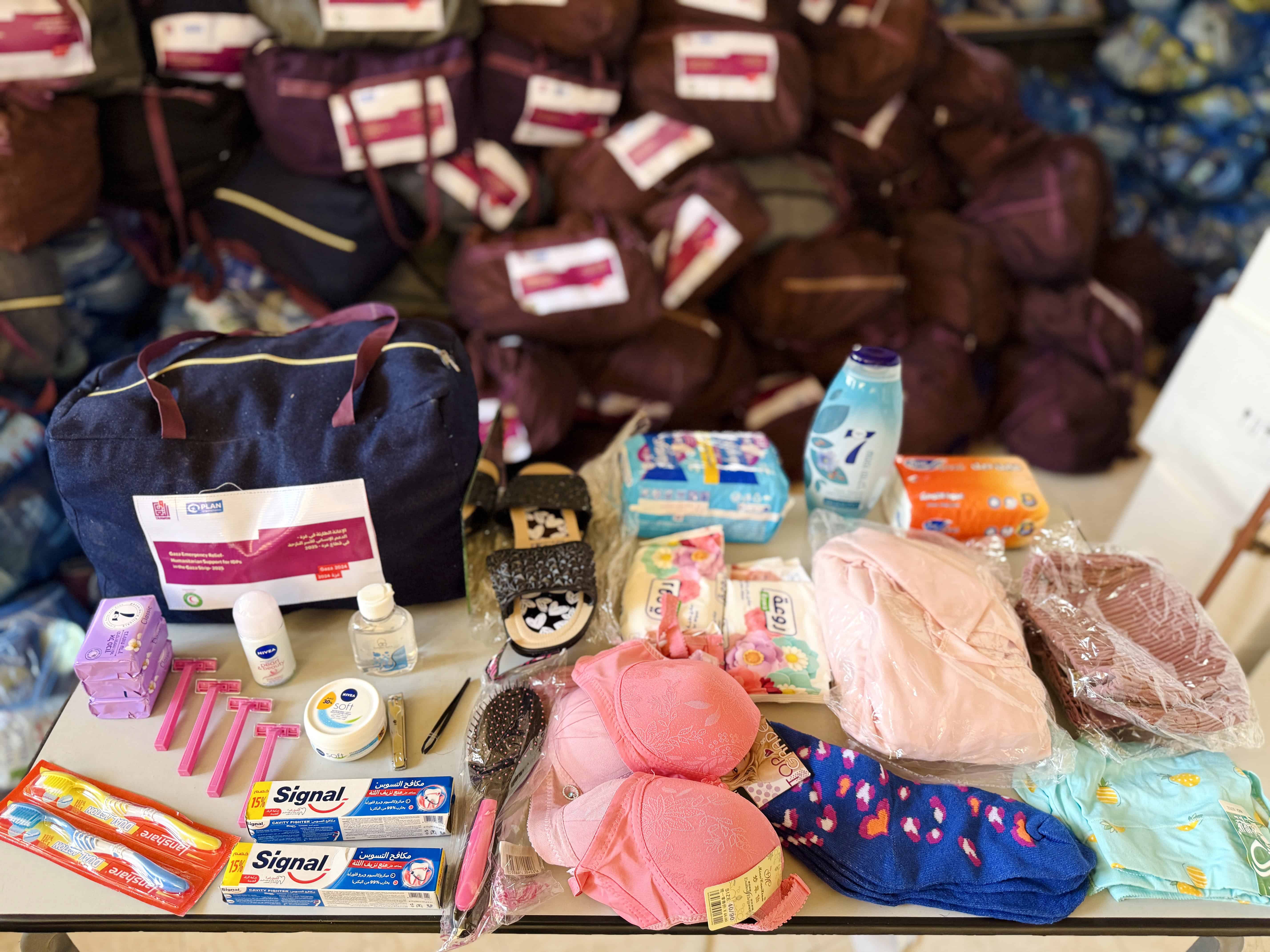
We are distributing dignity kits filled with essentials like soap, sanitary pads, toothbrushes, underwear and slippers. For women and girls who have lost everything, these kits offer safety, comfort and a small sense of normalcy in the chaos.

A table displays hygiene kit items in Gaza, including soap, sanitary pads, toothpaste, slippers, clothing and other supplies, with packed kits stacked behind.

Plan distributes hygiene kits in Gaza, including soap, sanitary pads, toothpaste, clothing and other essentials for displaced families. | Ā© Plan International / Ahmed Salama

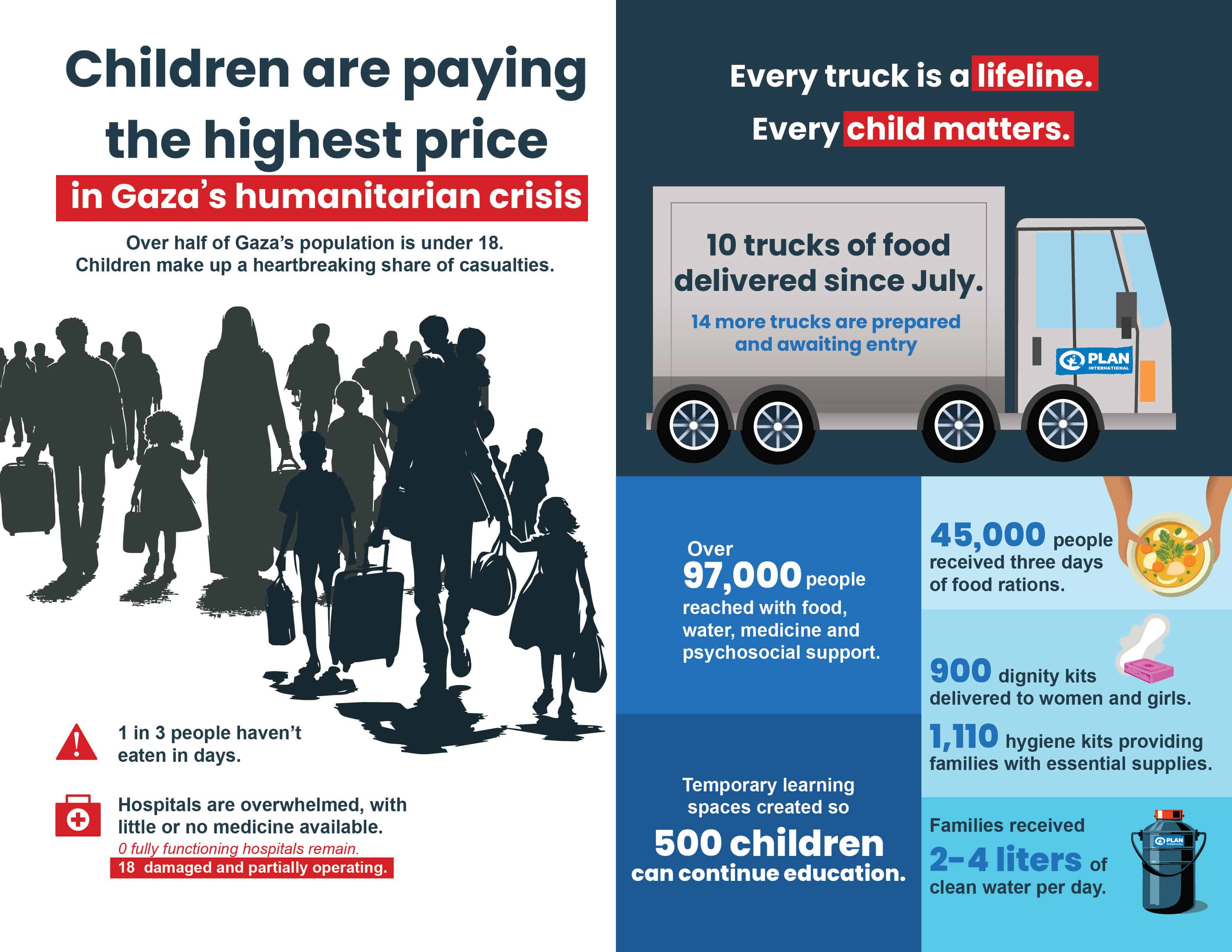
Infographic showing the impact of Gaza’s humanitarian crisis on children, with statistics on hunger, hospitals, food deliveries, hygiene kits and education support from Plan International.

Scaling up humanitarian aid in Gaza

Right now, Plan is one of the few organizations able to get trucks into Gaza. Even registered international NGOs have had their trucks denied, but through relentless negotiation, strong partnerships and creative problem-solving, we have managed to break through.

This access did not come easily. It took exhausting every avenue, exploring multiple alternatives and leveraging every humanitarian relationship we had. But it worked. In the last few weeks, we have delivered food, water and essential supplies to more than 100,000 people.

But survival is only the first step. To truly protect children, we also have to safeguard their futures. That is why we are preparing temporary learning spaces and planning to launch education in emergencies programs for 500 children by September 1. In Gaza, education is lifesaving. It gives children safety, structure and hope in the middle of chaos. For girls especially, staying in school reduces the risk of early marriage, exploitation and violence.

With enough resources, we could send dozens more trucks every day and expand education support to thousands more children. The window is open, but only as long as we can keep filling it.

Numbers can never capture the full pain of this crisis, but they help show just how deeply children are being affected.

How you can help families in Gaza

Every child matters. Every hour matters. Every truck matters.

Your gift today will mean more children have food to eat, medicine when they are sick, clean water to drink and dignity kits to protect their health and safety, and continued education so they do not fall too far behind and have the routine and sense of community they need to stay strong.

Every child deserves to learn, lead, decide and thrive. So, together, we will not stop until we are all equal.

Donate now to support children in Gaza


Meghan Mattern, senior technical advisor at Plan International USA, wrote this article. To learn more about Plan’s work, get in touch:

[email protected].


When young people have skills, confidence and supportive environments, they thrive. They graduate. They start businesses. They drive innovation and contribute to healthier, more prosperous communities.

But what happens when girls grow up believing that public spaces aren’t meant for them? When they internalize fear, limit their movements and step back from opportunity?

Plan International’s Real Choices, Real Lives study reveals how deeply rooted gender norms around violence and protection shape girls’ behavior — and how those behaviors have a lifelong effect on their access to education, skills and decent work.

How social norms limit girls’ access to education and work

Too often, youth employment challenges are framed in technical terms — skills gaps, lack of opportunity or underemployment. But adolescent girls face significant barriers before they even enter secondary or vocational school, with lifelong impacts.

Plan’s longitudinal study, which followed 142 girls across nine countries from birth to age 18, revealed how harmful social norms are internalized during adolescence. The findings are sobering:

  • 91% of girls reported experiencing violence, starting as early as age 11.
  • By ages 14–15, 68% believed male violence was ā€œjust the way things are.ā€
  • By 18, 67% believed it was their personal responsibility to protect themselves — even if that meant limiting their movement, dress or activities.

These beliefs shape behavior. When girls feel unsafe or solely responsible for their protection, they often withdraw by skipping school, avoiding training opportunities or disengaging from everyday spaces. In losing access to these spaces, girls lose critical opportunities to develop the life and employment skills they need for the future.

ā€œWe are told to be careful, to protect ourselves, but no one is telling boys not to hurt us.ā€ — Girl, 17, Brazil

The connection between girls’ safety and skills-building

Skills-building doesn’t happen in a vacuum. If girls don’t feel safe, they miss out on training programs, apprenticeships and other economic opportunities.

And the issue isn’t limited to physical safety.

As digital platforms become essential for education, employment and connection, online environments must also be safe. Plan’s Building Digital Resilience report — developed in partnership with CNN’s As Equals series — found that fear of harassment and gender-based abuse online is pushing girls offline. Many avoid sharing opinions, joining forums or using learning platforms due to threats, stalking or trolling.

This exclusion from digital spaces directly affects their ability to build skills, networks and confidence in a digital economy.

This personal exclusion has societal costs as well. According to the World Bank, violence against women can result in economic losses of up to 3.7% of a country’s GDP.

Tackling these barriers requires more than training — it demands a shift in how programs are designed and delivered.

What program implementers can do to shift norms and boost economic outcomes

The data is clear: Adolescence is a critical window to act. When we address social norms during this formative time, we can positively shape girls’ safety, agency and long-term economic participation.

Recommendations for technical practitioners and donors:

  • Pair skills and livelihoods programming with gender norms transformation. Combine financial literacy or vocational training with sessions that unpack social expectations and beliefs.
  • Engage caregivers and communities. Girls’ mobility and access to opportunities are often shaped by parents or extended family. Norm change must extend beyond the classroom.
  • Design for safe access. Consider transit, location and public space safety in every program — in urban, rural or conflict-prone areas.
  • Follow girls’ lead. Young people know what they need to be successful. Support mentorship groups, youth clubs or collectives where leadership and technical skills grow together.

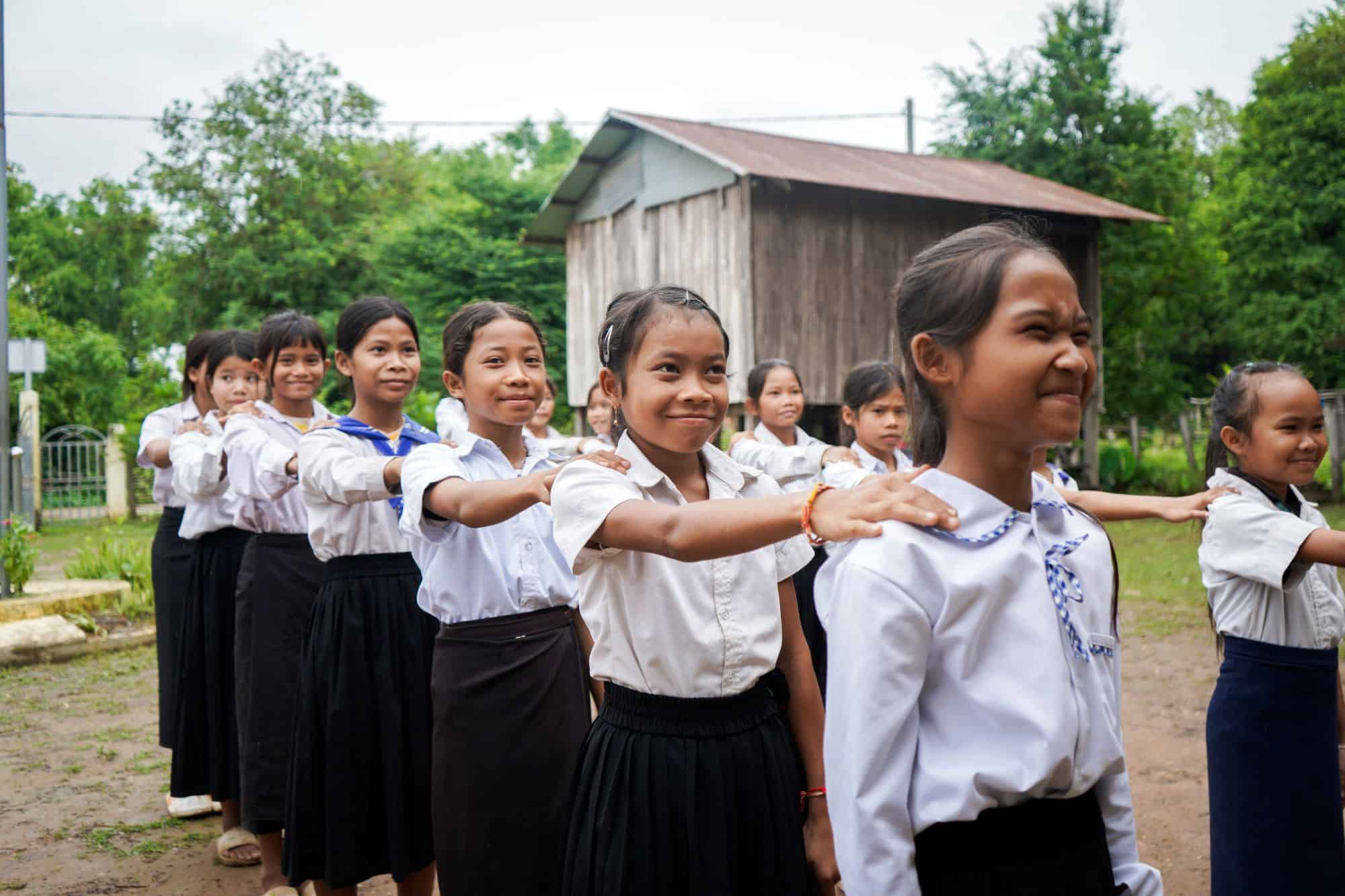
Safety is the foundation of learning. In Cambodia, girls take part in a disaster preparedness drill through Plan International’s Safe Schools programme — one way we help close the safety gap that limits girls’ education and opportunities. Ā© Plan International

Program case studies: skills, safety and success

Across multiple countries, programs that integrate psychosocial safety, self-belief and work readiness are showing real impact.

In 20 cities globally, Plan’s Safer Cities for Girls program has worked to build safer, more inclusive urban environments for adolescent girls (ages 13–18). The program focuses on three goals:

  • Increasing safety and access to public spaces.
  • Expanding meaningful participation in urban governance.
  • Enabling autonomous mobility for girls.

A midline evaluation in Kenya, Ethiopia, Uganda and Zimbabwe found 53% of participants were engaged in decent work, an 18% increase from baseline.

In Guatemala, the Connection to Success project supports young women’s economic futures by combining:

  • Entrepreneurship and vocational training
  • Access to internships and startup funding
  • Shifting community attitudes and expectations around gender

Among the program’s second cohort, 54% of participants improved their well-being through increased earned income (defined as the percentage of youth who can fully cover a minimum set of basic necessities).

ā€œBoys can be taught to stop being aggressive.ā€ — Girl, Real Choices, Real Lives study

Why safety must come first in youth economic empowerment

Too many girls grow up believing that their lives must be small to be safe. This belief, formed early, undermines their ability to develop skills, join the workforce and achieve economic independence.

But the Real Choices, Real Lives study also shows hope: By age 18, most girls involved in the study were vocal in their belief that they deserve the same freedoms as boys. They’re calling on adults to listen to their voices and include them in decisions that affect their safety and protection. Girls are questioning the norms they inherited. They’re demanding safer, more equitable futures.

It’s time for the systems around them to catch up.

Economic empowerment begins with belief.

Belief that girls are capable, that the world can be safe and that adolescence isn’t the end of possibility — but the beginning.

As famine grips Gaza, putting over a million children at risk, Plan International is demanding a ceasefire and unrestricted humanitarian access.

Famine has taken hold in Gaza Governorate and will expand to Deir al-Balah and Khan Younis without urgent action, according to a new report from the UN-backed Integrated Food Security Phase Classification (IPC) published today, Friday 22 August.

Preventable catastrophe

Responding to the IPC’s latest report, Dr. Unni Krishnan, Global Humanitarian Director at Plan International said:

ā€œThe fatal consequences of Israel’s weaponization of hunger and blocking of humanitarian aid are devastatingly clear for all to see. No conflict should ever reach this point. What we are seeing in Gaza today is an entirely man-made and preventable catastrophe that is leaving more than a million Palestinian children – and 2.2 million people in total – struggling to stay alive.

ā€œFamine in Gaza is not a failure of logistics or aid — it is the outcome of brutal war and deliberate starvation.ā€

Dr. Unni Krishnan, Global Humanitarian Director at Plan International

ā€œPlan International has recently managed to deliver urgently needed aid into Gaza, but far more is needed. The continued illegal blockade of life-saving supplies means children and families are being condemned to die, painfully and needlessly.

Profound impact on generation of children

ā€œChildren in Gaza are not only being starved, they are also being maimed and permanently disabled in staggering numbers due to the Israeli army’s excessive use of force and newly intensified military campaign. Since the escalation of conflict in Gaza, disabilities have risen by 60% and Gaza now has the highest number of child amputees in the world. Hunger, injury and forced displacement into militarized zones are all highly traumatic events and will have a profound impact on an entire generation of children.

ā€œThe world cannot look away. Every hour lost costs more lives. Famine in Gaza is not a failure of logistics or aid — it is the outcome of brutal war and deliberate starvation. We demand – without delay – an immediate and sustained ceasefire, a complete halt to arms transfers to Israel, and the full lifting of Israel’s illegal blockade on humanitarian aid. This must include safe and unrestricted humanitarian access, so that we can reach more children and families with food and the basics needed for survival.ā€

For further information or interview requests, please contact:

MƩlina Froidure, Global Media Officer, Plan International
Tel: +33685583513
Email: [email protected]

About Plan International

Plan International is an international development and humanitarian nonprofit that advances children’s rights and equality for girls. Working together with children, young people, supporters and partners, we strive for a just world, tackling the root causes of challenges children face. We are there from birth until adulthood, and we support children to prepare for and respond to crises and adversity, while particularly focusing on the experiences of girls. With more than 85 years of experience, we work to transform lives in more than 80 countries. We won’t stop until we are all equal.

For more information, please visit www.PlanUSA.org.

Children at gravest risk as full-fledged famine unfolds in Gaza

A joint statement from more than 100 organizations, sounding the alarm to allow life-saving aid into Gaza.

100+ NGOs call for an end to Israel’s weaponization of aid. Despite claims by Israeli authorities that there is no limit on humanitarian aid entering Gaza, most major international NGOs have been unable to deliver a single truck of lifesaving supplies since 2 March.

Instead of clearing the growing backlog of goods, Israeli authorities have rejected requests from dozens of NGOs to bring in lifesaving goods, citing that these organizations are ā€œnot authorized to deliver aid.ā€ In July alone, over 60 requests were denied under this justification.

ā€œAnera has over $7 million worth of lifesaving supplies ready to enter Gaza – including 744 tons of rice, enough for six million meals, blocked in Ashdod just kilometres away,ā€ said Sean Carroll, President and CEO of Anera.

This obstruction has left millions of dollars’ worth of food, medicine, water, and shelter items stranded in warehouses across Jordan and Egypt, while Palestinians are being starved.

Many of the NGOs now told they are not ā€œauthorisedā€ to deliver aid have worked in Gaza for decades, are trusted by communities and experienced in delivering aid safely. Their exclusion has left hospitals without basic supplies, children, people with disabilities, and older people dying from hunger and preventable illnesses, and aid workers themselves going to work hungry.

The obstruction is tied to new INGO registration rules introduced in March. Under these new rules, registration can be denied on the basis of vague and politicised criteria, such as alleged ā€œdelegitimisationā€ of the state of Israel. INGOs warned the process was designed to control independent organisations, silence advocacy, and censor humanitarian reporting. This new bureaucratic obstruction is inconsistent with established international law as it entrenches Israel’s control and annexation of the occupied Palestinian territory.

Unless INGOs submit to the full registration requirements, including the mandatory submission of details of private donors, complete Palestinian staff lists and other sensitive information about personnel for so-called ā€œsecurityā€ vetting to Israeli authorities, many could be forced to halt operations in Gaza and the West Bank, including East Jerusalem, and remove all international staff within 60 days. Some organisations have even been issued a seven-day ultimatum to provide Palestinian staff lists.

NGOs have made clear that sharing such data is unlawful (including under relevant data protection laws), unsafe, and incompatible with humanitarian principles. In the deadliest context for aid workers worldwide, where 98 percent of those humanitarians killed were Palestinian, NGOs have no guarantees that handing over such information would not put staff at further risk, or be used to advance the government of Israel’s stated military and political aims.

Today, INGOs’ fears have proven true: the registration system is now being used to further block aid and deny food and medicine in the midst of the worst-case scenario of famine.

ā€œSince the full siege was imposed on 2 March, CARE has not been able to deliver any of our $1.5 million worth of pre-positioned supplies into Gaza,ā€ said Jolien Veldwijk, Country Director of CARE. ā€œThis includes critical shipments of food parcels, medical supplies, hygiene kits, dignity kits, and maternal and infant care items. Our mandate is to save lives, but due to the registration restrictions civilians are being left without the food, medicine, and protection they urgently need.ā€

ā€œOxfam has over $2.5 million worth of goods that have been rejected from entering Gaza by Israel, especially WASH and hygiene items as well as food,ā€ said Bushra Khalidi, Oxfam Policy Lead. ā€œThis registration process signals to INGOs that their ability to operate may come at the cost of their independence and ability to speak out.ā€

These restrictions are part of a broader strategy that includes the so-called ā€œGHFā€ scheme – a militarized distribution mechanism promoted as a humanitarian solution. In reality, it is a deadly tool of control, with at least 859 Palestinians killed around ā€œGHFā€ sites since it began operating.

ā€œThe militarized food distribution scheme has weaponized starvation and curated suffering. Distributions at GHF sites have resulted in extreme levels of violence and killings, primarily of young Palestinian men, but also of women and children, who have gone to the sites in the hope of receiving food,ā€ according to Aitor Zabalgogeazkoa, MSF emergency coordinator in Gaza.

Both the ā€œGHFā€ scheme and the INGO registration process aim to block impartial aid, exclude Palestinian actors, and replace trusted humanitarian organizations with mechanisms that serve political and military objectives. They come as the government of Israel escalates its military offensive and deepen its occupation in Gaza, making clear these measures are part of a broader strategy to entrench control and erase Palestinian presence.

ā€œAt this point, everyone knows what the correct, humane answer is, and it’s not a floating pier, airdrops or the ā€œGHF.ā€ The answer, to save lives, save humanity and save yourselves from complicity in engineered mass starvation, is to open all the borders, at all hours, to the thousands of trucks, millions of meals and medical supplies, ready and waiting nearby,ā€ said Sean Carroll of Anera.

We call on all states and donors to:

– Press Israel to end the weaponization of aid, including through bureaucratic obstruction, such as the INGO registration procedures.

– Insist that INGOs are not forced to share sensitive personal information, in violation of the General Data Protection Regulation (GDPR), or compromise staff safety or independence as a condition for delivering aid.

– Demand the immediate and unconditional opening of all land crossings and conditions for the delivery of lifesaving humanitarian aid.

Editor's Note

– The occupied Palestinian territory is the deadliest setting for aid workers worldwide, with Palestinian staff accounting for 98% of aid worker fatalities: 509 out of 517 killings that took place between 2023 and 2025,Ā accordingĀ to the Aid Worker Security Database.

– On 6 May, 55 organisationsĀ warnedĀ that Israel’s new INGO registration measures are a grave threat to humanitarian operations and international law.

– On 1 July, 200+ organisationsĀ calledĀ for immediate action to end the deadly Israeli distribution scheme, including the so-called ā€œGHFā€ in Gaza, revert to the existing UN-led coordination mechanisms, and lift the Israeli government’s blockade on aid and commercial supplies.

– On 23 July, 100+ organisationsĀ warnedĀ that, as mass starvation spreads across Gaza, our colleagues and those we serve are wasting away.

– On 29 July, the Integrated Food Security Phase Classification (IPC)Ā wroteĀ that the worst-case scenario of famine is currently playing out in the Gaza Strip.

– Israel has consistentlyĀ denied restrictingĀ the amount of aid allowed into Gaza, including throughout the period of July 2025, when most of the denials discussed in this statement were issued.

– On 31 July, OHCHRĀ wroteĀ that since 27 May, at least 1,373 Palestinians have been killed while seeking food: 859 in the vicinity of the ā€œGHFā€ sites and 514 along the routes of food convoys. Most of these killings were committed by the Israeli forces.

– On 4 August, a Palestinian nurse in GazaĀ was killedĀ when an airdrop struck

– On 5 August, it wasĀ reportedĀ that Israeli authorities are planning for the full occupation of the Gaza Strip.

– On 6 August, UN agencies and NGOsĀ warnedĀ that without immediate action most international NGO partners could be deregistered by Israel in coming weeks.

– On 6 August, the Dutch Data Protection Authority (DPA)Ā concludedĀ that Israel’s information requests under the INGO registration process risk violating the General Data Protection Regulation (GDPR). The DPA advised that INGOs should not comply with these requests, and that the only solution is for Israel to amend its requirements and for the relevant ministries to issue a formal protest.

– On 7 August, MSFĀ releasedĀ a report stating food distributions in Gaza run by the so-called ā€œGHFā€ are sites of ā€œorchestrated killing and dehumanizationā€ that must be shut ā€

– On 10 August, Save the ChildrenĀ reportedĀ the deaths of 100 children due to starvation in Gaza since October 2023.

– On 12 August, a group of UN Special Rapporteurs on human rightsĀ publishedĀ a letter to the Israeli government, stating deep concern that the INGO registration measures ā€œweaken the ability of INGOs to operate independently and impartially and to carry out their humanitarian and human rights work without interference or fear of reprisalā€ and that ā€œthe obligation to report on INGO personnel, in the context of occupation, armed conflict and serious violations of international law, could raise serious protection and reprisal concerns.ā€

Signatories

  1. Action Against Hunger (ACF)
  2. A New Policy
  3. ACT Alliance
  4. Action For Humanity
  5. ActionAid Denmark
  6. ActionAid International
  7. All We Can
  8. Alliance Sud
  9. American Friends Service Committee (AFSC)
  10. Americares
  11. Anera
  12. Asamblea de Cooperación por la Paz
  13. Bystanders No More
  14. Campaign Against Arms Trade
  15. Canadian Foodgrains Bank
  16. CARE
  17. Caritas Internationalis
  18. Caritas Jerusalem
  19. Caritas Middle East and North Africa
  20. Caritas Switzerland
  21. Center for Jewish Nonviolence
  22. Charity & Security Network
  23. Children Not Numbers
  24. Christian Aid
  25. Churches for Middle East Peace (CMEP)
  26. CISS – Cooperazione Internazionale Sud Sud
  27. Committee to Protect Journalists
  28. Cooperation Canada
  29. COORDINADORA VALENCIANA ONGD
  30. DanChurchAid
  31. Danish Refugee Council (DRC)
  32. Department of Service to the Palestinian Refugees
  33. Diakonia
  34. Diakonie Katastrophenhilfe
  35. EDUCO
  36. Embrace the Middle East
  37. Emergency – Life Support for Civilian War Victims Ong Ets
  38. Entreculturas
  39. Forum Ziviler Friedensdienst V. (Pro Peace)
  40. Frieda – the Feminist Peace Organization
  41. Friends Committee on National Legislation (FCNL)
  42. Fund for Global Human Rights
  43. Glia
  44. HEKS/EPER (Swiss Church Aid)
  45. HelpAge International
  46. Humanitarian Coalition
  47. Humanity Auxilium
  48. Humanity & Inclusion – Handicap International
  49. Humanity First UK
  50. INARA
  51. Insecurity Insight
  52. International Development and Relief Foundation (IDRF)
  53. INTERSOS
  54. Islamic Relief
  55. Jahalin Solidarity
  56. Japan International Volunteer Center (JVC)
  57. Jüdische Stimme für Demokratie und Gerechtigkeit in Israel/Palästina JVJP Switzerland
  58. KinderUSA
  59. Kvinna till Kvinna Foundation
  60. La Coordinadora de Organizaciones para el Desarrollo (The Spanish Development NGO Platform)
  61. MƩdecins du Monde France
  62. MƩdecins du Monde International Network
  63. Médecins Sans Frontières (MSF)
  64. MedGlobal
  65. Medical Aid for Palestinians (MAP)
  66. medico international
  67. medico international schweiz
  68. Mennonite Central Committee (MCC)
  69. Middle East Children’s Alliance
  70. MPower Change Action Fund
  71. Muslim Aid
  72. NORWAC – Norwegian Aid Committee
  73. Norwegian Church Aid
  74. Norwegian People’s Aid (NPA)
  75. Norwegian Refugee Council (NRC)
  76. Oxfam
  77. Palestinian Children’s Relief Fund (PCRF)
  78. PANZMA – Palestinian Australian New Zealand Medical Association
  79. PARCIC
  80. Pax Christi International
  81. Peace Watch Switzerland
  82. People in Need (PIN)
  83. Plan International
  84. Polish Humanitarian Action (PAH)
  85. Portuguese Platform of Development NGOs
  86. Premiere Urgence Internationale (PUI)
  87. Project HOPE
  88. Relief International
  89. Right to Play
  90. Sabeel-Kairos UK
  91. Saferworld
  92. Save the Children International
  93. Secours Islamique France (SIF)
  94. Solidar Suisse
  95. SolidaritƩs International
  96. SWISSAID
  97. Terre des Hommes Italy
  98. Terre des Hommes Lausanne
  99. The Eastern Mediterranean Public Health Network (EMPHNET)
  100. The United Church of Canada
  101. United Against Inhumanity (UAI)
  102. Vento di Terra
  103. War Child Alliance
  104. Weltfriedensdienst V.

Ā 

For further information or interview requests, please contact:

Robin Knowles, Global Media Manager, Plan International
Tel: +1 (437) 326-8410
Email: [email protected]

About Plan International

Plan International is an international development and humanitarian nonprofit that advances children’s rights and equality for girls. Working together with children, young people, supporters and partners, we strive for a just world, tackling the root causes of challenges children face. We are there from birth until adulthood, and we support children to prepare for and respond to crises and adversity, while particularly focusing on the experiences of girls. With more than 85 years of experience, we work to transform lives in more than 80 countries. We won’t stop until we are all equal.

For more information, please visit www.PlanUSA.org.

Humanitarian aid truck with Plan International banner

Discover how one young woman’s passion and her mom’s unwavering support are turning big dreams into real-world change.

Back-to-school season means fresh notebooks, new routines, and, for some students, brand-new opportunities to lead. At Plan International, our Youth Advisory Board is where bold ideas meet real impact. This group of passionate teens and young adults from across the U.S. works side by side with Plan’s leadership to ensure young voices are part of the decisions shaping the future for girls everywhere.

One of those changemakers is Byronie, a university student and advocate for educational equity whose passion for global youth policy is matched by her mom Sara’s dedication to empowering women and communities. Together, they offer a rare, dual perspective on leadership — one from a young leader finding her voice, and the other from the parent who has been cheering, guiding and inspiring her every step of the way.

Come meet Byronie and Sara and see how leadership can start at home — and grow to reach the world.

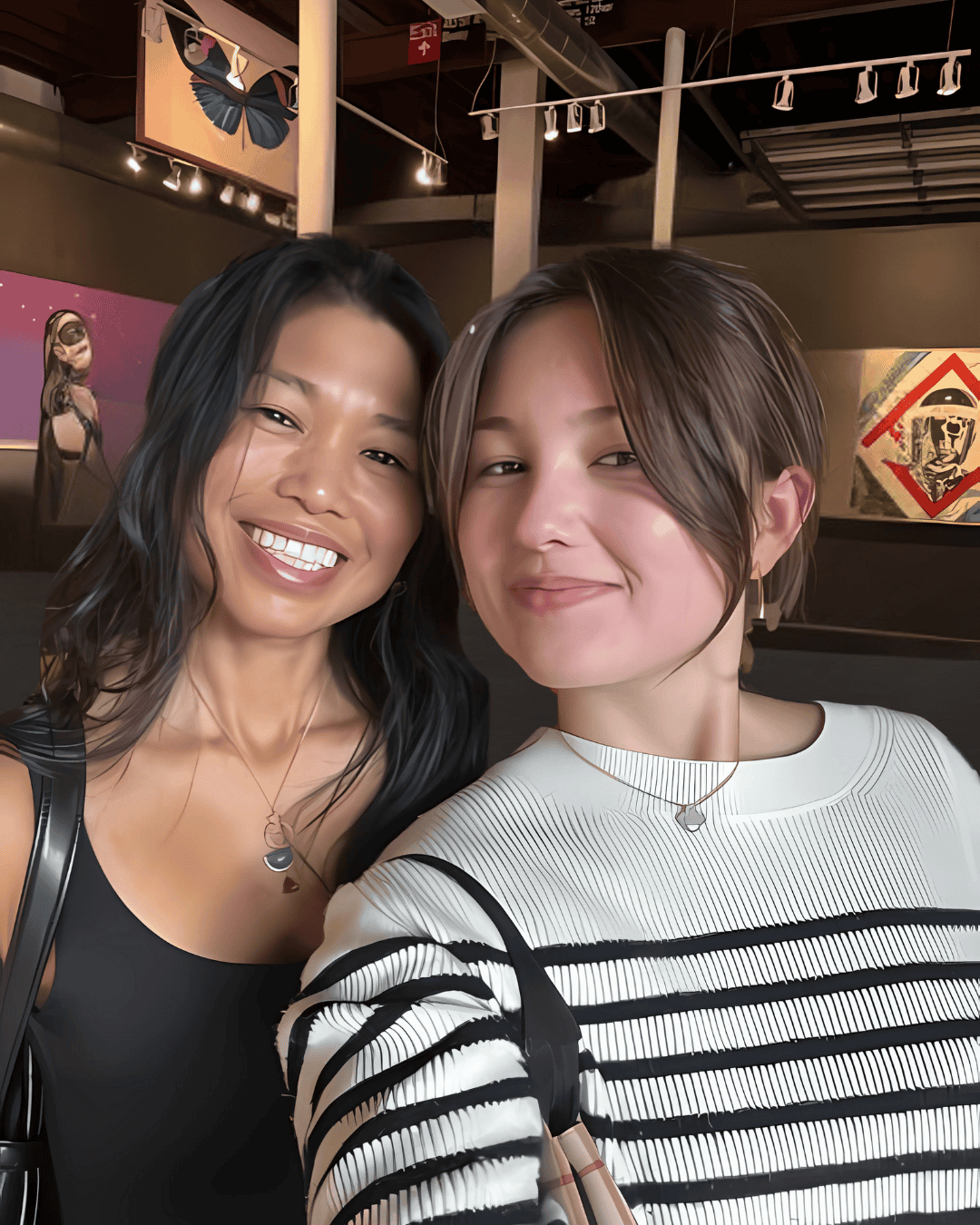
Byronie (right) and her mom, Sara, share how family support can help young leaders thrive — from the kitchen table to the world stage.

Byronie (right) and her mom, Sara, share how family support can help young leaders thrive — from the kitchen table to the world stage.

ā€œLoveā€ — one word that describes us

Byronie: ā€œAs daughter to the best mom in the world, she is undoubtedly my best friend and the person I tell everything to. Whether it’s personal or professional, she gives the best advice, and I constantly think, ā€˜I want to be her when I grow up!ā€™ā€

Sara: ā€œFor me, love is everything — and my family is at the heart of it all.ā€

A proud beginning

Sara: ā€œPhilanthropy and giving back to the community have always been important to me. Seeing Byronie take on new challenges and find her own path and causes that are meaningful to her has been a highlight of watching her grow up. I am incredibly proud of her commitment to service and can’t wait to see what unfolds for her.ā€

A global perspective

Sara: ā€œI’ve seen her perspective expand so much since she started working with Plan. At first, her view was shaped mainly by her own experiences and what she observed at home in Portland, Oregon, and in the U.S. However, through her work with Plan, she has connected with young people from across the globe and gained a profound understanding of the challenges they face. It’s been incredible to watch her develop a more global and deeply empathetic outlook — one grounded in a broader awareness of what young people are experiencing around the world versus just within her community.ā€

A moment that stood out

Sara: ā€œOne moment that really stands out for me was when Byronie was invited to attend the United Nations Commission on the Status of Women. It was such an incredible opportunity — especially at her age — to be surrounded by powerful voices and global leaders. I could see how much it impacted her. She came home more confident, more thoughtful and with a real sense of purpose. Experiences like that are shaping who she is and who she’s becoming, and I’m just so grateful she’s had the chance to be part of something so meaningful.ā€

Support every step of the way

Byronie: ā€œMy mom has been there, truly, every step of the way in my journey with Plan — both in the Youth Advisory Board and running the London Marathon with Plan. She is my biggest supporter and my biggest advocate. My mother is the most important woman in my life. But more than anything, she is also my inspiration. Growing up, she was always a champion for causes she cares about — a leader focused on humanity and connection. She always led with poise, grace and organization. I aspire to be that kind of leader and that kind of woman. It is her example that I have found most supportive in these last two years at Plan.ā€

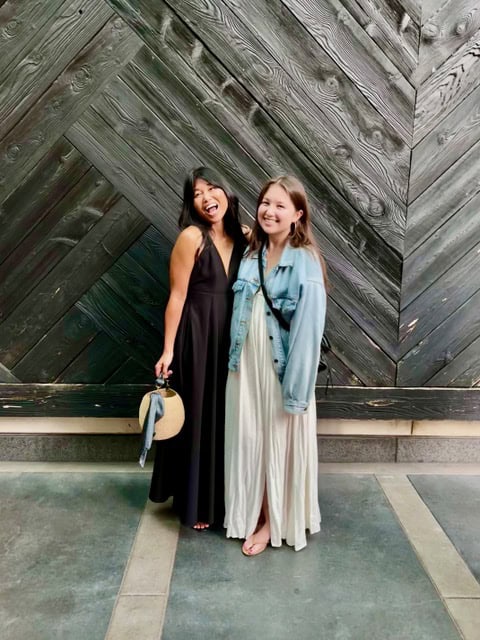
Byronie (right) and Sara know that big change often starts with the people who believe in you most.

Byronie (right) and Sara know that big change often starts with the people who believe in you most.

Lessons in independence

Sara: ā€œI’m constantly learning from Byronie, but if I had to name one thing that really stands out, it’s independence. This year, she lived abroad in the United Kingdom, and that experience felt even more significant than when she first left for college. So much of my identity has been centered around being a mom, and watching her spread her wings in such a big way — so far from home — was both beautiful and challenging. I’ve had to come to terms with her growing independence, and in doing so, I’ve found myself reevaluating my path as well. As she steps into this exciting chapter of young adulthood, I’m also beginning to explore new opportunities and experiences I hadn’t had the bandwidth for before. It’s been a season of growth for both of us.ā€

What we admire most

Sara: ā€œIt’s hard to choose just one thing I admire most about Byronie, but what stands out is how deeply caring and empathetic she is — it’s just part of who she is. I admire her kindness, her determination and the way she shows up wholeheartedly for the people she loves and the causes she believes in. She has always had a strong inner drive to make a difference, and I know that her passion for creating a better world will carry her far in whatever path she chooses to pursue.ā€

Advice for other families

Sara: ā€œI’d tell any parent with a child interested in YAB to be supportive and open-minded. For our family, it was incredible to see how Byronie’s eyes were opened to the very real and varied challenges that youth face around the world. It gave her perspective — some of the things she used to worry about started to feel smaller in comparison. Being part of YAB broadened her understanding of global issues and policy in a way that has shaped her view of the world. But even as they step into big ideas and take on the important work of Plan, they’re still young — and they still need our support and guidance. It’s essential to be present to discuss what they’re learning and the emotions associated with this experience.ā€

Looking ahead

Sara: ā€œI’ve seen her grow so much, both personally and professionally, through her time at YAB. Her view of the world has expanded, and she has acquired critical professional skills, including leadership, communication, working with diverse team members, and managing, motivating and supporting others. I believe this experience is helping to prepare her for whatever challenges she may face in the workplace and life. What matters most to me is how YAB has sparked a deeper curiosity in her and a real desire to connect with people. I hope she always holds on to that empathy and her strong sense of our shared humanity and keeps working toward a kinder, more just world. Change doesn’t always come from big, dramatic moments — it’s often the small, everyday actions rooted in kindness and compassion that really make a difference. She’s already taking those steps, and I’m sure she’ll keep making a difference in everything she puts her heart into.ā€

Closing reflection

From international conferences to everyday conversations at home, Byronie’s journey with the YAB has been shaped by both her own determination and the steady encouragement of her mom. Sara’s pride in her daughter’s growth is matched by her belief that parents play a vital role in helping young leaders thrive — not by leading for them, but by creating the space and support they need to lead themselves.

Their story is a reminder that leadership isn’t just about the titles we hold but about the people who stand beside us as we learn, grow and take action. Sometimes, the first step toward changing the world starts with someone at home saying, ā€œI believe in you.ā€

In disaster-prone Indonesia, girls and marginalized children face unique risks when emergencies hit. Maulinna Utaminingsih, a humanitarian expert with Plan International, shares what an inclusive, ethical response really looks like – and how it can change lives.

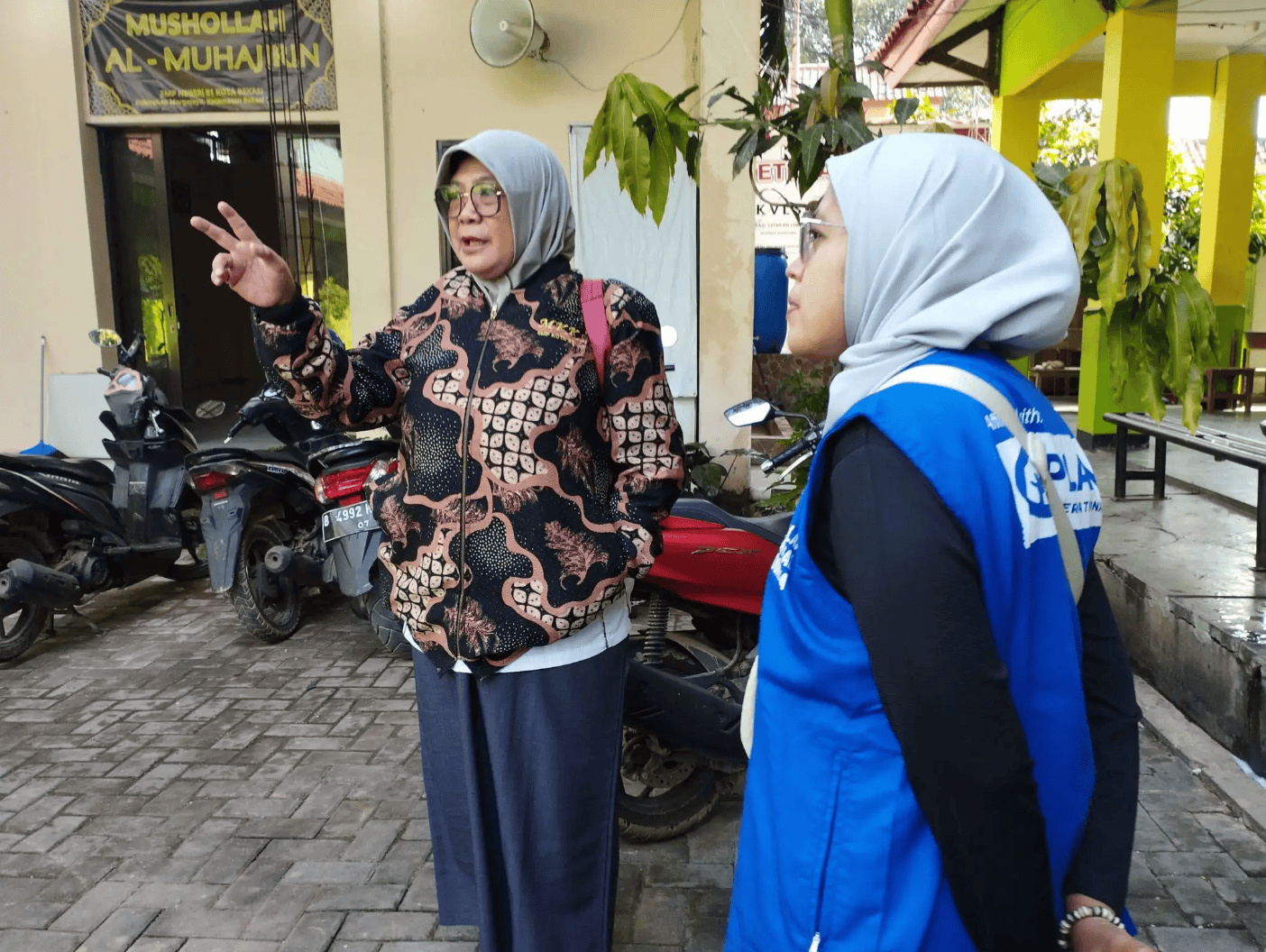
Maulinna speaking to a local about what the community needs as part of the response assessment after the Bekasi flood. Ā© Plan International

When I first joined Plan Indonesia’s emergency response team in 2010, I wasn’t sure where the journey would take me. What I knew was quite simple though: I wanted to help people the right way, the dignified way, without causing further harm.

Over time, what started as a calling has become a lifelong commitment. From water, sanitation and hygiene (WASH) and education in emergencies to child protection, I’ve worked in different regions and in different roles, from leading disaster response efforts to training others. The more I work closely with disaster-affected communities, the more I understand just how critical it is that humanitarian response be rapid, inclusive, and above all, protection-sensitive. At the heart of our work is one clear priority: making sure that children, especially girls, those with disabilities, and those from the most marginalized communities, are not left behind.

When distribution is unequal

Indonesia faces disasters every year, from earthquakes and floods to landslides and volcanic eruptions. These events ripple through every part of life, disrupting health services, education, livelihoods, and public safety. But while the response efforts are often well-intentioned, I’ve seen firsthand how they can fall short of fundamental humanitarian principles. Too often, there is a lack of understanding about what an effective and ethical emergency response really looks like. I’ve heard people say that ā€˜aid distribution is unequal,’ and it’s true.

Often, aid is distributed unevenly, sometimes requiring documents that survivors have lost in the chaos. Donations can pile up but remain undelivered due to a lack of personnel or planning. Sometimes, well-meaning people bypass formal channels altogether, creating uncoordinated distributions that result in some families receiving multiple school bags — in one case, a single child received 13 school bags — while others go without basic essentials. One young woman I met told me she didn’t feel comfortable asking for sanitary pads at a relief center because every volunteer was male. It’s a small detail that speaks volumes. Without a gender-sensitive approach, we risk silencing the needs of half the population.

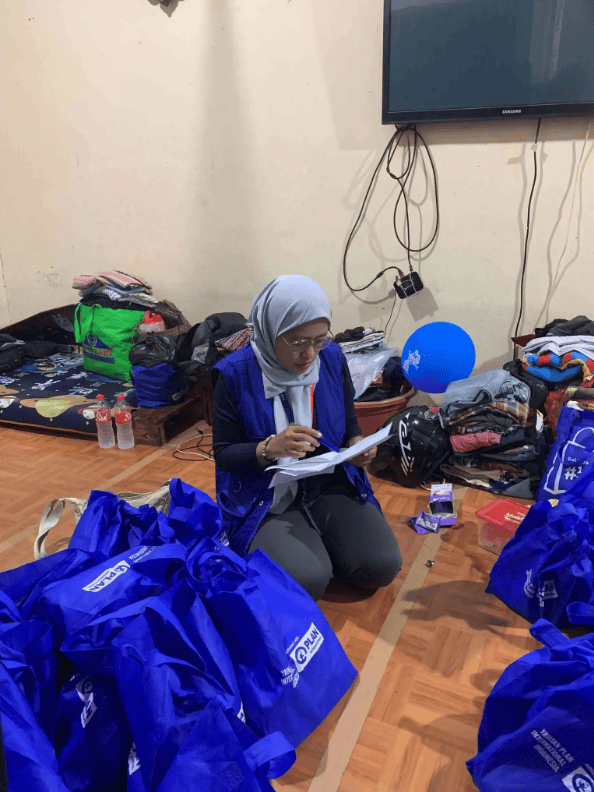
Maulinna checking off the distribution list to ensure people are receiving the correct aid after the Bekasi flood. Ā© Plan International

Children, too, face unique struggles. Some are embarrassed to return to school without uniforms or supplies. Others are bullied for wearing different clothes or transferring into unfamiliar schools. The emotional impact of a disaster doesn’t end with physical safety; it remains in shame, disruption, and the loss of routine.

Involving people in shaping the help they receive

That’s why our work at Plan Indonesia is focused not just on response, but on building systems that protect, include, and empower people and communities. We’ve distributed hygiene kits containing items like underwear that are often forgotten, but critically needed. We’ve trained teachers on how to continue education in emergencies. These small but meaningful steps are making a big difference.

In every response, we also set up feedback mechanisms with support from local government and youth volunteers. These systems have become an important bridge, allowing affected communities to ask questions, make suggestions, or quite simply be heard and be seen. People were grateful that their concerns were met with real answers, and for many, it was the first time they felt included in shaping the help they received.

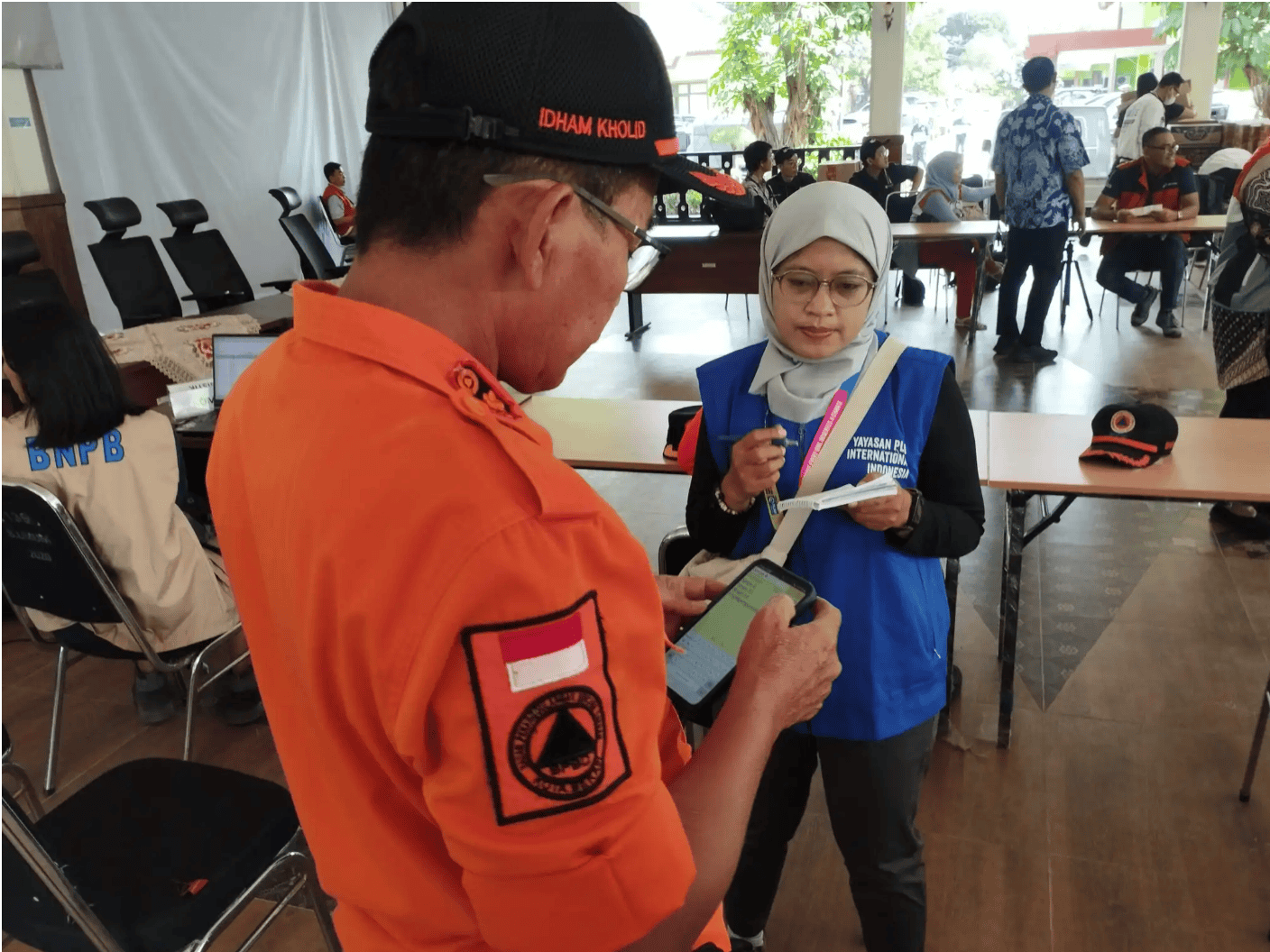
Maulinna coordinating the rapid needs assessment after the Bekasi flood.

Education can’t be overlooked

Still, there is much more to do. My biggest concern is that education continues to be overlooked in the early days of a disaster. Schools are often used as evacuation shelters, and the learning process is put on hold. But for children, school is more than just a classroom; it’s stability, safety and a space to recover emotionally.

If I could make one change, it would be to ensure that every school in Indonesia — not just on paper, but in practice — is prepared for disaster. That means drills, not just documents, and community participation, not just policies, and it means making sure that infrastructure is truly safe so schools can remain open even when everything else shuts down.

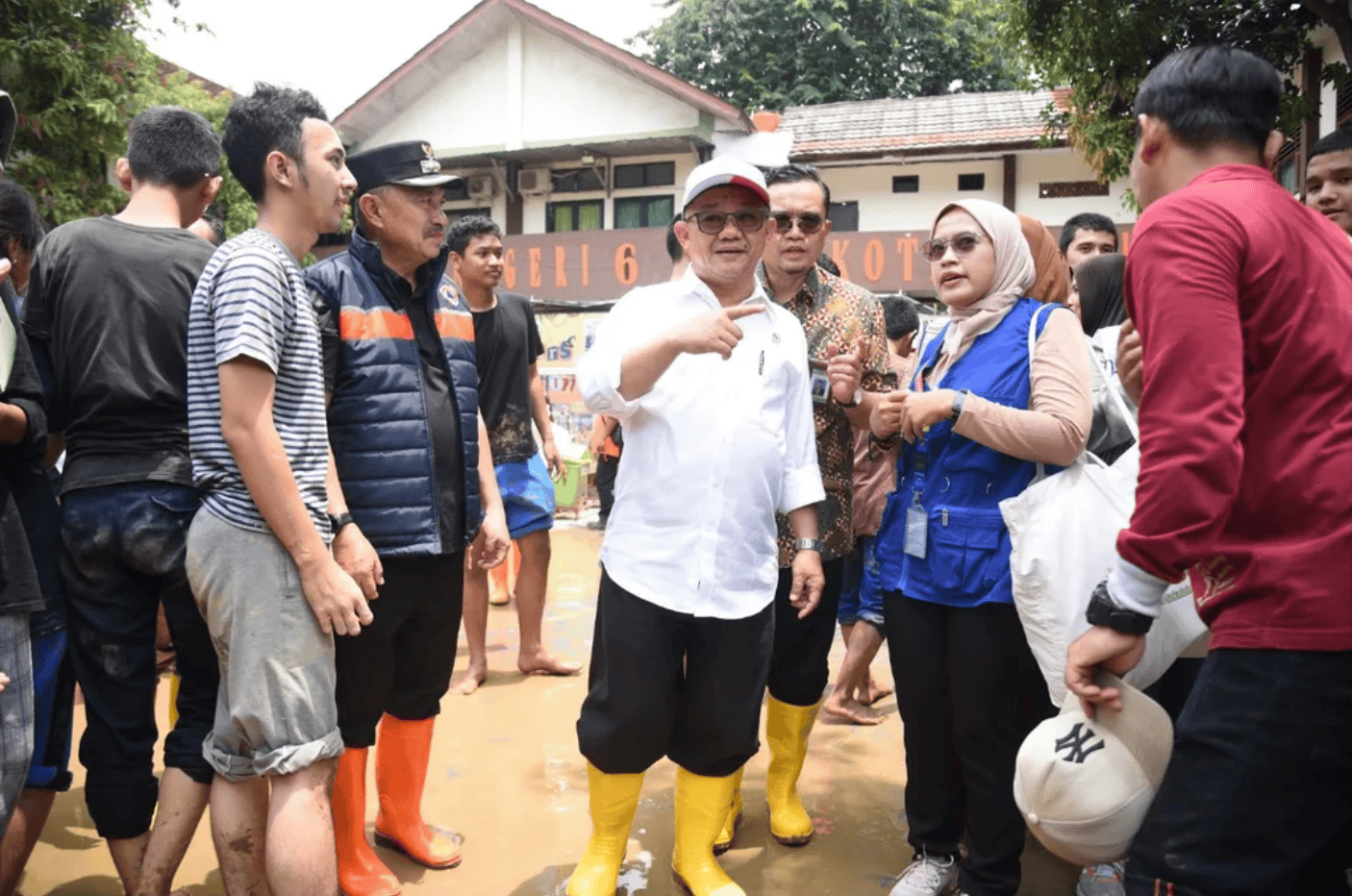
Maulinna meeting with the Education Ministry during the Bekasi flood, to assess the required educational response. Ā© Plan International

Invest in training

My message to donors and global partners is simple: invest in training. Support teachers, youth and education authorities across all regions so that when disaster strikes, the response is fast, inclusive, and appropriate. We can reach a future where no child is harmed at school, and no day of learning is lost.

What gives me hope is the belief that children deserve to feel safe, even in times of crisis. We are not doing this alone, either. Collaboration with government, schools, and local communities is precious and a work in progress. I believe that if we engage young people now, we’re not just helping in the moment; we’re building a more resilient, more prepared generation for the future.

Maulinna (right) distributing hygiene kits during the assessment of the eruption of Mount Semeru, East Java. Ā© Plan International

Stay updated on Plan International’s technical work by

signing up for ā€œFrom Plan to Action,ā€

our quarterly newsletter.