Search Results

Search results for

0 result(s) found

The Rockefeller Foundation has launched an emergency response in collaboration with Plan International to support children affected by the recent earthquake in Myanmar. This $200,000 grant focuses on delivering lifesaving assistance in the form of safe spaces, psychosocial care, and nutritional support in the hardest-hit regions of Mandalay and Sagaing. Following the March 28, 2025 earthquake—Myanmar’s deadliest in over a century—the Foundation’s response addresses urgent needs while laying the groundwork for long-term recovery and resilience. Children, particularly girls, are among the most vulnerable in disaster scenarios, and this joint effort aims to protect their well-being and future. Through this partnership, The Rockefeller Foundation continues its mission to foster equity and resilience in crisis-affected communities across Asia.

Read the full press release: Rockefeller Foundation and Plan International Launch Emergency Response to Support Earthquake-Affected Children in Myanmar

Rockefeller Foundation and Plan International Launch Emergency Response to Support Earthquake-Affected Children in Myanmar

This article was written by members of the Youth Advisory Board at Plan International USA. To get in touch with the YAB, contact [email protected].

The Economist reports that 85% of women online have witnessed online violence such as video- and image-based abuse, defamation, cyberharassment, doxing and more. Plan’s research shows this abuse is pushing women and girls out of online life, with 1 in 5 disengaging for their own well-being. The UK, European Union and some U.S. states have passed laws to address these issues, but so far, no laws protect all girls and women across the United States from online harassment and abuse.


Profile page on social media or online portal.

Profile page on social media or online portal. Man reading feed, status update or post with mobile phone. Follow, like or send friend request. Using personal or professional business network website.


Now, the ā€œTools to Address Known Exploitation by Immobilizing Technological Deep Fakes on Websites and Networks Actā€ — or TAKE IT DOWN Act — is an online safety bill designed to help address the problem. It criminalizes knowingly publishing or threatening to publish nonconsensual intimate imagery (i.e., explicit photos or videos shared without permission), including content generated through AI, online. Specifically, it targets deepfake and revenge pornography (intimate images shared to humiliate or harm someone). The act also requires online platforms to remove child sexual abuse material and nonconsensual intimate images within 48 hours of being notified by a victim to stop the rapid spread online and prevent further harm.

As a notable bipartisan movement, the bill is gaining traction in Congress. It was introduced in the Senate in June 2024 by Sen. Ted Cruz, R-Texas, and Sen. Amy Klobuchar, D-Minn., and reintroduced into the House in January 2025 by Rep. Maria Salazar, R-Fla. By February 2025, it passed the Senate unanimously — an extremely rare occurrence — and is currently advancing through the House with significant support from many tech companies, President Trump and the first lady.

As a body of young people vocalizing the needs of youth, we recognize the new challenges facing our generation in this country and urge fiercer protections for ourselves and our peers as they continue to live in a chronically online world. Over two years, the U.S. saw more than 13,000 cases of sextortion of minors through deepfakes, primarily victimizing 14- to 17-year-olds. The risks are real and growing.

Therefore, as the Youth Advisory Board of Plan International USA, we call on policymakers, youth advocates and caregivers to support and help pass the Take It Down Act.

The Take It Down Act not only holds offenders accountable via criminalization, but also ensures survivors are empowered and victims are protected in good faith through exemptions, such as to law enforcement or for medical purposes, while protecting free and lawful speech. The act specifically includes AI-generated content, as up to 95% of all internet deepfake videos depict nonconsensual intimate imagery, a staggering percentage that underscores the urgent need for action to protect minors and women this content principally targets. The Take It Down Act is the first of its kind in the online safety space, offering nationwide protections where only 20 states currently have explicit laws covering deepfake NCII. Even with these laws, victims have struggled to have images depicting them removed. This can lead to retraumatization, the continuous spread of said content and allowing perpetrators to evade responsibility. This reality makes swift action all the more urgent.

This act changes that. It would establish criminal penalties for publishing NCII across all states and require platforms to remove NCII within 48 hours of a victim’s request. Instead of placing the burden — especially financial and emotional — on victims to bring civil action to remove NCII, the responsibility would shift to perpetrators and online platforms. It would send a clear signal to all American citizens that online abuse is not tolerated and that victims deserve respect and empowerment.

Like the Kids Online Safety Act, which we also support, the Take It Down Act is not perfect, but it is a net positive that would address a threatening situation that is currently spiraling out of control. This is especially relevant given that social media platforms — where deepfake pornography and other forms of image-based abuse spread and surface — have reduced their content moderation policies, while AI has accelerated the production and dissemination of NCII and child sexual abuse materials. For example, a 2024 survey by Plan and CNN’s As Equals found that NCII is now the most common form of online harassment and abuse, with more than 40% reporting they received or saw unwanted sexual images online.

To stay updated on the Take It Down Act, visit the National Center on Sexual Exploitation and Design It For Us for more youth perspectives on this bill and other key legislation. As the Youth Advisory Board, we encourage readers — especially young readers — to stay informed not only about the Take It Down Act but also other bills impacting women and girls across the country. By staying informed, we can help build a more inclusive, safe and resilient society where all women and girls are empowered and protected online.

Profile page on social media or online portal.

Centering girls’ protection, education and mental health in disaster response

Frank Manfredi, vice president for humanitarian programs at Plan International USA, wrote this article. For more information on Plan’s work, please get in touch with Frank Manfredi at  [email protected].Ā  When a 7.7 magnitude earthquake struck central Myanmar on March 28, the world’s attention quickly shifted to the destruction. Homes, hospitals and schools were destroyed. Roads and bridges collapsed. Families were displaced overnight, forced to seek shelter wherever they could. The confirmed toll now exceeds 3,500 deaths, with nearly 5,000 injured and over 200 people still missing.Ā  But for thousands of girls, the most dangerous aftershocks were just beginning.Ā  In displacement settings where normal social and protective structures break down, girls face heightened risks of trafficking, violence and being pulled permanently out of school. Without urgent action, thousands of girls are at risk of losing their future.Ā  At Plan International, we are committed to standing with girls during this critical time. Despite challenges on the ground, our focus is clear: protect children’s rights, ensure adolescent girls are not left behind and provide survivors with the tools they need to rebuild their lives with dignity.Ā  The scale of devastation is massive. Beyond the physical destruction, displacement has severed the critical support systems children — especially girls — rely on. Without the stability of school, family networks and safe spaces, protection risks escalate quickly. In the chaos that follows a disaster, adolescent girls are often the first to lose access to education — and the last to regain it, if they return at all.Ā  Globally, around 129 million girls are already out of school. Emergencies like this one push that number even higher, closing the door on opportunity for generations to come.Ā  Today, girls in Myanmar face escalating threats, including:Ā  Ā  Ā  Ā  Ā  — Increased risk of human trafficking due to displacement and dislocation.Ā  Ā  Ā  Ā  Ā  — Violence and exploitation in displacement settings.Ā  Ā  Ā  Ā  Ā  — Growing mental health challenges without access to services.Ā  Ā  Ā  Ā  Ā  — Long-term disruption to their education. Over 24,000 schools have been affected, with 1,800 schools damaged or destroyed, further threatening girls’ access to education.Ā 
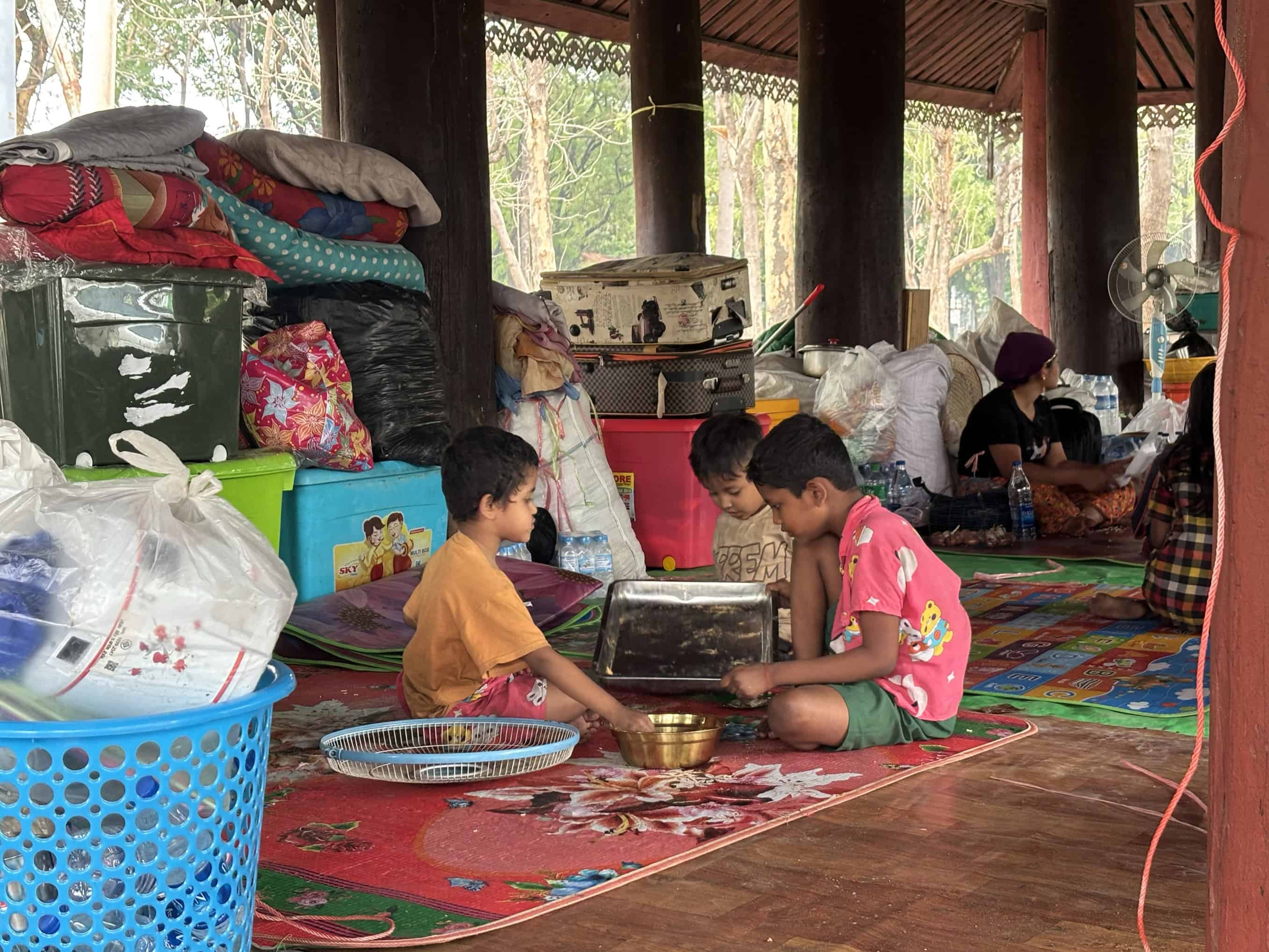
Children share a meal at a temporary shelter set up in a temple after the earthquake in Myanmar.
Children share a meal at a temporary shelter set up in a temple after the earthquake in Myanmar. About two weeks after the disaster, large parts of the country remain without essential services. | Ā© Plan International
  We are already seeing troubling signs on the ground. Displacement camps have limited access to clean water, electricity and basic health care. Girls face increased risks of violence and abuse, while the need for mental health support is growing, especially among young survivors traumatized by the disaster. With the breakdown of law and order in many areas, the risk of human trafficking has spiked alarmingly.Ā  Our teams are delivering critical support to survivors, with a strong focus on girls’ needs, including:Ā  Ā  Ā  Ā  Ā  — Child protection services to prevent violence, abuse and trafficking.Ā  Ā  Ā  Ā  Ā  — Psychological first aid and referrals for ongoing mental health care.Ā  Ā  Ā  Ā  Ā  — Safe spaces and education activities to help children return to learning.Ā  Ā  Ā  Ā  Ā  — Hygiene kits, menstrual health supplies and household items.Ā  Girls’ voices are not just being heard — they are shaping our response. Through our GirlEngageĀ  approach, we are committed to involving girls in decisions that affect their lives, even in emergencies. We are actively including girls in our rapid response analysis to ensure their needs, priorities and solutions are reflected from the very beginning. Their leadership, ideas and perspectives are essential to building a recovery that is not just about survival, but about resilience and equality.Ā 
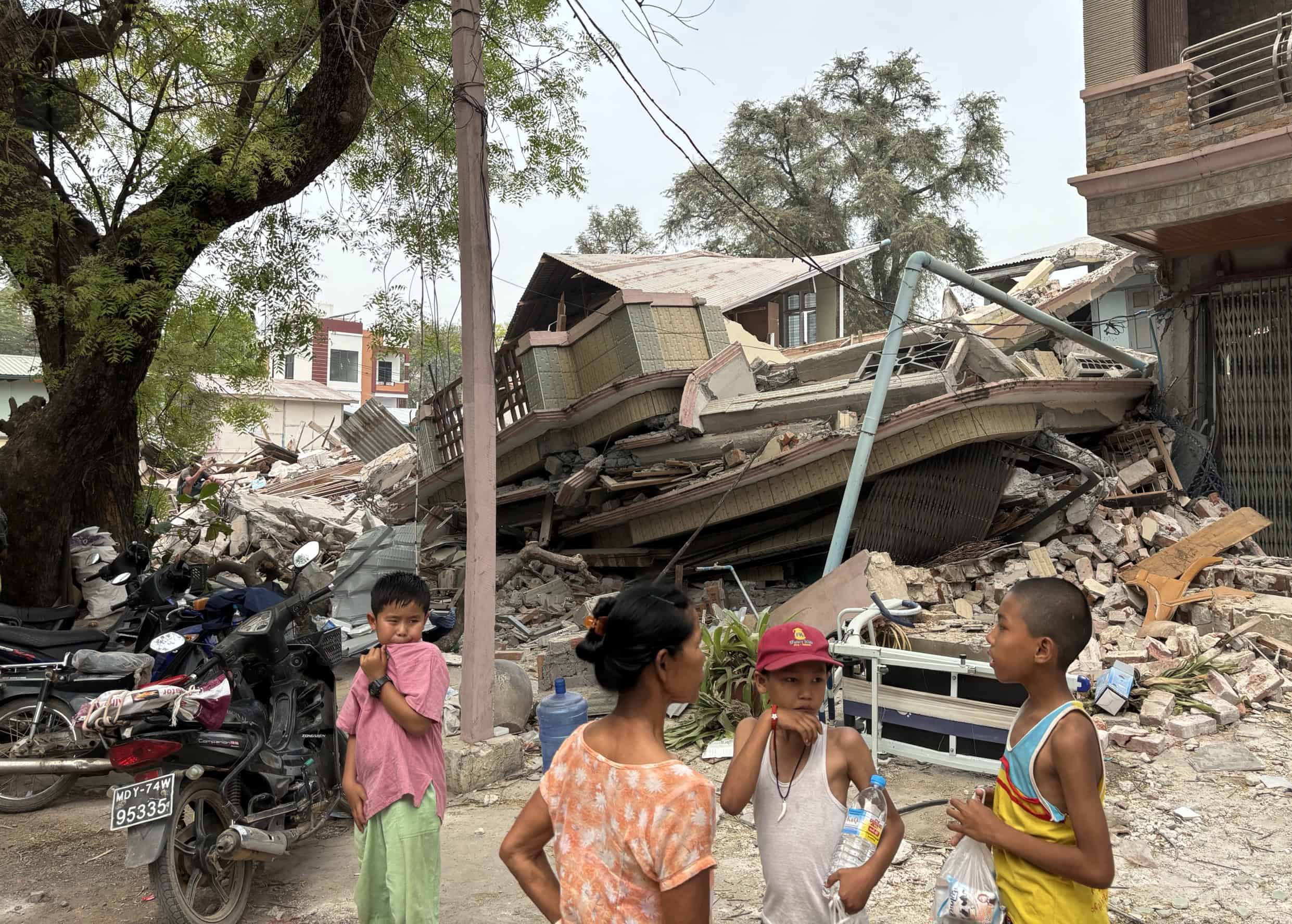
Children play next to a collapsed building in Mandalay after a devastating earthquake struck Myanmar.
Children play next to a collapsed building in Mandalay after a devastating earthquake struck Myanmar. Aid is slowly reaching affected communities, but widespread destruction and blocked roads continue to threaten recovery efforts. | Ā© Plan International
  Our experience responding to crises worldwide tells us that flexible funding is the most powerful tool we have right now. It allows us to adapt quickly as needs shift, purchase and distribute essential supplies and support recovery programs that keep girls safe and learning.Ā  This response is about more than immediate relief — it’s about the future. If we fail to protect girls now, the impacts will reverberate for years. Educating girls doesn’t just change individual lives; it transforms entire economies. Research shows that educating girls to the same level as boys could benefit low-income countries by at least $112 billion each year.Ā  In the chaos left by disaster, girls deserve more than survival. They deserve a future.Ā  You have the power to help girls reclaim their future.Ā  Your contribution today can deliver critical supplies, create safe spaces and keep girls learning — giving them the strength and support they need to rebuild their lives with dignity, hope and opportunity.Ā  Donate now to support girls Stay updated on Plan International’s technical work by signing up for ā€œFrom Plan to Action,ā€ our quarterly newsletter.  

In a recent CNN Newsroom segment with anchor Rosemary Church, Haider Yaqub, Plan International’s Country Director in Myanmar, shared firsthand insights from Mandalay following the devastating 7.7 magnitude earthquake. He described the widespread destruction and emphasized the ā€œvery badā€ conditions facing children and girls—many of whom are now living on the streets with no access to basic services. Yaqub urged the global community to act quickly, warning that without immediate support, more lives could be lost.

The Myanmar earthquake Plan International response is challenged by continued aftershocks, civil conflict and damaged infrastructure. Yaqub noted that while local support networks are helping transport the injured, aid delivery is extremely difficult in conflict-affected areas. He called on all players to work toward peace and recovery, and emphasized the urgent need for trauma care, clean water and protection for children.


Read the full transcript: CNN Newsroom – April 1, 2025, Segment 20

CNN Newsroom: Haider Yaqub on Plan’s earthquake response in Myanmar

The Myanmar earthquake Plan International response continues following the devastating 7.7 magnitude quake that struck Mandalay on March 28. The New York Times reports that dozens were killed and many more remain missing after buildings, including the Sky Villa Condo, collapsed. The destruction has left thousands in urgent need of humanitarian assistance.

Plan International has been active in Myanmar since 2008 and is now focused on providing emergency relief to affected children and families. The Myanmar earthquake Plan International response includes setting up safe spaces for children, delivering essential supplies and offering psychosocial support. Plan has also launched a dedicated Myanmar Earthquake Appeal to fund its response efforts.

Read more: The New York Times – Myanmar Earthquake Kills Dozens, Traps Residents in Condo Collapse


As U.S. foreign assistance shrinks, the development sector is left to ask: Who will step in to support girls now? In a guest piece for Inside Philanthropy, Shanna Marzilli, president and CEO of Plan International USA, explores the critical role philanthropy must play in defending the progress made for girls around the world.

Marzilli points to rising political pressure and shrinking public budgets as a defining moment for funders. She calls for boldness, commitment and sustained investment in girl-centered programming—reminding readers that the stakes are high. ā€œUntil we are all equalā€ isn’t just a tagline — it’s a promise. The question is whether philanthropy will continue to stand behind it.

Read the full article here: Will philanthropy stand strong for girls around the world?

In a recent Inside Philanthropy article titled ā€œIs It Time for Bill Gates to Get Angry?ā€, journalist Connie Matthiessen examines the fallout of sweeping USAID cuts, particularly on programs that support girls around the world. The piece explores the silence of major philanthropic actors and questions whether global leaders like Bill Gates should take a stronger stance.

Plan International USA’s President and CEO Shanna Marzilli is quoted in the article, noting that programs promoting girls’ education and protection have already been severely impacted. Her remarks reflect growing concern across the sector that hard-won progress for girls is being rolled back.

Read more:


Inside Philanthropy – Is It Time for Bill Gates to Get Angry?


Inside Philanthropy logo

In the wake of Myanmar’s 7.7 magnitude earthquake, 5 lessons in effective crisis response from Dr. Unni Krishnan, Plan International’s Global Humanitarian Director.

Flattened homes and scattered debris now stand where once there were thriving communities. Around them, frightened children huddle, wary of the next aftershock. The 7.7-magnitude earthquake struck Myanmar’s Mandalay region and early media reports say ā€œhundreds feared dead.ā€

Strong tremors were also felt in neighbouring Thailand. Myanmar and Thailand have declared national emergencies and Myanmar is appealing for international assistance. Reports paint a picture of overcrowded hospitals filled with survivors who have sustained head injuries and broken limbs. It may take days for the full extent of the devastation to emerge. Buildings in neighbouring Thailand have reportedly been damaged, adding to the destruction.

Having worked shoulder to shoulder with local volunteers and communities in earthquake zones across India, China, Iran, Japan, Afghanistan, Haiti, Turkey, and Indonesia, I have witnessed both the unique devastation of each quake and the universal human solidarity that follows. Powerful earthquakes reconfigure lives and landscapes—nothing is ever the same again.

Here, I share a few hard-learned lessons from the rubble.


People stand past the debris of a collapsed building in Mandalay

People stand past the debris of a collapsed building in Mandalay, Myanmar following the earthquake on March 28, 2025.| STR/AFP, Ā©ļøGetty Images

1. Preparedness and caution can save lives

ā€œAftershocks finished the task that the main earthquake started,ā€ a mother in Haiti told me in 2010. The 7.0 magnitude earthquake that struck the Caribbean nation was followed by over 50 aftershocks in just two weeks. These secondary aftershocks can turn already fragile and half damaged structures into death traps. Predictions about aftershocks are nearly impossible, but preparedness and caution can save lives.

2. Support, don’t replace, local responders

Local volunteers are always the first responders, sometimes the only responders for days. In the immediate aftermath, when every second counts, it is often these community heroes who pull survivors from debris with their bare hands. They are the backbone of relief efforts, real and often invisible heroes.

Aid from outside should complement, not compete with local efforts or replace local volunteers. In Nepal after the 2015 earthquake, my colleagues from Plan International reminded me that the mega earthquake was too vast for Nepal to handle alone. ā€œUniversal solidarity is key,ā€ they said. External aid must respect and strengthen local efforts, not overshadow them.

3. Life-saving aid is vital — but so are invisible needs

Food, water, and medical supplies can mean the difference between life and death. Cash assistance in a crisis is life saving as it provides dignity, flexibility and choice for affected people, especially women, to meet their basic needs. But all needs are not visible, such as the matters of the mind.

The mental toll of an earthquake is profound and long-lasting. In Iran (2003) and Japan (2024), I saw firsthand how aftershocks stretched people’s ability to cope. In India, following the Gujarat earthquake (2001), children told me they were too scared to sleep. Mothers later recounted how their children woke up screaming from nightmares. We must provide mental health support to children and families in the wake of emergencies.

4. Protect the most vulnerable: children first

Earthquakes impact everyone, but not equally. Children, the elderly, women, and people with disabilities face greater risks. Separated children are especially vulnerable. In some contexts, girls are at an even higher risk due to social and cultural vulnerabilities, which disasters amplify.

Imagine children cut off in remote villages, children orphaned by earthquakes lost or wandering amidst ruins, girls at risk of trafficking and abuse. Engaging young people and giving adolescent girls a voice in decision-making can transform relief efforts. Plan International prioritises all children, especially girls in disasters because emergencies amplify their pre-existing vulnerabilities, making them easy targets for exploitation.

Paola Belotti, my colleague, based on her expertise on child protection in humanitarian settings and direct experience in other earthquake settings says ā€œearthquakes expose children to immense risks—separation from family, homelessness, and vulnerability to violenceā€. She warns that if schools collapse, children lose more than education; they lose safety, routine, and hopeā€. ā€œOpening learning spaces and safe spaces is not just important; it’s urgentā€. These places provide protection, emotional support, and a sense of normalcy in a shattered world.

5. Decoding a myth about earthquakes — weak buildings kill

A common myth is that earthquakes kill people. In reality, poorly constructed buildings cause deaths. If you are in a country with strict building codes and resilient infrastructure, you have a far better chance of survival.

Take the 2014 San Francisco earthquake (6.1 magnitude): roads were damaged, people were injured, but there were no immediate deaths. Compare that to Haiti in 2010 (7.0 magnitude), where 220,000 people perished. Or Pakistan in 2005, where 16,000 children died when schools collapsed. The difference? Building standards. Safer structures mean fewer deaths, less suffering.

I still recall the wreckage in Nepal, the fear in children’s eyes, the centuries-old buildings reduced to dust. Yet, in places with strong buildings and disaster preparedness, life goes on. The difference is not in the magnitude of the quake but in the choices we make before the ground shakes.

Compassion and solidarity: the true measure of humanity

Humanitarian efforts must uphold the dignity of survivors and adhere to good and humane practices such as the Sphere humanitarian minimum standards. Protecting children, tackling gender-based violence, and ensuring the safety of adolescent girls are not optional—they are essential.

In my years of working in disaster zones, I have met some of the most resilient, selfless relief workers. They remind me that investing in communities before a disaster strengthens resilience and readiness. This is how we break the cycle of vulnerability and destruction.

Aid efforts should continue long after the news cameras leave. Humanitarian work is an act of compassion and solidarity. In a globalised world, everyone can make a difference—by sharing messages of support, donating, and advocating for children and girls in emergencies.

Monster earthquakes leave lasting scars on both landscapes and hearts. There are always thousands of urgent tasks. But if we must start somewhere, let it be with the children—they need us the most.

Every earthquake multiplies the suffering of the vulnerable. But if we act with compassion and foresight, we can ensure that fewer lives are lost the next time the earth trembles.

Plan International is responding to the earthquake in Myanmar. Your gift today will rush aid to families who need it in the aftermath of this and other emergencies. Please rush your most generous gift today.


People stand past the debris of a collapsed building in Mandalay