Clement has noticed an unsettling trend when he takes attendance at the primary school where he works in South Sudan.
“I’ve found some gaps,” he explains. “Girls especially are not turning up to school. I call their names out, asking ‘Where is this or that girl?’ But they’re not in the classroom.”
He visited one of his students’ homes to investigate — a girl who had stopped showing up entirely.
“When I arrived at their home, I found the girl alone,” he says. “Her parents were not there, and when I talked to her she said to me, ‘My parents told me to stay at home to look after the children, fetch water and to look for some food for the children while they are out looking for food.’”
It’s the result of an ongoing food security crisis in South Sudan, caused by a perfect storm of conflict, climate change and rising food prices due to the war in Ukraine.

Clement teaches science, math and English at a primary school in the Lakes State of South Sudan.
“Girls will be more at risk”
“Last year, people were in a community crisis,” Clement says. “There was a lot of fighting that prevented the people from farming. Then, the rain not coming this year was a big problem because we survive on rainfall. When there is rain, we plant our seeds.”
The complicated situation has a pretty simple outcome: People are starving.
“Although it is clear that both boys and girls are affected by this situation, girls will be more at risk,” Clement explains. “Our parents here think that it should be the girl who stays at home and takes care of the children for hours or even a few days. This is so that the mother can go far distances looking for food.”
Plan staff has seen this dynamic play out across a variety of different countries and cultures over more than 85 years in communities like Clement’s. In crises like this, girls end up bearing the brunt of the problem, because of cultural beliefs about who should do what. Many families often see the value in sending their boys to school, but prefer to keep girls at home to do housework or help to find food. Maybe it’s not their first choice, but desperate times force parents to make desperate decisions.

Clement challenges himself and his students to reach for the stars. “I always tell myself, ‘Clement, there is nothing you can’t do,’” he says. “That is what I teach to the children, although lately my aim is to keep the children in school during the food crisis.”
“Now, there is no lunch at home and no lunch at school”
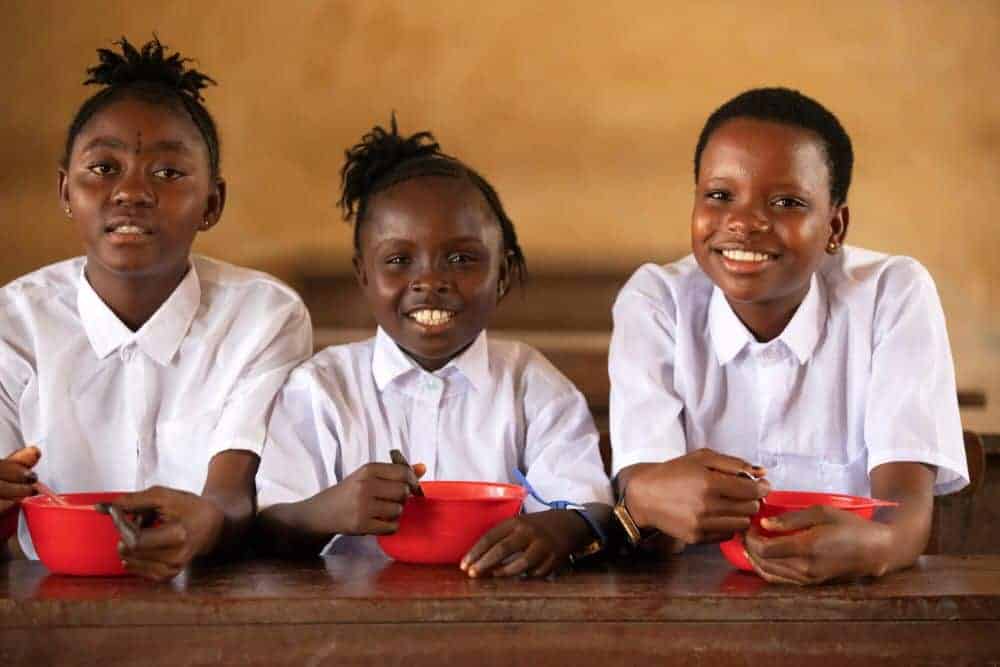
Clement and his students were protected from the hunger crisis at first, thanks to a program that provided school lunches to both students and staff. But as the crisis stretched on, funding for the program ran out.
“Girls being absent from school isn’t something that happens normally in our community,” he says. “It is only because this year there’s no food, no school feeding program, and less food distributions to the vulnerable community.”
Usually, students at Clement’s school stay until 3 p.m. But because of the lack of food, classes this term finished at 12 p.m. sharp so that the children could return home for lunch.
“In the mind of a child is that they know that they’ll be in school for a time and then they’ll have something to eat,” Clement says. “And, in the mind of the parents is that their children will have their lunch at school, so they get busy looking for what to eat in the evening. But this year, the afternoon lessons were not carried out because there were no school meals.”
Now, the school hasn’t provided lunch since April 2022.
“The thing that we most feared has happened,” Clement says. “Now there is no lunch at home and no lunch at school.”
Before, when Clement noticed one of his female students wasn’t coming to class, he would call the parents to school and tell them about the importance of girls’ education. Now, he’s turned his sights to getting the school lunch program back.
“That’s why I call myself an education activist and why I think that school lunch is important,” he says. “It contributed to maintaining the school enrollment, it controlled the drop-out rate of children, lessons could be taught according to the timetable, and girls in our community were able to attend school.”