WASHINGTON — What do young people in the United States think about gender equality in 2026? Overwhelmingly, they support it. But most believe full equality has yet to be achieved, and many are navigating social pressures, online harassment and gendered expectations that limit their freedom to be themselves
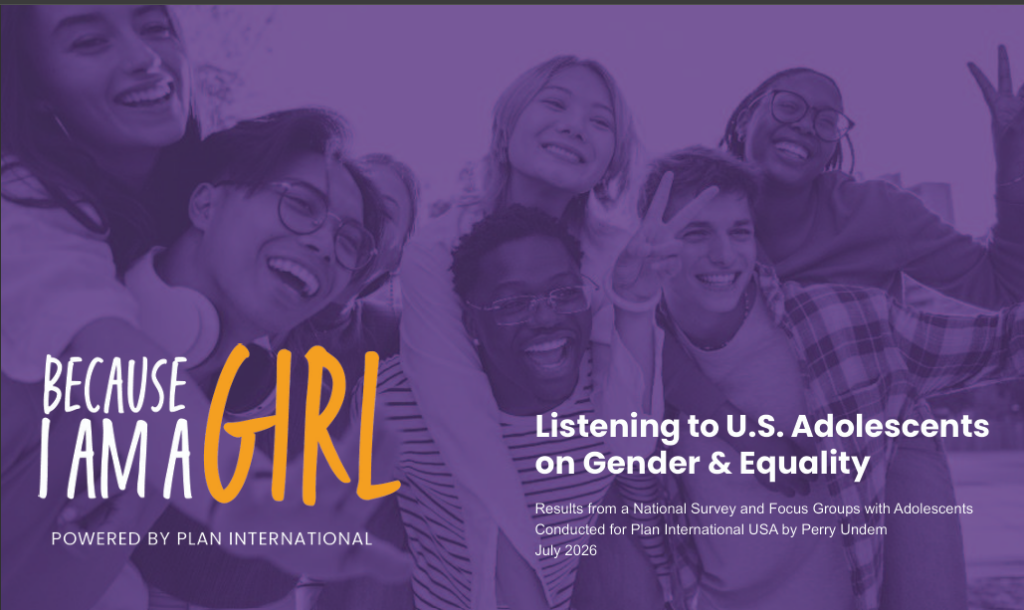
Plan Internati.onal’s new study, “Listening to U.S. Adolescents on Gender & Equality,” surveyed 1,037 young people aged 10 to 19 across the United States. Conducted by the nonpartisan research firm PerryUndem, it examines adolescents’ experiences with gender equality, social media, mental health and leadership. The study builds on our 2018 research, offering a new perspective after eight years of seismic social, technological and economic change.
Key findings from the 2026 survey:
- 94% of adolescents agree women and men should be treated equally, but 64% say full equality has not been achieved.
- 42% of girls aged 14 to 19 rate their mental health at 6 or below on a 0-to-10 scale, compared with 25% of boys their age.
- 36% of girls aged 14 to 19 who use social media report experiencing at least one form of online sexual harassment included in the survey.
- Just 21% of adolescents have considered becoming a politician or running for office, down from 33% in 2018.
Behind these numbers are young people who want to feel safe, seen and heard, express themselves without fear and have a meaningful say in decisions affecting their lives.
Do U.S. adolescents believe gender equality has been achieved?
The gap between belief and experience is striking. While 94% of adolescents support equal treatment for women and men, 64% say women still lack full equality in work, politics and life. And 84% want equal numbers of women and men in leadership positions.
Everyday experiences help explain that disconnect. Seventy-nine percent of girls report hearing boys make sexualized or demeaning comments at least monthly, and 54% hear them weekly or more often. Many girls are growing up with a troubling contradiction between the equality they believe in and the discrimination or harassment they encounter.
How do social media and gender expectations affect young people’s mental health?
Online spaces can help adolescents connect, express ideas and pursue interests. But harassment, unrealistic expectations and fear of criticism can also limit their freedom to participate.
Among girls aged 14 to 19 who use social media, half say they have withheld an opinion for fear of mean comments. Girls in that age group also report feeling pressure to look pretty (60%) and be perfect (51%).
Just 14% of adolescents trust social media companies to take sexual harassment and assault seriously. As one teenage girl told researchers about reporting sexual harassment or assault, “A lot of times, girls just feel like no one’s going to do anything, and no one is listening.”
The pressures extend beyond social media. Forty-two percent of girls aged 14 to 19 rate their mental health at 6 or below on a 0-to-10 scale, compared with 25% of boys their age. The research identifies associations between poorer mental health and experiences including online harassment, comparisons with others and pressure to hide emotions.
Many young people are already taking steps to protect themselves. Among girls who use social media, 53% have blocked someone because they felt unsafe, and 60% have changed their privacy settings. But responsibility for online safety shouldn’t fall primarily on children and adolescents.
What do girls and boys say about gender expectations?
Despite the challenges, young people’s priorities offer reasons for optimism. Being their true selves ranks among adolescents’ highest priorities: 79% say it’s very important, while 72% say the same about feeling at peace. These aspirations outrank traditional milestones such as marriage and parenthood.
Yet gender expectations can make achieving those goals difficult.
Girls describe pressure to be attractive, confident and agreeable. Boys face different pressures, including expectations around physical strength, fitting in and controlling their emotions. Notably, among boys who feel pressure to hide their feelings, 43% rate their mental health at 6 or below on a 0-to-10 scale, compared with 16% of boys who don’t report feeling that pressure.
These findings underscore why listening to both girls and boys matters. Every young person deserves the freedom to express emotions, challenge stereotypes and develop a sense of belonging.
Fewer young people consider elected office
The survey also reveals a striking shift in young people’s political ambitions. In 2018, 33% of adolescents said they had considered becoming a politician or running for office. By 2026, that figure had fallen to 21%.
But that doesn’t mean young people have rejected leadership. Many still see themselves as leaders, even if fewer imagine a future in elected office.
Team sports linked to better mental health, leadership
The research also identifies promising connections between participation in team sports, mental health and leadership. Among girls aged 14 to 19, those who play team sports report better mental health and are more likely to see themselves as leaders than those who don’t participate.
These are associations, not proof that sports alone produce those outcomes. But they do highlight the value of supportive environments in which girls can build confidence, collaborate and lead.
How can we support young people and advance gender equality?
The pivotal starting point is simple: Listen to young people, involve them in decisions that affect them and invest in finding, creating and sustaining opportunities where they can flourish.
Parents and educators can help adolescents recognize harassment and understand how to report it. Technology companies and policymakers can make young people’s safety a top priority. Coaches, mentors and community organizations can nurture leadership and create environments where adolescents feel safe, valued and heard.
At Plan International, young people aren’t just beneficiaries of our work. They help shape it.
Our Youth Advisory Board provides input on campaigns and youth engagement, while our Youth Leadership Academy equips young people to design and lead advocacy projects in their own communities. These programs reflect a central principle of our approach: Young people should be partners in creating solutions to the challenges they face.
The findings also reinforce the importance of Because I Am a Girl, the renewed global movement powered by Plan International to advance girls’ safety, education and freedom to shape their own futures.
The challenges girls face are interconnected, and so are the solutions: Their safety, education and capacity to decide their own futures depend on having safe environments, supportive communities and opportunities to make their views known and their voices heard.
Young people have told us what matters. Now it’s our turn to listen and act.
Explore the research, join the movement or support Plan International’s work to help girls learn, lead, decide and thrive.
About the research: PerryUndem surveyed 1,037 U.S. adolescents aged 10 to 19 from April 28 to May 5, 2026, using Ipsos Knowledge Panel. The nationally representative sample has an overall margin of sampling error of plus or minus 3.5 percentage points. Researchers also conducted two focus groups in July. Comparisons with 2018 involve separate samples rather than the same adolescents surveyed over time.